
Updated Feb. 4, 2026, 11:41 a.m. ET
Legendary Detroit Tigers pitcher Mickey Lolich, whose three complete game victories in the 1968 World Series delivered a championship and earned him the series MVP, has died at age 85.
As one of the anchors of the Tigers’ pitching staff in the 1960s and ’70s, the portly southpaw, who once called himself “a beer drinker’s idol,” developed into one of the game’s most durable and best left-handed starting pitchers ever.
Fifth on the career strikeouts list for left-handers (2,832, behind only Randy Johnson, Steve Carlton, CC Sabathia and Clayton Kershaw), Lolich struck out more batters than Hall of Famers Bob Feller, Warren Spahn, Don Drysdale, Christy Mathewson, Cy Young and his childhood idol, Whitey Ford.
Over his 16-year major league career, Lolich won 15 or more games eight times, threw 195 complete games and struck out 200 or more batters in seven seasons while missing just one start due to injury. He remains the Tigers’ all-time leader in strikeouts (2,679), starts (459) and shutouts (39).
A World Series for the ages

Entering the 1968 World Series, the spotlight was on the pitching matchup between St. Louis Cardinals ace Bob Gibson and 31-game winner Denny McLain, the MVP and Cy Young Award winners for their respective leagues.
Although Gibson set a World Series record with his 17 strikeouts in Game 1, it was Lolich who stole the show with three complete-game victories against a powerful lineup that included Lou Brock, Curt Flood and Orlando Cepeda.
In Game 2, Lolich pitched a six-hit, complete-game victory to tie the series at a game apiece. He helped his own cause by hitting the only home run of his career in the 8-1 win.
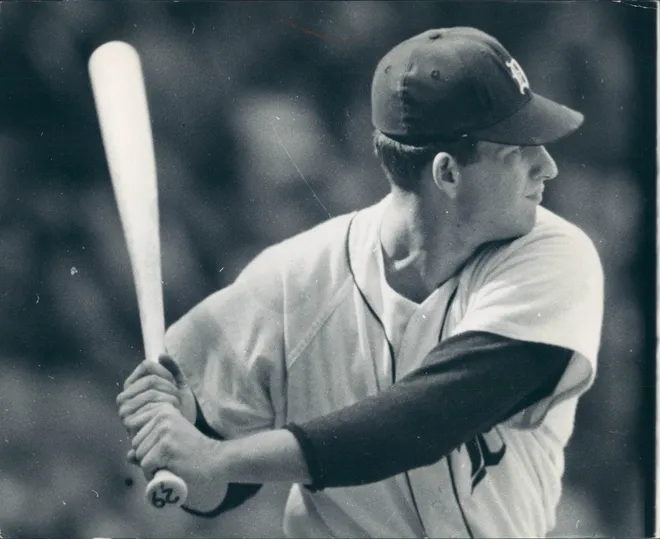
Down three games to one in the Series, Lolich pitched another complete game, helping the Tigers in a come-from-behind 5-3 win at Tiger Stadium.
During Game 6, when the Tigers pulled away for a 13-1 victory, manager Mayo Smith had begun to seriously think about who was to pitch the deciding seventh game.
“I was at the far end of the bench when Mayo came up to me and asked if I could pitch the next day,” Lolich said. “I knew it was (loser of Game 3) Earl Wilson’s turn to start and I told him that if he needed me for a couple of innings out of the bullpen, I could do that. He said, ‘No, I want you to start, can you give me five?’ I did the math and knew I averaged about 15 pitches an inning and realized I could probably give him that.”
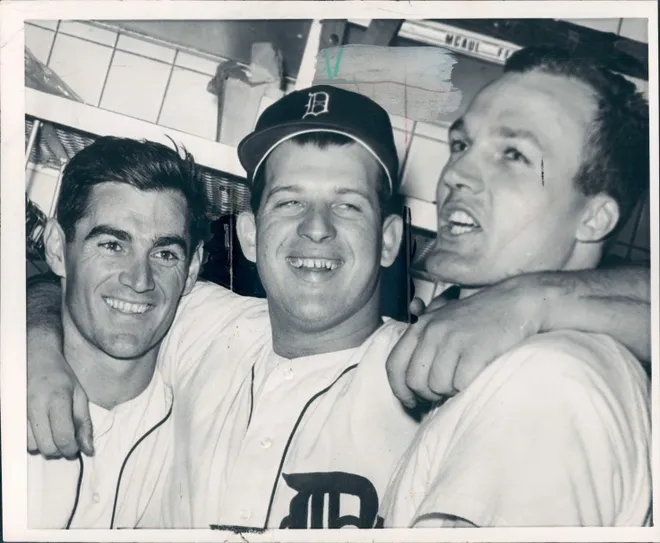
Smith then ordered Lolich to go back to the hotel to rest and avoid reporters.
When Lolich entered the dugout after setting down the side in the bottom of the fifth inning of a scoreless tie in Game 7 on just two days’ rest, he assumed his day was done, but Smith asked him if he could give him one more inning. The man with the rubber arm agreed.
In the bottom of the sixth, Lolich’s heroics continued when he ended a potential Cardinals rally by deftly pulling off the improbable − picking off speedsters Brock and Flood at first base.
After the Tigers took a 3-0 lead in the top of the seventh, highlighted by Jim Northrup’s two-run triple over Flood’s head, Lolich delivered a message to Smith.
“I tapped him on the shoulder and said, ‘Now I’ll finish it for you.’ Mayo said, ‘That’s exactly what I wanted to hear.’ ”
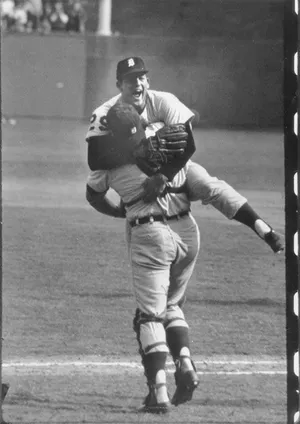
Relying largely on his sinking fastball as he had done all day, Lolich completed his trifecta when Tim McCarver popped out to Bill Freehan, who immediately lifted his battery mate off the ground in a celebratory embrace that was captured in what became one of the most famous images in Tigers history.
In his 27 innings pitched in that series, the Cardinals scored just five runs.
“The first couple of years I played with him I didn’t have that much confidence in him,” teammate Mickey Stanley said in 2026. “The way he pitched in the seventh game of the World Series, on two days’ rest, was unbelievable. He became a real pitcher in that Series and from then on, it was like night and day. It was great to play behind him because he threw strikes and was a great competitor.”
Lolich is the only left-handed pitcher in American League history to win three complete games in a World Series and just the third of either hand, for either league, since the start of the 1921 season. (The other two: Lew Burdette for the Milwaukee Braves in 1957 and Gibson for the Cardinals in 1967.) Given the modern approach to pitcher usage, Lolich will likely be the last.
[ Mickey Lolich’s epic World Series wins still turn heads, 50-plus years later ]
A teen star in Oregon
While riding a tricycle as a toddler in his Portland, Oregon, neighborhood, Michael Steven Lolich knocked over a parked motorcycle that fell and broke his left arm.
Naturally right-handed, his parents’ form of physical therapy included tying his right hand behind his back − forcing him to depend on his left arm. From then on, Lolich threw left-handed.
“I was an only child and there were no other kids on my block, so I used to entertain myself by throwing figs at city buses 150 feet from the top of my grandparents’ garage,” he said in 2015.
Lolich’s entry into baseball did not come until his teens, according to his 2018 autobiography “Mickey Lolich: Joy in Tigertown” (penned with Tom Gage). The nascent lefty was introduced to baseball at age 11, when he happened upon a game at the city park maintained by his father. A local team of 14- and 15-year-olds were short one player and asked Lolich if he would play. Having never played before, he borrowed a glove from an opposing player and was relegated to right field.
“We were getting beat pretty bad and I thought, ‘I can throw as good as those guys,’ so I volunteered to pitch,” Lolich said. “To the surprise of everyone, I blew all the batters away because they couldn’t hit my fast ‘fig.’ ”
By age 14, Lolich was a star in the local Babe Ruth League and a batboy for the Pacific Coast League’s Portland Beavers; for two consecutive seasons (1955-56), he took his hometown team to the Babe Ruth World Series while winning MVP awards each year.
After signing with the Tigers in 1958, he struggled with his control in four minor-league seasons and briefly quit in 1962 after refusing an assignment to Knoxville. But on loan that year to the hometown Beavers, he found his groove, thanks to pitching coach Gerry Staley.
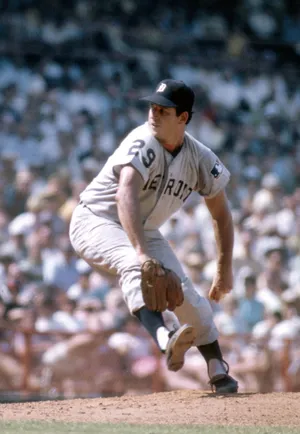
Lolich returned to the Tigers for spring training 1963; a month into the season, he was called up to make his major league debut. On May 12, he came out of the bullpen against Cleveland and struck out the first two batters he faced, Max Alvis and Sam McDowell. Two weeks later, he earned his first victory while scattering eight hits and going the distance against the Angels in Los Angeles.
By 1967, Lolich and Denny McLain had established themselves as one of the top starting duos in the AL while the Tigers battled in one of the most exciting pennant races ever, losing out on the AL crown on the last day of the season.
Serving his country in 1967
Earlier that year, Lolich found himself wearing a different uniform once civil unrest broke out in Detroit that summer.
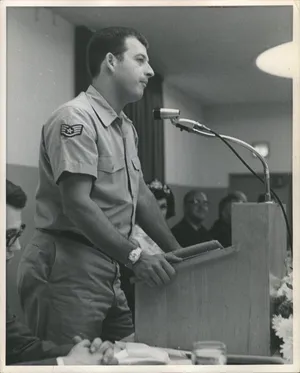
He took the loss in the first game of a doubleheader against the Yankees at Tiger Stadium on July 23, the first day the disturbance spilled onto the streets of Detroit. The following morning, he was activated by the Air National Guard. Lolich, who since 1963 had missed two weeks in the middle of every season for mandatory summer camp, was a sergeant in charge of 11 men and served 10 days in downtown Detroit during the disturbance.
[ Detroit ’67: As violence unfolded, Tigers played two at home vs. Yankees ]
On active duty for 12 days, Lolich was one of three Detroit athletes activated: receiver John Henderson and quarterback Tom Myers of the Lions, both summoned from the Cranbrook training camp.
The next summer, while McLain became the talk of baseball on his way to winning 31 games, Lolich had struggled a bit. To his surprise, manager Mayo Smith assigned him to the bullpen in August 1968.
“I was mad and told him, ‘I’ll tell you one thing, before this year is over, you’re going to need me,’ and Mayo said, ‘We’ll see,’” said Lolich, who after several successful relief appearances returned to the starting rotation for the final month of the regular season.
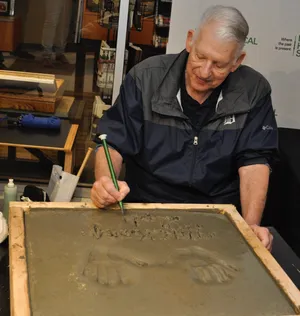
After McLain was traded in 1970, Lolich became the Tigers’ ace and established himself as a workhorse. From 1971-74, he pitched at least 300 innings each season.
“As good as he was, though, I always thought Mickey didn’t realize himself how good he really was,” 1968 teammate Jon Warden said in 2026. “[Catcher] Bill Freehan told me ‘I could catch McLain with my bare hand but Lolich killed me. I had to wear a rubber glove and a wrap around my hand because it was swollen after every time I caught him.’”
After perfecting a cut fastball in 1971’s spring training, the three-time All-Star had his greatest season, leading the league in wins (25), strikeouts (308), complete games (29) and innings pitched (376). That year he also earned the save in the 1971 All-Star Game at Tiger Stadium. Lolich was edged out of the Cy Young Award by American League MVP Vida Blue.
Reggie Jackson, who called Lolich’s 1971 season “one of the greatest of all time,” has always praised the man who gave him fits at the plate.
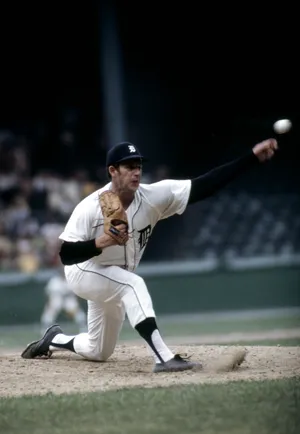
“Lolich was a gallon of ice cream when you only wanted a cone, simply a great pitcher, and for seven or eight years the toughest lefty in the league,” Jackson said in 2015. “When he stepped on the mound at 1 p.m., you knew he would be there until the end and he never missed a start. Today they talk about 200 innings being special. Hell, Mickey had 200 innings by Aug. 1. I just wish he had gone into the donut business 10 years earlier.”
In 1972, Lolich helped lead the Tigers to the AL East title with 22 victories.
“He was an outstanding starter who could pitch down and away all day long, get a thousand ground balls or with a two-strike count come up and in and blow you out of there,” said former slugger Frank Howard, a teammate with the ’72 Tigers, in 2015.
By 1975, the Tigers were bereft of talent and even though Lolich was frustrated with the lack of run support and a poor defense, he was still disappointed when the Tiges traded him to the New York Mets for Rusty Staub.
“I had always wanted to finish my career with the Tigers and I almost didn’t agree to the trade, but looking back now I wish I hadn’t,” he said in 2015.
After signing a two-year contract with the Mets, Lolich pitched in 1976 but then retired and sat out the 1977 season before signing as a free agent with San Diego; the woeful Padres coaxed him out of retirement with a two-year deal worth more than he had ever been paid.
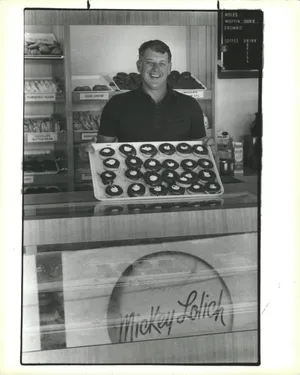
Following the 1979 season, Lolich retired and later owned and operated his own donut shop outside of Detroit for several years.
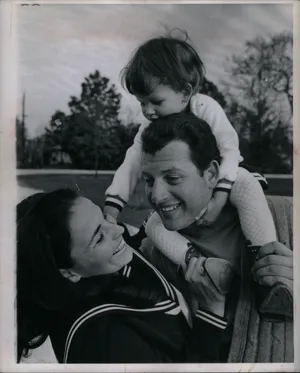
Lolich is survived by Joyce, his wife of 61 years; daughters Kimberly, Stacy, and Jody; and three grandsons.
Want more Tigers news? Download our free app for the latest news, alerts, eNewspaper and more.