
A final vote approving President Donald Trump’s proposed triumphal arch passed late Thursday after a marathon public hearing of citizens voicing fierce opposition to the president’s pet project. The approval clears the way for construction to begin and will likely trigger a fresh round of legal wrangling from opponents trying to stop the project.
The National Capital Planning Commission, one of two federal agencies that oversees architectural and design changes in Washington, gave the final greenlight to build the 250-foot monument at its virtual meeting on Thursday after more than 120 citizens, many of them veterans, lined up to plead with the panel to block the project.
After more than eight hours of public testimony, the commission approved the arch by a vote of 8-4 around 10:29 p.m.
The Trump administration has said it might begin construction immediately after the final vote.
Opponents denounced the structure as a vanity project for Trump and objected to its planning, which was not approved by Congress.
Approval from the commission, which is stacked with Trump-appointed supporters, marks the closing step in jamming through one of the central projects in the president’s quest to reshape Washington’s landscape to his own liking. The White House is eager to move forward before a new Democrat-controlled Congress takes power in January.
Trump has said the goal would be to complete the arch before he leaves office in two years.
The aggressive timeline is likely to be complicated by legal challenges, including a high-profile lawsuit brought by veterans and preservationists. The opponents say its scale and location would disrupt the sightline of the row of national landmarks that includes the Lincoln Memorial, Arlington House and the Robert E. Lee Memorial, and that the towering monument will break the solemnity of funerals of Arlington National Cemetery.
They argue that the project is illegal because it does not have approval from Congress, pointing to the Commemorative Works Act which requires congressional authorization for new monuments in Washington.
CNN
” data-fave-thumbnails=”{“big”: { “uri”: ” }, “small”: { “uri”: ” } }” data-vr-video=”false” data-show-html=”” data-byline-html=”
” data-timestamp-html=”
” data-check-event-based-preview=”” data-is-vertical-video-embed=”false” data-network-id=”” data-publish-date=”2026-11-05T19:21:56.433Z” data-video-section=”politics” data-canonical-url=”” data-branding-key=”” data-video-slug=”veteran-objects-to-trump-plan-to-build-arch” data-first-publish-slug=”veteran-objects-to-trump-plan-to-build-arch” data-video-tags=”” data-breakpoints=”{” video-resource–media-extra-large=”” data-display-video-cover=”true” data-details=””>
” class=”image__dam-img image__dam-img–loading” onload=”this.classList.remove(‘image__dam-img–loading’)” onerror=”imageLoadError(this)” height=”1080″ width=”1920″/>
Michael Lemmon, the main plaintiff in a lawsuit to stop the arch, speaks in opposition to the project at a protest.
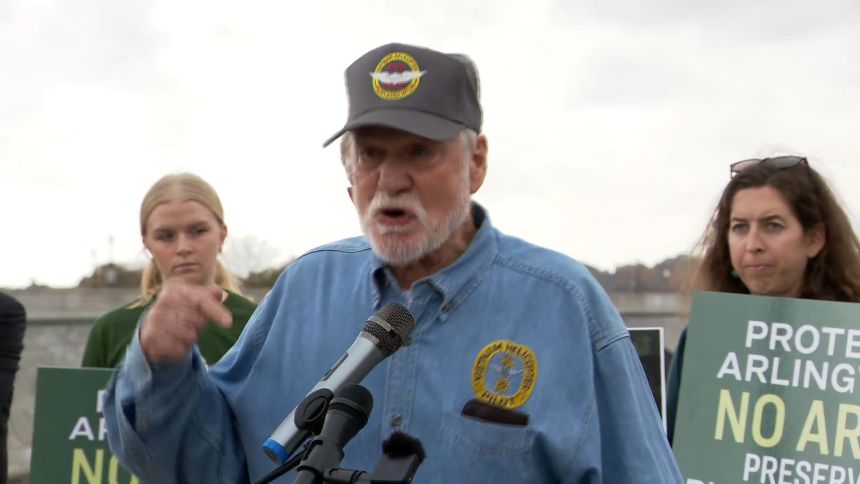
Michael Lemmon, the main plaintiff in a lawsuit to stop the arch, speaks in opposition to the project at a protest.
0:47
On Wednesday, US District Judge Tanya Chutkan, an Obama appointee who is overseeing the case, has said she must be told of any decision by the planning commission within an hour. The administration must also give 30 minutes notice before any action on construction.
However, the order would not, on its face, stop groundbreaking, and the Trump administration has gotten around court-ordered limits to act before.
Protests near the site took place throughout the day. “This monumental abomination of one man’s ego disrespects every service member who’s buried there,” Democratic Rep. Don Beyer, whose district encompasses Arlington National Cemetery, said at a protest that included veterans and other arch opponents Thursday morning.
But ahead of the meeting, the commission’s chair said he would vote to approve the project, calling it an “historic effort” by Trump.
The arch is just one example of the president’s efforts to leave a legacy in DC. Construction and renovation projects around Washington, from the Lincoln Memorial Reflecting Pool to the Kennedy Center, have figured heavily in his second term — something his critics have labeled “vanity projects.”
Yet the president began his first public appearance on Wednesday following an electoral rout for his party in the midterms celebrating progress on the construction another high-profile endeavor, the White House ballroom.
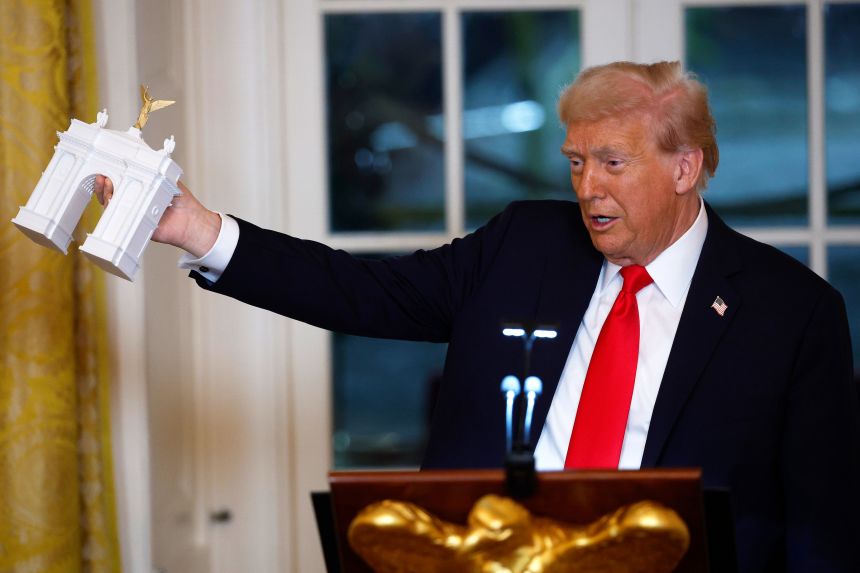
Sitting in the Oval Office in October as his triumphal arch was first being proposed last year, Trump presented different scaled models of the structure — envisioned to be the largest arch in the world.
Asked by a reporter who the arch was for, Trump pointed to himself and said: “Me.”
The president later has said the arch will commemorate the nation’s 250 anniversary, the American spirit, the American military and American “competence.”
More recently, he has argued that the arch, located in a busy traffic circle near the Potomac River, would serve both as a tourist attraction and a military complex to store drones and ammunition.
While the final plans submitted for the planning commission to approve Thursday did not include the military components Trump described, administration officials have said they would not require any structural modifications and could be fully integrated into the existing design.
The administration has already laid out an aggressive plan for construction that would include two 10-hour shifts daily for work to happen nearly around the clock. On Thursday, the National Park Service, which oversees the project for the administration, admitted to the court that the construction company it used had drawn markings around the site without permission, and said that it would cease preparatory work without giving notice.
Giving testimony in opposition to the arch at the commission meeting Thursday, Michael Lemmon, the main plaintiff in the lawsuit against the construction questioned the fidelity of the review process, which he said was “rushed” with a “predetermined outcome.”
“We have witnessed the deliberate exclusion of Congress a repeated bending of the rules and ignoring of professional evaluations including by NPS of the negative impact on Arlington.”
Democratic Rep. Jared Huffman, who is poised to become chairman of the House Natural Resources Committee that will have oversight over NPS issues said, “This arch would dishonor America our ideals and our laws. We should honor the 250th anniversary of the Declaration of Independence by upholding the rights of the American people and their votes on Tuesday night, rather than indulging a president who thinks he is a king.”
In a review released by the National Park Service in August, the administration has acknowledged that the arch would have “adverse” effects on as many as 42 historic sites, with the most serious concentrated on six near the structure. These include Arlington National Cemetery, the Lincoln Memorial corridor and Arlington House, a memorial to Robert E. Lee featuring the home where he lived before leading the Confederate army.
Among the adverse effects to surrounding landmarks, the report found that the arch would alter the “design continuity” of iconic Washington settings and would alter views of surrounding monuments. When completed, the arch will be seen all the way to the US Capitol, the Georgetown waterfront and the Pentagon, among other viewpoints.
NPS said it considered alternatives but ultimately concluded that the arch must stay at the proposed site on the banks of the Potomac River as the project is “inherently location dependent” and “not interchangeable” with any other placement.
That assessment, known as a Section 106 review, is mandated under the National Historic Preservation Act and requires independent groups that have an interest or expertise in historical preservation matters related to a project to sign off.
Last month, the administration said it will end the Section 106 review, terminating the consulting process, essentially giving up on reaching an agreement, and allowing Trump to bypass a significant hurdle in the approval process for getting built. Within half an hour of approval from the NCPC, the Department of Interior, which oversees the NPS, said it would move forward.
CNN’s Dugald McConnell contributed to this report.
This story has been updated with additional developments.