
Ten years ago this month, Kosovo were not recognised by football.
On Tuesday, the Balkan nation with just 1.6million inhabitants will qualify for the men’s World Cup if they defeat Turkey in the play-off final.
Kosovo were only granted membership status by FIFA, global football’s governing body, and its European equivalent UEFA in May 2016. The decade since has had challenges, setbacks and resistance, but it may yet have a fairytale ending.
Football’s youngest nation may find themselves on sport’s biggest stage and the symbolism goes far beyond the pitch.
Is Kosovo’s independence recognised?
Kosovo’s history is too long, complex and nuanced to fully explain here.
Kosovo was, alongside the northern Serbian province of Vojvodina, one of two autonomous provinces in the Serbian republic of the former Yugoslavia.
Kosovo was not one of the Yugoslav federation’s six republics — Serbia, Croatia, Bosnia-Herzegovina, Slovenia, North Macedonia, Montenegro — which, following the state’s break-up after a series of wars throughout the 1990s, declared independence.
The issue of Kosovo’s independence from Serbia sparked a 1998-99 war in which at least 13,000 people died. Serbia launched a crackdown on a separatist rebellion by the area’s ethnic Albanian population, which led to NATO bombing Serbia in 1999 to bring a conclusion to the war.
In 2008, Kosovo declared independence from Serbia. It has not yet been integrated into the United Nations (UN), despite more than 100 UN members recognising its independence, with veto-holding states including China and Russia opposed to its recognition.
Kosovo played their second unofficial friendly, against Turkey, in 2014 (NurPhoto/Corbis via Getty Images)
In football, Kosovo were only permitted to play unofficial friendly matches in 2014. In May 2016, they were admitted into UEFA following a narrow vote at its general congress.
Of the 54 member nations, 28 voted in their favour, 24 against and two votes were considered invalid. Serbia led the opposition, and pledged to have the decision reversed, but to date they have not succeeded. Kosovo were admitted to FIFA 10 days later.
‘Football helps UN membership’
Within Kosovo, there is a belief that a World Cup appearance could help boost the state’s international recognition. “Football is an important and effective platform for Kosovo to strengthen its state identity internationally,” Leart Svecla, a football reporter for DigitAlb, tells The Athletic.
Arben Berisha, a commentator for Radio Television of Kosovo, goes further: “Football could absolutely help UN membership status. World Cup qualification would be the most important day since Kosovo’s Declaration of Independence in 2008.”
Xhemajl Rexha, chairperson for the Association of Journalists of Kosovo (AGK), highlights how Kosovo’s participation in international football has helped Kosovo’s ambitions for recognised statehood.
For political reasons, Kosovo cannot be paired with Bosnia-Herzegovina or Serbia in tournament draws, but the team have still played nations who, at government level, do not recognise their independence.
In November 2024, Kosovo players refused to complete a Nations League fixture away to Romania following chants from the home fans. Audible chants of “Serbia, Serbia, Serbia” could be heard from video footage posted on social media, prompting Kosovo’s players to walk off. Romania were subsequently ordered by UEFA to play their next home match behind closed doors due to the “racist and/or discriminatory behaviour of its supporters” during the match.
When Spain played Kosovo in 2021, the Spanish TV broadcast referred to their opponents as the ‘team of the Kosovo FA’ and their opponents as coming from ‘the territory of Kosovo’, with ‘kos’ decapitalised on the broadcast scoreboard. Spain, like Romania, does not recognise Kosovan independence.
Slovakia, who Kosovo defeated in the World Cup play-off semi-final on Thursday, also does not recognise Kosovo. “The media headlines in Kosovo after the match showed the power of football,” AGK chairperson Rexha explains. “It read how Slovakia ‘recognises’ Kosovo, because of the result.”
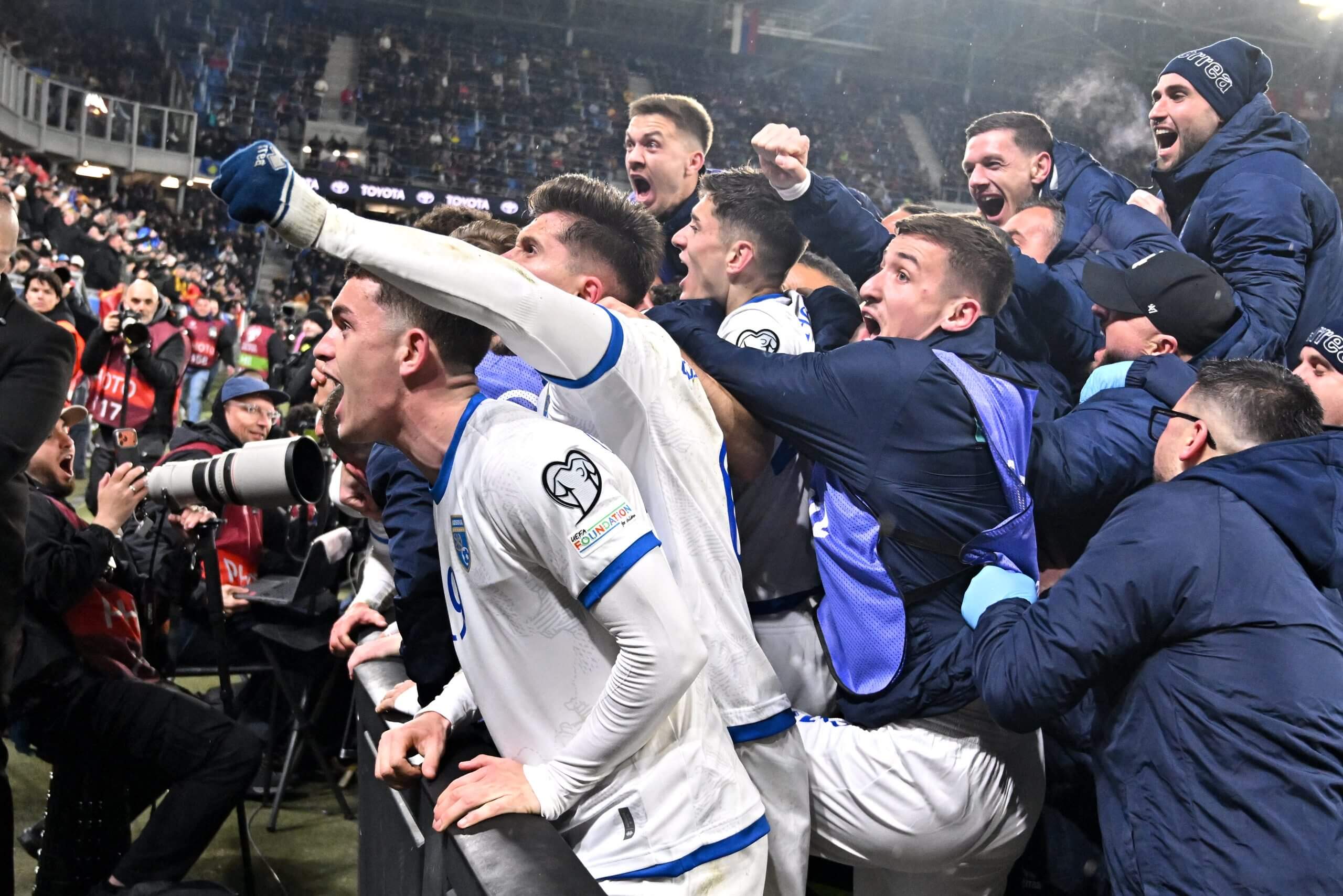
Kosovo celebrated their World Cup playoff semi-final win over Slovakia on Thursday (Joe Klamar/AFP via Getty Images)
Rexha adds, when asked on the possible significance of World Cup qualification: “Maybe people will Google Kosovo and learn about a country ravaged by war 25 years ago.”
Kosovan sports reporter Svecla agreed on the national team’s symbolism: “Football could have more impact than years of political efforts to promote the country through conferences or diplomatic channels.”
‘Kosovans will always support Albania’
“During the play-off semi-finals, most Kosovans watched two TV channels: the games of Kosovo and Albania,” explains Berisha. Albania — who qualified for the European Championship in 2016 and 2024 — were defeated 2-1 by Poland in their play-off semi-final.
A significant majority, around 93 per cent, of Kosovans are ethnically Albanian — a Balkan-based group which shares Albanian ancestry, language, culture and religion: a mix of secular Islam, Agnosticism and Christianity.
Kosovo only declared independence 18 years ago, and it took a further eight years for football’s governing bodies to recognise this act. Kosovans traditionally identified with Albania and independence did not stop their support for its national team. “Kosovans have always supported Albania and always will,” says Svecla.
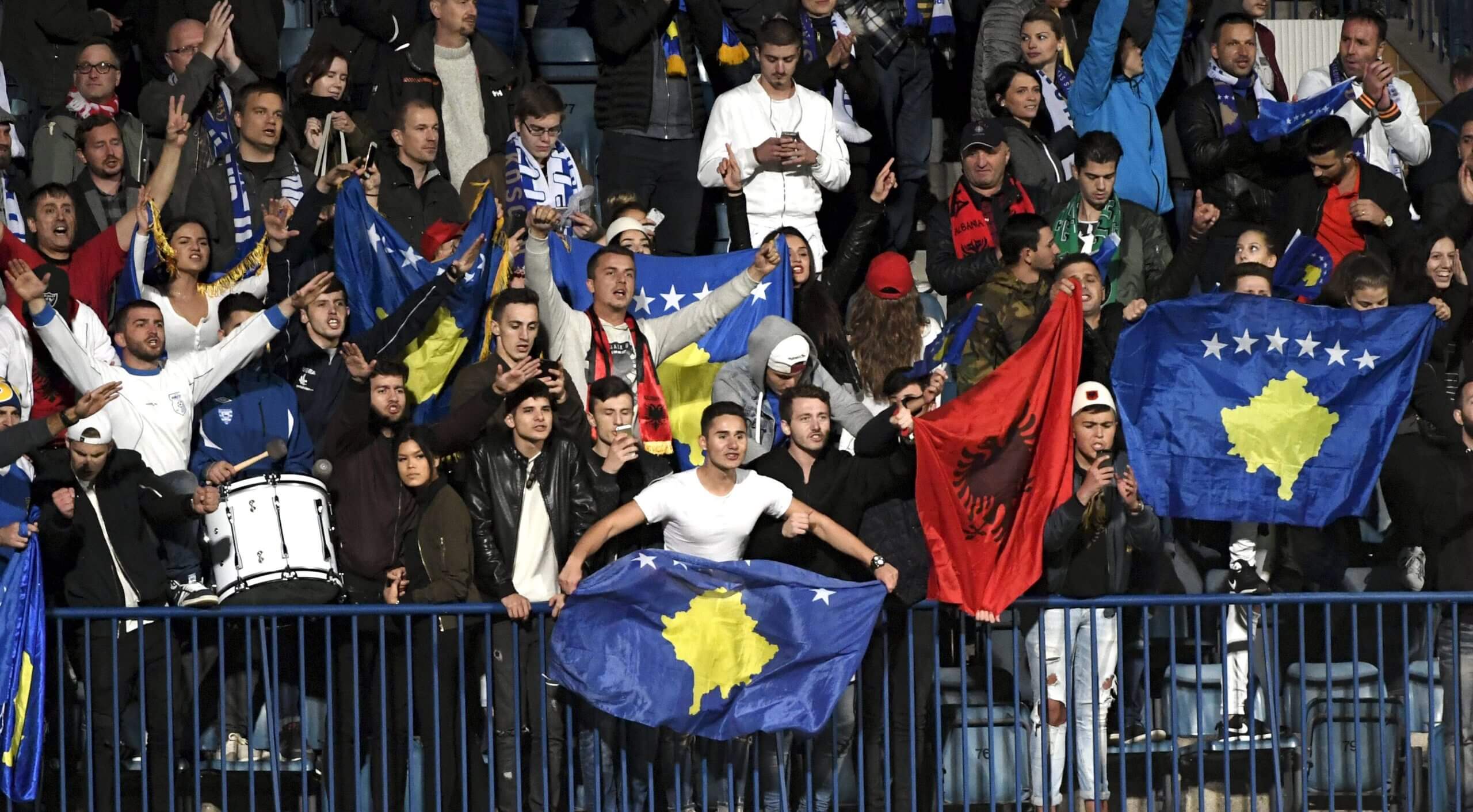
Kosovo and Albania flags are often seen together during international matches (Jussi Nukari/AFP via Getty Images)
The situation, however, is evolving and the change has been accelerated by Kosovo’s improved results. “Kosovo’s young generation is very emotional about the national team,” explains Rexha. Svecla agrees: “Kosovo is the most significant match now. With Kosovo realistically qualifying for tournaments, the perception changes.”
Despite on-field successes, not all of Kosovo’s population supports its national side. “There are Kosovars who think Albania should be the one national team,” Rexha explains. “The ultras group of 11-time Kosovo club champions Prishtina FC, for instance, only attends Albania matches, not Kosovo.”
The same complex criteria of national identity applies to Kosovo’s players, many of whom are eligible to represent multiple nations. Of the current 24-player squad, 13 were born abroad and seven in Switzerland.
Some 300,000 people — more than a sixth of the entire population of Kosovo — settled in Switzerland after emigrating in the 1990s. Switzerland captain Granit Xhaka’s family were among those to flee from Kosovo while Xherdan Shaqiri, who scored 32 goals for Switzerland, was born in Kosovo before his family relocated in his childhood. When Switzerland played Albania in 2012, four years before Kosovo’s footballing recognition, nine of the players to start the match were born in or had roots in Kosovo.
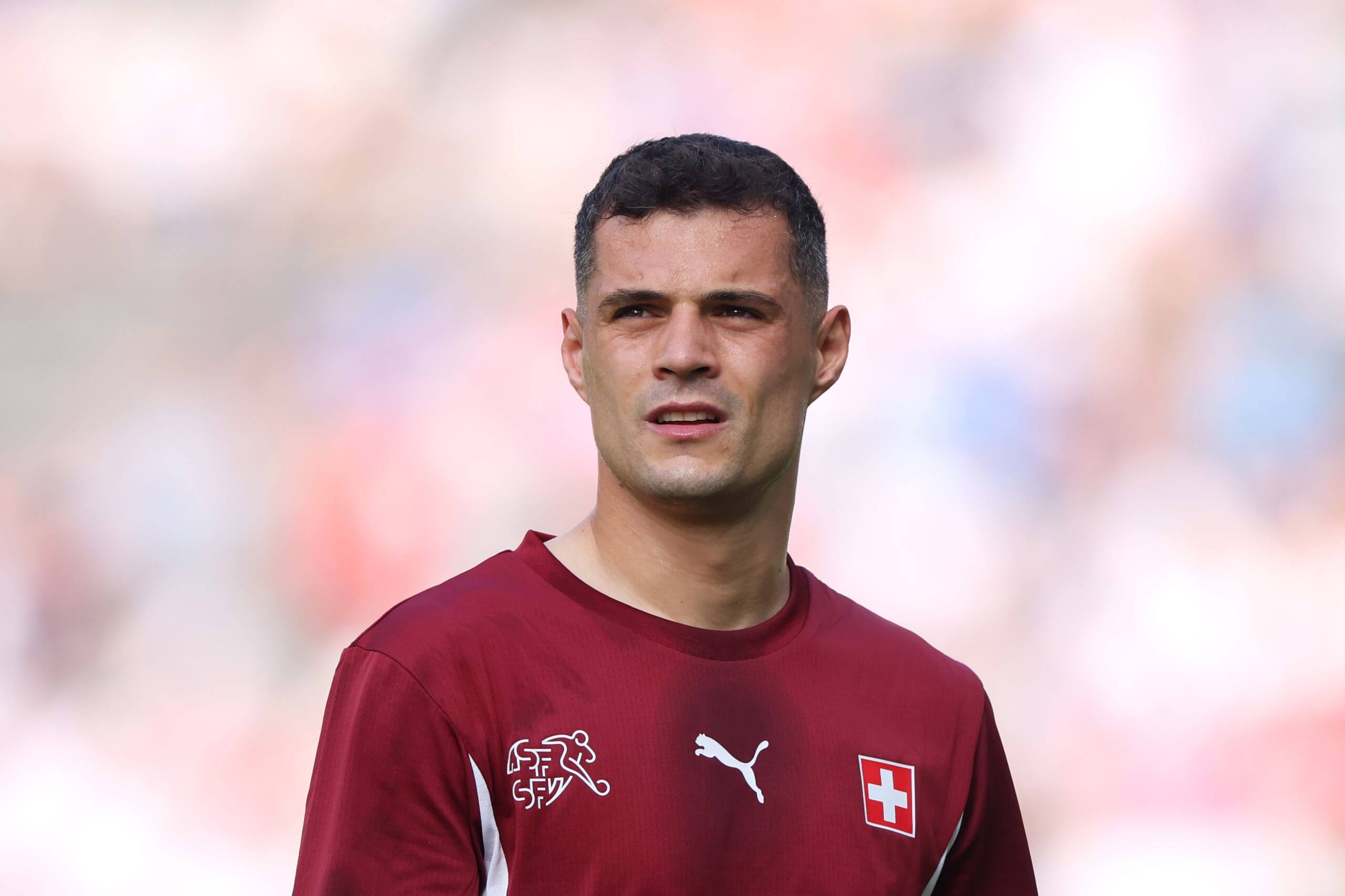
Granit Xhaka, from a Kosovan family, has made 143 appearances for Switzerland (Alex Grimm/Getty Images)
Kosovo’s existence has added an additional layer of complexity, with players regularly switching allegiances between national sides. Albian Hajdari played once for Switzerland last year before declaring for Kosovo, while Leon Avdullahu represented Switzerland up to under-21 level before making the same move. In 2021, the Football Federation of Kosovo said striker Andi Zeqiri would declare for their side. Zeqiri, however, remained with Switzerland, playing 18 senior games.
Kosovo have also lost internationals to others. Uran Bislimi (Switzerland), Mirlind Daku and Arber Hoxha (both Albania) are among players to appear for Kosovo before switching allegiance to other nations.
‘Kosovo don’t fear anyone’
Kosovo will not be favourites for their play-off against Turkey, but they have home advantage in Pristina and no shortage of quality in their team.
Vedat Muriqi has scored 18 goals this season for Mallorca in Spain’s La Liga — only Kylian Mbappe has more — while Fisnik Asllani has scored four goals in 13 international appearances. Asllani is one of three players at Hoffenheim, fifth in Germany’s Bundesliga, but his club team-mate Leon Avdullahu misses out through injury, alongside Napoli defender Amir Rrahmani.
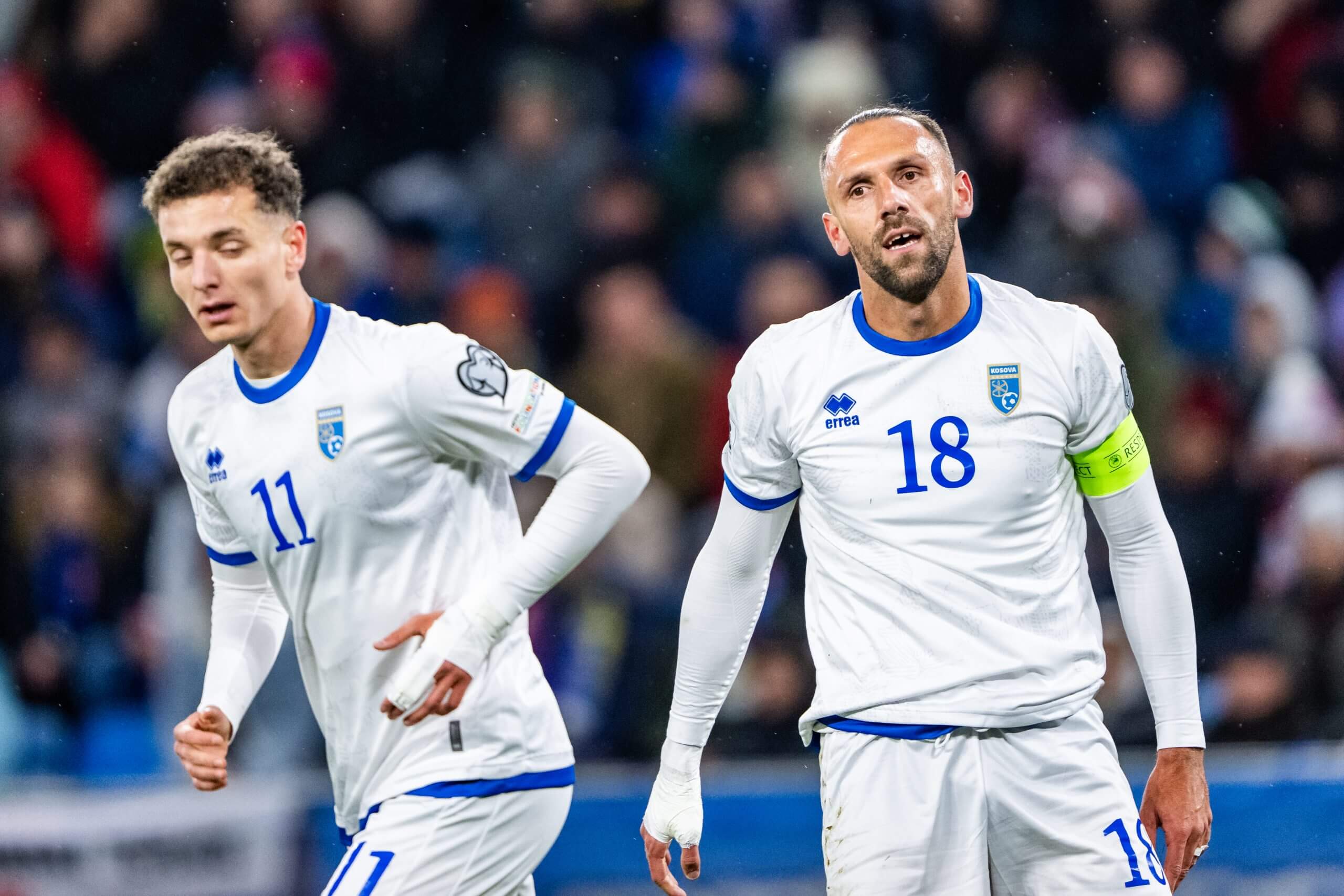
Fisnik Asllani and Vedat Muriqi are Kosovo’s main goal threats (Christian Bruna/Getty Images)
The play-off carries great significance for Turkey, who have qualified for just one of the past 17 World Cups — finishing third in 2002. Turkey are, however, regulars in the European Championship and their current stars include Real Madrid’s Arda Guler and Kenan Yildiz of Juventus.
“Confidence in Kosovo is very high, we are the underdog but it does not feel like that,” says Rexha. Svecla agrees there is “full belief” in Kosovo that they can qualify. “All tickets for the game sold out within two hours, even before the semi-final! There is a lot of confidence about this team.”
Kosovo are unbeaten in their past eight home matches, including this qualification campaign’s visits of Switzerland, Slovenia and Sweden, the latter of whom they defeated twice. “We have a stadium only for 13,000 spectators, but if it were possible, there would be 100,000, for sure,” Kosovo coach Franco Foda said before the game.
“Turkey are favourites on paper, but Kosovo don’t fear anyone,” says Berisha. “They face big opponents in European leagues every week, they are used to this calibre of opponent. This game has even more significance with Kosovo’s geopolitical context, this is the game of their lives.”
Less than a decade after being accepted into the world of football, Kosovo could be about to gatecrash its biggest event.