
THE ALL ENGLAND CLUB, London — At some point, Coco Gauff was going to win another tennis match on grass.
Gauff waited all afternoon for No. 2 Court to free up, and when it finally did just after 7 p.m. Monday, she made quick work of Germany’s Tamara Korpatsch, the world No. 78.
Needless to say, Gauff has won bigger matches in her life and her grass career, but this was a long time coming. It was her first win on grass in two years, which goes a long way toward explaining the big-old grin that spread across her face when Korpatsch’s last ball flew long.
“I don’t regret the past, I just learn from it,” Gauff said on court with a laugh about her grass losing streak, after winning 6-2, 6-1 in less than an hour.
There wasn’t a ton of mystery to this one. Gauff had more aces than double faults. She had more winners than unforced errors.
She was tidy. She was clean. She took charge early and didn’t let up, stepping on the gas like she said she wanted to after establishing a lead in way she often hasn’t the past month. She was everything she hadn’t been the past two years on the most rarefied surface in tennis.
In 2024, Gauff’s campaign ended with her standing on Centre Court in tennis disarray, yelling at her coaches as she slid to a fourth-round defeat against compatriot Emma Navarro.
Last year, she lost her first warm-up match, at the Berlin Tennis Open, and then her first-round match at Wimbledon, too. Two weeks ago, she lost another opening match on the grass in Berlin.
“We don’t have the best relationship,” Gauff, 22, joked in her pre-Wimbledon news conference Saturday. “I definitely think I have the ability to play on it. I think it’s more about the confidence.”
Why are some players better on clay than grass?
Tifo Sports
Seven years after her breakthrough week at the All England Club, when Gauff upset her idol Venus Williams as a 15-year-old and made it to the round of 16, Wimbledon remains the one Grand Slam where Gauff has yet to make the quarterfinals.
That seems a little strange, given the way Gauff started all those years ago. During her three wins in 2019, she was aggressive, took control of points and used her serve to keep her opponents at bay. Against Williams, she fired four aces in 10 games. She won 78 percent of her first-serve points, and 73 percent on her second serve. She converted all three of her break points.
More than that, she stroked the ball with authority. At one stage, she won 11 consecutive points, against a five-time Wimbledon champion. There was little sign that day, or during the rest of the week, that grass would become something of an Achilles heel for her.
Conventional wisdom would say Gauff is too talented a player, and too good an athlete, to never figure out grass — and preconceptions about a player’s style can sometimes hide the reality of their records. Coming into Wimbledon last year, Aryna Sabalenka, Iga Świątek, Gauff and Elena Rybakina were ruling the top of women’s tennis.
Rybakina, the 2022 Wimbledon champion, and Sabalenka, the world No. 1, were seen as favorites. Gauff was in with a shot; Świątek appeared to be the outsider. Their grass-court win percentages were as follows: Rybakina 71; Świątek 68; Gauff 67; Sabalenka 64.
Come the end of the tournament, Świątek held the trophy.
“I didn’t dream that because I thought it was impossible,” Świątek, who won her 2025 semifinal 6-2, 6-0 and the final 6-0, 6-0, said Saturday.
Not so much, as it turned out. Świątek served about as well as she ever has during those two weeks. She hit the corners and scarred the lines on her first serve like Novak Djokovic.
Coming into Wimbledon last year, Iga Świątek’s grass-court win percentage was 68. (Henry Nicholls / AFP via Getty Images)
Telling a tennis player to serve well is like telling a pitcher in baseball to make batters swing and miss more. But there is more to it than that. Gauff may be the best athlete in women’s tennis, but Świątek has the best footwork, the adjustment steps and tiny movements that take her to the ball and propel her from attack to defense and back again.
Gauff is incredibly fast, which helps on any surface. But speed doesn’t always translate into good footwork, especially on grass, where acceleration can actually work against players if they don’t know how to optimize it for a surface that can change in a matter of minutes if the humidity shifts.
Świątek also has the racket speed, hand speed, and controlled aggressiveness to consistently step in and take the ball on her forehand, even with her extreme Western forehand grip, the same one that Gauff uses. Gauff can do this when she is feeling good on the court, but recent defeats on all surfaces have seen her dial back on aggressiveness when she has had a lead, taking the ball later than she might want and putting herself on the back foot.
“She’s got fast hands, fast feet, so she can adapt,” Matt Daly, a coach specializing in grip technique who has worked with several top-10 players, said of Świątek during an interview. “If you don’t have, let’s call it, the same skill set, it’s just very tough to adapt.”
When Świątek lifted the Venus Rosewater Dish, Daly had a vested interest in how she did it. He was one of Gauff’s coaches at the time, working with her to adjust her grip and swing path to improve her serve and her forehand.
Gauff’s adaptability and Daly’s guidance helped her win the French Open in 2025, but three weeks later came that Wimbledon loss to Ukraine’s Dayana Yastremska, who skidded the ball through under the No. 1 Court roof and rushed Gauff out of the building.
In Świątek’s box was Wim Fissette, who grew up in Belgium playing on fast carpet, which requires footwork similar to grass.
“Too many players focus on being low, where my main focus is always being light, especially with like the first steps, but also running through the ball,” Fissette, who Świątek split with earlier this year, said in a voice message this week that was about as good a primer on grass court tennis there is.
“There shouldn’t be any hard stops or hard starts.”
Velocity is also key to the shots players choose.
“A fast ball will be very fast. It will like kind of skid through,” he said. “But on the other hand when the ball is slow it is super slow. It’s probably the slowest of any surface. Let’s say the ball falls out of the air, or it’s like a very defensive ball. It bounces low and you have to add a lot, so it’s actually the opposite.
“So the fast balls, you kind of have to try to use the pace of the opponent, maybe redirect but stay light on the feet. And when the ball is slow, very slow, you just have to load your legs and try to get as much energy as possible to really do something with the ball.”
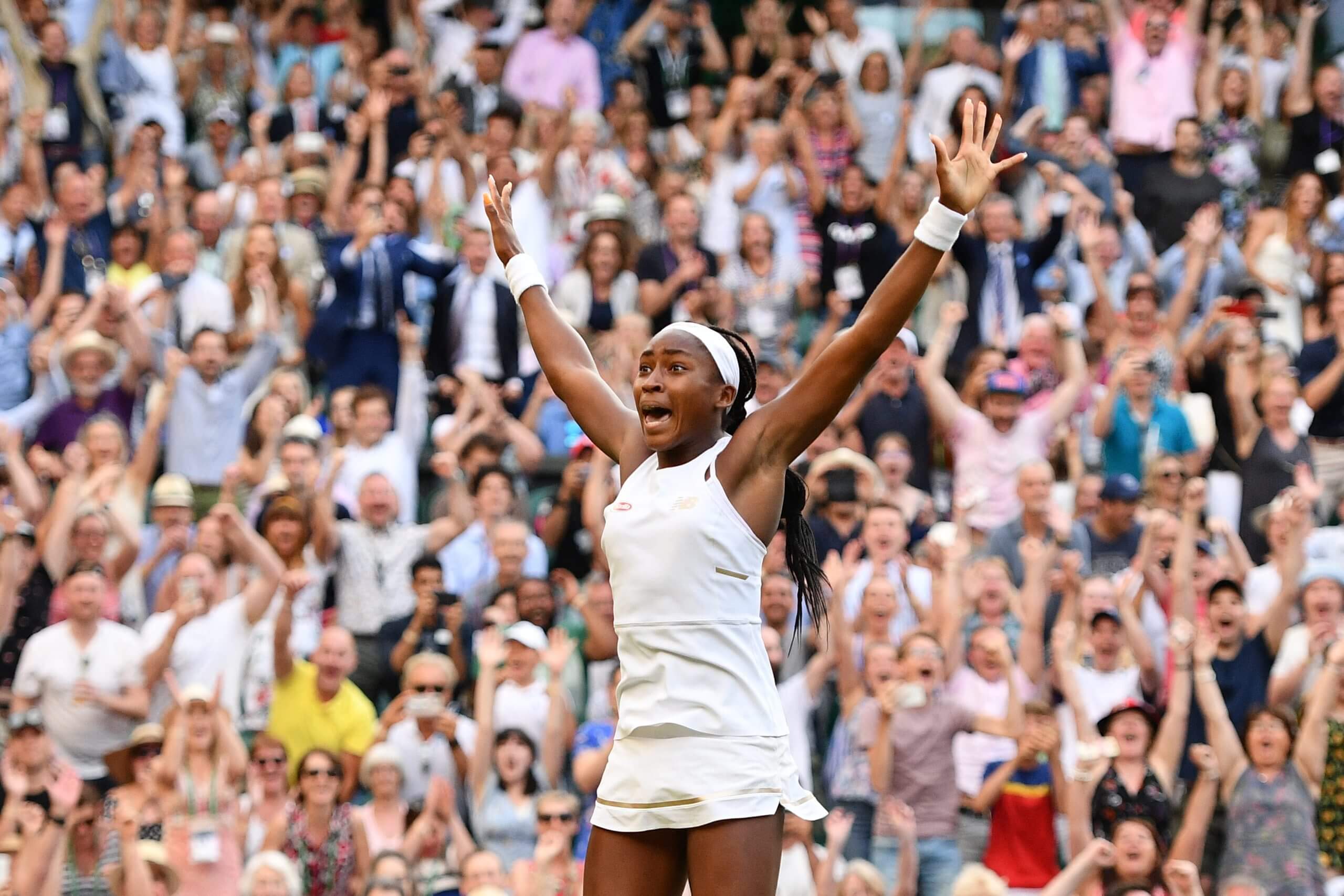
Coco Gauff made it to the round of 16 at Wimbledon in 2019. (Daniel Leal / AFP via Getty Images)
To understand Gauff’s path forward on grass requires a journey backward, into Gauff’s childhood. Gauff’s father and phonetic namesake (he’s Corey, she’s Cori) trained her to hit the ball differently than most women, to swing with the big sweeping forehand with heavy topspin and power that is more common among men.
Gauff was in her formative years when Rafael Nadal, Świątek’s idol, was taking over men’s tennis with his remarkable forehand. Nadal also uses the Western grip, which sends the racket strings from low to high while practically facing downward. The violence of the motion generates prodigious amounts of topspin.
During a neutral rally, that grip and motion usually work best when players can take a few steps back from the baseline. Unfortunately, that’s a terrible way to play tennis on a grass court, where the ball stays low and slides through the court. Gauff makes a lot of her living hanging back, using her speed to chasing down balls, and using her topspin to reset points until she can find an easy one to put away. Assuming the ball bounces high, that is.
“Her ball on the forehand is heavy and high and that is kind of frustrating for players, but on grass it doesn’t get above the shoulders,” Rennae Stubbs, the former player and commentator who is helping coach Serena Williams during her comeback, said during an interview.
There is a workaround though, as Nadal and Świątek proved (though Nadal’s grip is a little less severe than Gauff’s, Daly said).
They shortened their swings, stayed as low as they could, and got through the first week of the tournament, with the grass at its slipperiest. After a week of play — and perhaps sun — the courts have a slightly higher bounce, giving Nadal and Świątek’s strengths a better platform to shine.
All that requires the ability to anticipate shots and to stay light on the feet. Digging in and pushing hard off the grass, the way a gifted sprinter like Gauff does to generate speed on the first step can spell doom, even though grass tennis shoes have small dimples on the bottom to give players more traction.
Like Gauff, Steffi Graf had otherworldly straight-ahead speed. “Twinkle toes” is how Stubbs describes her. She tells players to imagine they are running on ice.
Daly mentioned his good friend James Blake, who reached No. 4 in the world and won 10 titles but never got past the third round of Wimbledon.
“One of the fastest on the hard court, but he didn’t move quite as well on grass,” Daly said. “He had the game to be very good on grass. I just think the movement wasn’t quite as natural.”
Gauff isn’t ready to give up yet. She wants to create more good memories on the grass. She says her practices are going well.
“Just really focusing on the footwork, the game style, and really trying to find my grass identity,” she said.