
“Vladimir Vladimirovich, people are afraid of you.” Those were the opening words of an Instagram post addressed to President Vladimir Putin by Russian beauty influencer Victoria Bonya, known for her make-up tips and lifestyle content.
“The people are afraid of you, bloggers are afraid of you, artists are afraid of you, governors are afraid of you. And you are the president of our country,” she continued.
In a direct appeal to Putin – who she says she supports – Bonya lists a wide range of ills in Russia. These include an alleged slow response to floods in Dagestan, claims the government brutally mismanaged recent livestock culls in Siberia and the intensifying restrictions on online social networks. This last, she alleged in Tuesday’s post, is preventing people from communicating with loved ones. “There’s a feeling that we’re no longer living in a free country,” she said.
By Friday afternoon, Bonya, who now lives in Monaco and has her own cosmetics line, had racked up 26 million views on her Instagram video, and more than 75,000 comments, many applauding her bravery.
Another popular Russian lifestyle and beauty influencer, who goes by Aiza and also lives abroad, took to her Instagram account to support Bonya, claiming the latest restrictions on the Telegram messaging platform would be a “huge hit to the Russian economy” and adding other grievances including high taxes and inequality. “How much money do you need to steal so that it’s enough?” she asked, citing “the average MP who owns property worth billions, millions of dollars and holds multiple (foreign) passports.” She later deleted the video.
The public pushback on the Kremlin come as several recent polls show sagging support for Putin – who has instituted internet crackdowns as he continues his yearslong push against Ukraine at a time of increased economic hardship at home for most Russians, including his supporters.
“It seems that something is shifting,” said Tatiana Stanovaya, founder of the political analysis firm R.Politik. Even in a society so accustomed to wartime restrictions and economic hardships, she told CNN, the mobile internet outages and Telegram crackdown of recent weeks were “something more resembling a pivotal moment.”
Internet restrictions in Russia have escalated since early spring, taking the country’s already tightly controlled information space into uncharted territory. Rolling mobile internet outages that upended daily life, including in Russia’s biggest cities, Moscow and St. Petersburg, coincided with the throttling of Telegram and new crackdowns on VPNs, used widely in Russia to circumvent existing restrictions on internet access.
Public officials have claimed the mobile internet blackouts are part of a security effort to counter “increasingly sophisticated methods” of Ukrainian attack, with the Kremlin promising that, “as soon as this measure is no longer deemed necessary, internet service will be fully restored to normal.”
‘I can’t stand what they are doing to us’
The Telegram restrictions have been particularly damaging for online influencers, who had already lost any income they might have earned on Instagram after a law came into force in September banning Russian residents from advertising on websites Russia blocked or deemed “undesirable.” Instagram was officially blocked in 2022 but is still widely accessed via VPNs.
On March 26, Liza Moka, a lifestyle and parenting writer and blogger in Russia, posted a tearful video message to her 900,000 Instagram followers. “I can’t go on like this,” she said. “I can’t stand what they are doing to us, these tyrants, divorced from reality.” She said that she lives in the remote countryside and the only way for her to work, or for her children to get an education, is online.
“When I tell my children, who I raised to be patriotic, ‘kids, I have to turn on a special VPN to get around what those who were supposed to look after you have thought up, so that you can f**king go to school,’ it’s nonsense,” she says. That video garnered 2 million views.
“I hope I don’t get put in jail for this video,” said a 19-year-old Instagram user named Artyom in early March. In a video that racked up more than 600,000 views, he said he was “in shock” at the fact Russia had not just blocked social networks but was now also banning the use of English words in advertising. “Where is freedom? I don’t understand people who still call themselves free. There are fewer and fewer opportunities,” he said.
And it’s not just social media figures speaking out. Several recent newspaper columns have railed against internet shutdowns being imposed on people without adequate explanation. One from “Nezavisimaya Gazeta” in late March openly compared the shutdowns to Stalin’s bans on some research into genetics and robotics.
Russian political scientist Ekaterina Schulmann, at the Carnegie Russia Eurasia Center in Berlin, suggests the internet restrictions have triggered more public commentary because they are seen as a somewhat apolitical topic, but she says subtle changes in the public mood started even earlier, particularly driven by Russia’s war in Ukraine.
“There were quite a lot of markers that show these shifting attitudes during 2025,” she told CNN. “We have witnessed a formation of a stable and growing majority of people who would rather see the war stopped, notwithstanding the non-achievement of its stated goals, rather than go on.” Many Russians had also let themselves hope, she said, that “our ally in the White House was going to make things alright, and the war was going to end with a victory on our terms. Nothing of this kind happened.”
And this is affecting those who had never before questioned their leaders, said Russian investigative journalist Andrei Soldatov. “The feeling of war fatigue is palpable even among patriots,” he said in written comments to CNN. “The hopes they had for Trump are gone.”
Understanding the impact of public opinion in Russia is complicated, said Schulmann, because “there is no direct and immediate connection in an autocracy between the fact that people are unhappy about something or want something else and… the actions taken by the authorities.”
“Russian citizens are not voters,” she told CNN, calling the result of upcoming parliamentary elections this autumn “pre-ordained” by those already in power.
And so the Kremlin’s response to this is notable. On Thursday, Kremlin spokesman Dmitry Peskov made the unusual move of commenting directly on Bonya’s video, saying “it touches on many topics, and work is being done on them separately… none of this is being ignored.”
During its daily press briefing on Friday, the Kremlin rejected the claim that Putin was being kept in the dark about the true scale of the country’s problems, as some of the bloggers had suggested in their videos. “Putin is the head of state. His authority covers the broadest range of issues on the agenda,” Peskov told CNN, dodging a direct question about whether he believes Russian people are scared of their president.
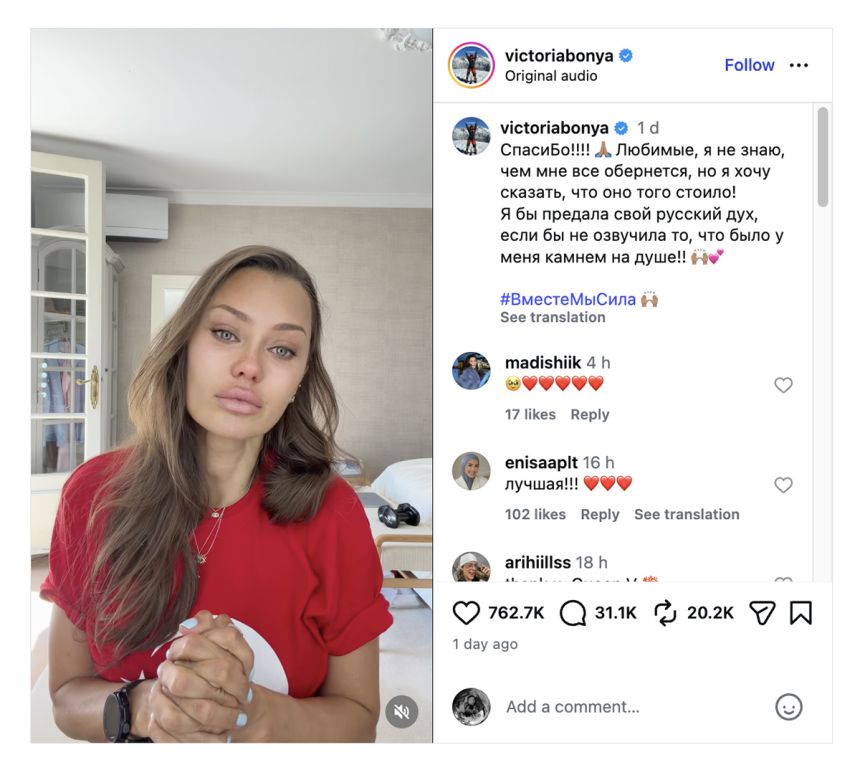
With her face streaked with tears, Bonya thanked Peskov in a video Thursday, and attempted to disassociate herself from coverage of her previous message by non-Kremlin-approved outlets – the BBC and Russian opposition channel TV Rain.
“I don’t know what will happen to me,” she continued, “I just want to say it was worth it.”
Bloggers in Russia have been under growing pressure.
In mid-March, pro-Putin blogger Ilya Remeslo posted a manifesto on his Telegram page labeling the war in Ukraine a “dead-end” and calling for Putin to be put on trial. A day later, it was reported he had been taken to a psychiatric hospital in St. Petersburg.
In her original video, Bonya also mentioned her concern over the case of Valeria Chekalina, a popular blogger known online as Lerchek, whose ex-husband Artyom Chekalin was sentenced on Monday to seven years in prison for illegal money transfers. Chekalina herself only had her own house arrest order, imposed over similar charges, suspended so she could attend treatment for stage 4 cancer.
Experts say there may be more repressive measures to come, especially with Putin’s approval rating slipping more than seven points so far this year, according to Russia’s state-owned polling firm VCIOM. “I would say that perhaps we will see rather soon a new wave of restrictions, repressions, maybe institutional changes, personnel reshuffles,” said Stanovaya.
The question now for overall regime stability, argued Schulmann, is whether Russians interpret the current situation of internet crackdowns, gradually increasing economic hardship and unending war as the status quo, or a temporary and abnormal situation.
“The president is the status quo,” she told CNN. “If you like it, then you approve of him. If you start disliking the status quo, then you start disliking him as well.”