
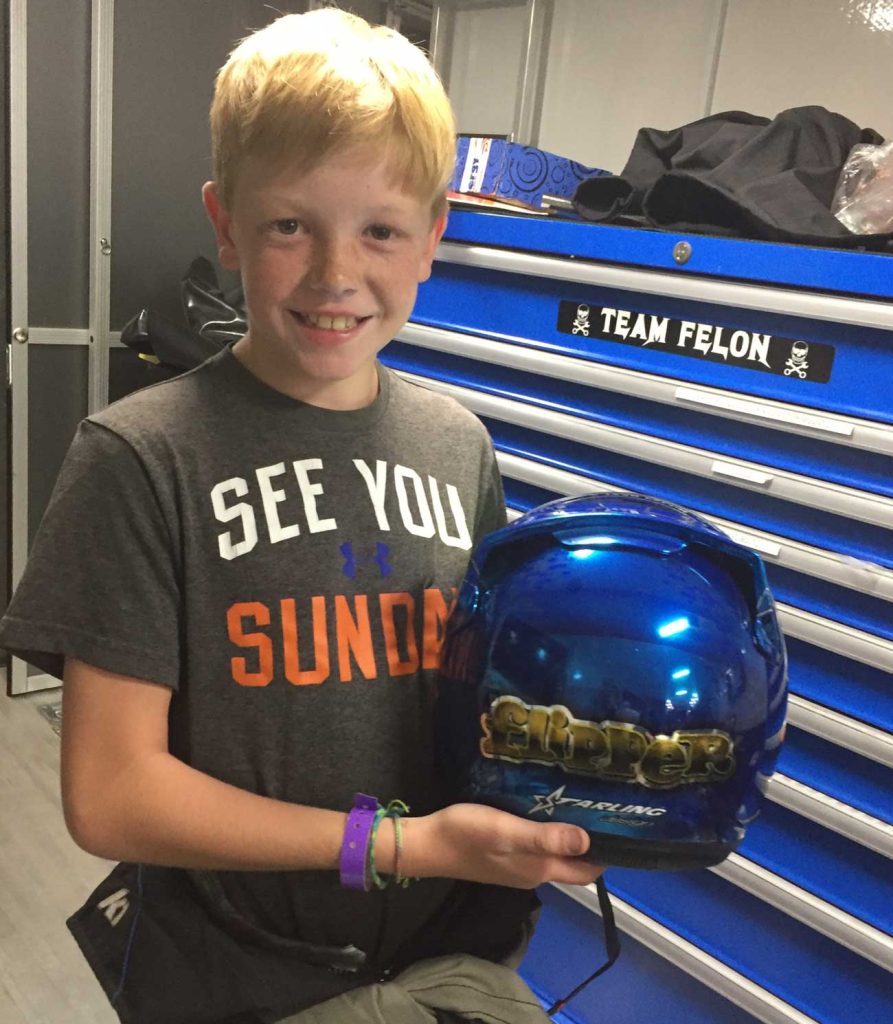
Before Connor Zilisch was Connor Zilisch, next big thing, winner of 10 races in his rookie O’Reilly Auto Parts Series season, and the bad-fast and most-anticipated Cup Series rookie in a generation, he was a rail-thin 11-year-old kid with a flop of strawberry blond hair practicing a go-kart in Italy.
He was slow, like, not competitive slow, like he might as well have just gotten out of the way slow. Zilisch didn’t know race-craft, at least not like he does now, he didn’t know car control, at least not like he does now, and he didn’t know how to drive deep into corners, at least not like he does now.
Those lightning-quick Euro brats schooled this American upstart, dive-bombing him at every opportunity.
Zilisch spent that unimpressive session under the tutelage of an accomplished driver and coach, who first approached other drivers to offer specific instructions on how to get faster before turning to Connor. He wasn’t good enough for that kind of instruction to matter. She tried to breathe life into this cherubic tween from the suburbs of Charlotte.
“Connor!” she called to him.
He looked up at her.
“Do you want to go for a Sunday drive?” she asked in her thick Italian accent. “What are you doing? You need big balls!”
And thus began the world-class racing education of Connor Zilisch.
School of hard knocks
That education is coming in handy during a challenging start to his rookie season in the No. 88 Chevrolet for Trackhouse Racing.
Two weeks into this season, Zilisch joined the NASCAR media for a video conference. He appeared to be in the bedroom he still lives in at his parents’ house in suburban Charlotte. Yes, he lives with his parents. He’s only 19, he loves them, they love him, what sense would it make to move out? He’s got the rest of his life to live the rest of his life. Anyway, he looked young, hopeful, fresh, as full of energy as any teenager whose future awaits him.
He declared himself accurately, sitting in dead last in points, and he did it with what appeared to be a smile on his face. What’s he going to do, mope about it? There are thousands of drivers who would kill to explain to a Zoom call full of reporters why they are dead last in Cup points.
Five weeks later, his position in the field has barely changed, as he has managed only one top-15 finish in the first seven races. His attitude hasn’t changed much, either. He’s annoyed and frustrated, of course, but he also recognizes that a season is long, a career is longer, and he’s just getting started. “I knew I was going to have a learning curve,” he says.
Most NASCAR fans know about Zilisch’s record-breaking rookie season last year in the O’Reilly Auto Parts Series. They think he’s been fast in every car he’s ever been in, and that’s mostly, but not entirely, true. As part of his development, he drove unfamiliar cars on unfamiliar tracks in unfamiliar series, all to make him comfortable being uncomfortable.
That’s paying off now.
No, he’s not having fun putting up bad finishes every week. But he is better prepared than most young drivers for this part of the experience.
“We talk about that a lot,” says Eric Warren, General Motors’ executive director for global motorsports competition. “What are the elements we’re looking for (in a driver)? It’s how they handle adversity.”
European history
Zilisch’s journey to the Cup level is unparalleled in NASCAR history. His background has uniquely prepared him to handle the ups and downs of the biggest and most competitive circuit in the country.
From his mom, Janice, who qualified for the 1984 Olympics as a Canadian gymnast but missed them due to injury, he learned competitive fire and the hard work necessary to compete at the highest level. From his dad, Jim, he learned to love racing and not take life too seriously. From his coach, Josh Wise, he learned that what looks like failure and success often aren’t and that knowing the difference between the two lights the path to success.
And from a gruff Italian coach, he learned to drive hard into corners.
A hallmark of Zilisch’s elite road-course performance today is his ability to drive deep into corners, brake hard and late, keep his car straight and under control, and zoom out ahead. NASCAR Hall of Famer Kevin Harvick, who helped discover Zilisch, has been telling people for years — since long before Zilisch got anywhere near NASCAR — that Zilisch is the best braker he has ever seen.
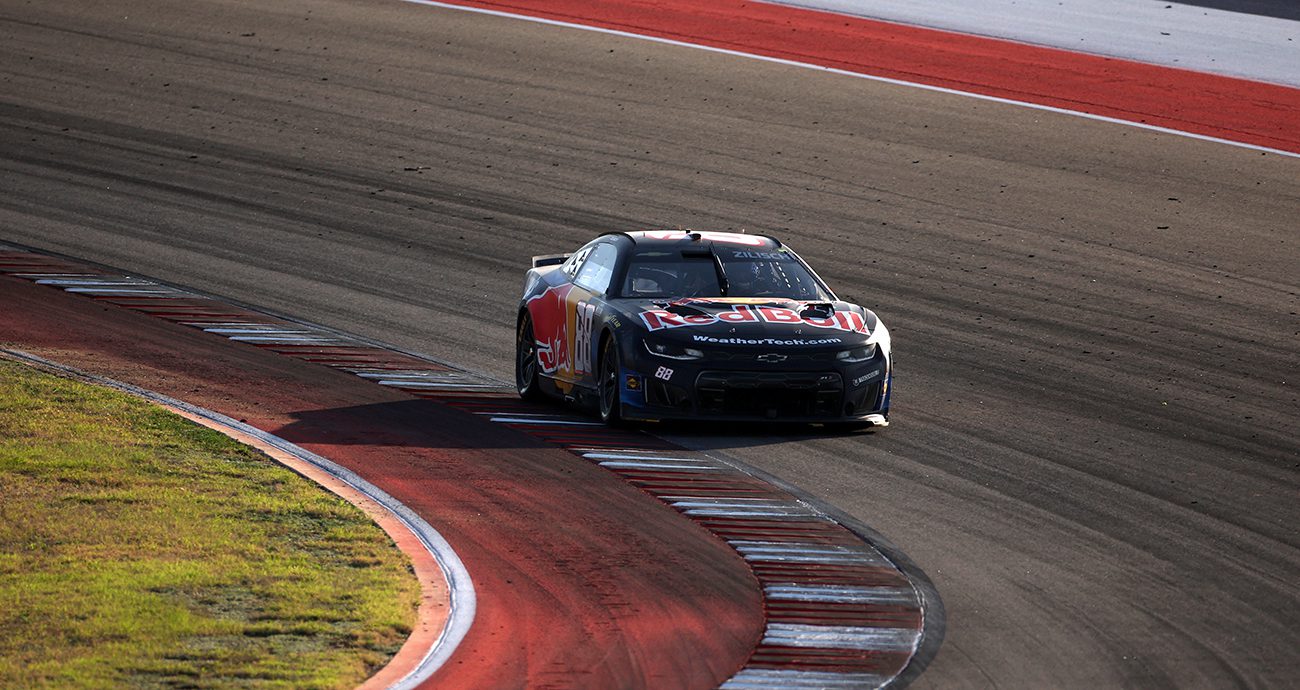
That skill is both natural and learned. To some degree, he was born with it. And to some degree, his development of it can be traced to that haranguing in Italy. After that coach — a former world champion, Jim Zilisch says — got in his face, he went out in the next practice session and was quite a bit faster, and a few weeks later, he won a world championship by beating the drivers who had dusted him in practice.
That transformation was as much mental as it was physical. He figured out quickly that the American style of racing and the European style of racing are very different. “Here, people do things that are aggressively stupid,” Connor Zilisch says. “It was more aggressively smart (in Europe), like putting you in a bad spot.”
Drivers in America work together. Drivers in Europe don’t. “There’s a lot more finesse and technique there,” he says. “It’s a lot harder to make moves. You have to think it out a lot more. Which I think helped me a lot. Here, it’s easy having to pass a guy. If I want to, I can just hit him out of the way.”
Computer science
Seemingly everyone has a story about Connor Zilisch that starts with him getting in a car or driving at a track for the first time and quickly setting a speed record. The speed is, of course, impressive. But the way he produces it might be even more so. He has an uncanny understanding of where the speed comes from and how to get more.
Darian Grubb, the director of performance for Trackhouse Racing, saw this in Cup testing last season. “In his first 15 minutes in the car, he’s able to articulate exactly what it is that he’s chasing, what he’s feeling in the car, what he’s not feeling in the car. He’s learning everything around him, and his feedback loop — what he’s able to describe — is pretty amazing.”
That skill is a blend of old-school savvy and a new-school way of attaining it. Decades ago, drivers like Rusty Wallace studied the geometry of the car and used that knowledge to diagnose problems. Zilisch studies the data that his laps produce, and he uses that to explain what the car is doing.
“He’s teaching us how to use our own tools, in some cases, because it’s obvious that he starves for that type of information,” Grubb says. “He is doing studying at home, at nights and weekends, before we come in for a Monday or Tuesday meeting. He says, ‘Oh, just click this. Do that,’ and I’m like, ‘Oh, I haven’t even used this tool nearly as much as you have.’”
Parenting
Talk to anyone who knows him well about why Zilisch is the way he is — grounded, intelligent, mature — and the conversation immediately turns to his parents and the environment in which they raised him.
Connor’s mom, Janice, grew up in Toronto with the aforementioned Olympic-caliber credentials. If Connor ever even thinks to complain to her about how difficult his training is … well, she silences that.
His dad, Jim, is a retired banker with an MBA and a delightful sense of humor. After Zilisch fell off his race car in Victory Lane last year and broke his collarbone, Jim posted this: “Silver lining. Pooping himself is no longer his most embarrassing moment.”
Jim Zilisch bought Connor and his two older brothers go-karts when they were young, and they raced first in Charlotte, then the Southeast, then the country and eventually the world.
Starting when he was 11, Zilisch spent several months for four summers racing across Europe without his parents. He traveled with an American mechanic, called home occasionally and otherwise was out on his own in the world, all before he could legally drive.

That is, to put it mildly, outside the norms of modern-day parenting, in which we barely let our kids out of our sight and helicopter over their every step, their every playdate, their every race, that is, for those few among us who can loosen our grip enough to let them race.
Janice and Jim Zilisch both said they knew from the time he was very young that Connor was different from most kids — more mature, more intelligent, more relationally courageous. Sending him off to Europe didn’t seem like a big deal.
Plus, there’s this: If Connor ever wanted advice from someone who had traveled around Europe competing in high-stakes sporting events without their parents, all he had to do was ask his mom.
Lesson plan
Before she was Janice Zilisch, executive for a biotech company who holds a PhD in pharmacology and mom of the bad-fast, most-hyped Cup Series rookie in a generation, she was Janice Kerr, superstar Canadian gymnast and All-American at the University of Florida who traveled behind the Iron Curtain to compete in international meets, without her parents, as a teenager.
That experience gave her life depth and breadth, just like it did for her son. “I remember sitting in a Romanian hotel, and they didn’t have enough electricity to keep the lights on all night, and it would get cold, and it would get dark,” she says. “And it was just amazing to me to watch the Romanian girls accomplish all they could accomplish with so little resources.”
There’s a parallel between an underfunded gymnastics team and an underfunded race team, and she tried to instill that idea in Connor. “He didn’t always have the best equipment under him. (But) he always said, ‘I’ve got to make the best of what’s beneath me.’”
It’s tempting to hear a story like that, add it to the one in Italy and see Connor’s time in Europe as part of a master plan to groom him for a career as a superstar in NASCAR.

But nobody had any master plan back then. Nobody thought Zilisch was being molded into anything. Says Jim Zilisch: “It was much more me being competitive with my little toy kid that I could put out and beat the other dads than it was we’re going to be a professional race car driver.”
Still, Zilisch’s experiences in Europe worked on him like a sculptor working on a piece of marble. Imagine how big a person’s dreams will be if his real life as a kid is that big. Imagine how fearless a person will be if he dares to do that as a kid.
That little toy kid had a blast gallivanting across Europe. He spent a day on a rented bike pedaling around Amsterdam, toured the Vatican and visited Venice so many times he’s like, meh, let’s go somewhere else next time. He learned about other cultures and other languages and other histories.
All of which has nothing — and everything — to do with being bad fast in a stock car. It’s not so much what he learned as how he learned it — wide-eyed, quickly, enthusiastically. Apply those attributes to driving and it’s no surprise his career has taken off since then.
He was a sponge for culture then.
He’s a sponge for speed now.
Grading on a curve
Asked to name the toughest challenge he has faced in his life and how he overcame it, Zilisch does not mention breaking his back in a wreck at Talladega, falling off his car in Victory Lane and breaking his collarbone or winning 10 races but losing the O’Reilly championship in 2025, which left him sobbing.
Instead, he travels back to earlier this decade, when his career rise was, temporarily, on hold for lack of funding. Then he learned racing’s dirty little secret: Talent, speed, intelligence and maturity don’t matter if you don’t have a car to drive. A driver’s potential is too often tied to their parents’ bank account. When their money dries up, so do the kid’s chances.
As Zilisch wondered if he would have a racing career, two things happened in quick succession: He was blazing fast in a 2021 Trans-Am test, which his dad saw as the point at which his son’s NASCAR career seemed possible; and he met Josh Wise, who completely changed his life.
This is when Zilisch’s racing education really took off. In 2021, Wise, a former developmental driver, was in the beginning phases of creating Wise Optimization, the company he runs that has become, essentially, a driver’s academy for General Motors.
Wise was looking for a young driver to groom into a champion. He saw Zilisch drive and was impressed, and then met him and was even more so.
“I brought Jim and Connor into my office, and I asked him if he wanted to become the youngest Cup champion in history,” Wise says. “And they kind of looked at each other and said, ‘That sounds like it’d be pretty good.’”
The path they have taken to achieve that goal is unique. Wise set out to teach Connor the things he wished he had known during his driving career. Among those topics were success, failure, how to deal with them and how to discern which is which.
Racing is a maddening sport because a win isn’t always a sign of great performance, and a 15th-place finish is not always the result of a poor performance. This might be the hardest lesson for drivers to learn, and some never do. Zilisch has learned this twice already this season — first at EchoPark Speedway near Atlanta in a crash and again at Circuit of The Americas when he drove from the back to the front, then got spun on the way to a potential top five.
NASCAR history is littered with hyped drivers who failed to live up to expectations. All they ever drove was fast cars. To borrow an old Molly Ivins joke, they were born in Victory Lane and thought they won the race. They never learned to wrestle a bad car. They never learned that some wins are unimpressive and some 15th-place finishes are phenomenal.
Wise knows all that because he lived it, and he designed Zilisch’s development so that he would learn it, but in a controlled way with an eye toward growth.
Wise wanted Zilisch to “under-specialize,” so he sent him out to drive as many different cars as possible. That’s why Connor spent a season learning to drive a dirt car. He considered it a good week if he made the A-main at a local track. Yes, the generationally great driver could barely hang with the locals. That alone gives him context for struggling in Cup against the best stock car drivers in the world.
And there’s more.
Wise had Zilisch dabble in different series, different tracks and most interestingly, different qualities of car. In one example, Wise told his staff to put Zilisch in a 10th-place car. Not so Zilisch could show off his talent, but so Zilisch could learn how to drive the car he has, not the car he wishes he had.
Wise could have put him in the fastest ARCA Menards Series car money could buy. But what good would that do? That would produce, as Wise put it, cheap results and give Zilisch a low ceiling. Zilisch would win, learn nothing and grow not at all.
But put Zilisch in a slow car and force him to “lose,” and he’d learn a ton. Seven weeks into the NASCAR season, when Zilisch has needed those lessons week after week, it sounds like a brilliant tactic. But at the time, Zilisch didn’t understand. He saw himself as a young hot shoe on the fast track to the top, and yet he was forced to drive a car that would not take him there. That Wise would do that on purpose was, to Zilisch’s mind, baffling.
“By no means were we going to compete for wins,” Zilisch says. “It was basically, if I can finish in the top 10, it’s a good day. And they told me that. But I didn’t really understand. I’m trying to make a name for myself, and I’m being put in these cars where I can’t.”
What he didn’t understand — yet — is that learning how to drive a car like that was more important than driving a race-winning car because in Cup, he will drive far more 10th-place cars than he will race-winning cars.
Today, Zilisch calls those races crucial for his development. He named them when Wise asked him for races he learned most from in his development, and he brought them up himself in an interview with NASCAR.com. And it’s easy to see how those struggles prepared him to deal with poor finishes to start this season.
“I’m in the deep end,” Zilisch says. “I’m coming back up to the top and trying to breathe for air. This Cup Series thing is no joke. I knew that coming into it. But I knew that I wanted to do this, and I wanted to do it so I can learn and figure it out.”
Zilisch has had to learn and figure out more than he wanted already this season. He completed every lap only twice in the first seven races. When he finished 14th at COTA, a track where he was expected to contend for a win, it was a disappointment. But that’s not the same as a poor performance, and Zilisch called that 14th-place finish one of the best races he has ever run — proof his racing education is doing exactly what it was built to do.