
“The problem is it’s so fast,” Danny Mackey says with a nervous laugh.
Mackey has spent the last eight months building up Olympic 1500-metre silver medalist Josh Kerr for his mile world-record attempt at the London Diamond League this Saturday.
“What’s weird is that he called it and is doing it in an actual race,” Mackey, who has coached the Briton since he turned professional in 2018, adds. “That’s not something that happens.”
Kerr is using the rare opportunity of a year without a global championship — the last off-season was the Covid-affected 2020, and there won’t be another until 2030 — to try and beat the three minutes, 43.13 seconds run by Hicham El Guerrouj in 1999, a time that has stood longer than any previous men’s mile world record.
‘Project 222’ is how this record attempt has been billed, and it is based on the number of seconds the 28-year-old wants to run the mile (equating to 3:42s). To support the Briton, there has been plenty of research, testing and product development.
The Athletic spoke to multiple people to understand the science behind Kerr’s world record attempt:
- Danny Mackey: Kerr’s long-time coach, and lead coach for Brooks Beasts Athletic Club
- Bryan Conrad: Senior manager of run research at Brooks, his sponsor
- Danny Orr: Senior director of product development at Brooks
- Brad Wilkins: PhD in human physiology, professor and director at the University of Oregon’s ‘Performance Research Laboratory’
The technology: Bespoke spikes and speed suit
“We’ve got to deliver just as much as Josh,” says Orr, who spent 15 years at New Balance before he joined Brooks last June. Just five months later, Kerr pitched his record-breaking idea.
Since foregoing his final year of NCAA eligibility and turning professional, Kerr has been a Brooks athlete, allowing the brand to build nearly a decade of data explaining how he runs.
Kerr has won Olympic and world championship medals running in non-personalised Brooks spikes. For Saturday’s attempt, the approach has been different.
Orr explains their thought process: “There are opportunities to make marginal gains: put a new (foam) formula, change the plate or the pins. But we’re building something from the ground up, reinventing the way we think about this type of product and trying to be led by Josh and the data.”
The process? A lot of computational modelling, in-the-lab and on-the-track testing, and multiple prototypes.
The result? A one-of-one spike built for Kerr and his biomechanics, which Orr says is “optimised” for this race. It is built to go at 55.5 seconds per 400m, the speed that Kerr needs to hold for four laps to knock at least 2.22 seconds off his PB and beat El Guerrouj.
The appropriately named Hyperion 222 spike has little foam in the heel, a lot in the mid-foot, and an aggressive taper that cuts sharply to the toes. It’s designed to act as a rocker, propelling Kerr forwards. Brooks say it “breaks all previous (design) moulds” and the titanium pins are not available on the mass market. The parts, including a carbon-fibre plate, provide “maximum stiffness”.
One key detail is Kerr’s size. At 6ft 2in (187cm), he’s tall for his sport. “He’s bigger than most on the start line, his feet are generally bigger too,” Orr says.
That means more force and more potential energy to return. “He’s got a specific view of what locking his foot onto the (spike) platform looks like, so we’ve taken his feedback there,” he adds.
In the main, they have asked Kerr for his full trust. “He won’t mind me saying this — in some ways, we’ve scared him a little bit,” Orr smiles. “The prototypes were very rough. As we got into the second one, he could start to see the vision.”
How does Kerr find the spikes? “You feel like you can’t slow down,” he told The Athletic in a recent interview. “They’ve taken the brakes off. It’s aggressive. They can run 55s (per lap), and, if it’s time to slow down, then those spikes aren’t going to let you. You might fall flat on your face.”
They did a wear test in a session when Kerr ran in old spikes and a couple of prototypes.
“I went into that day pretty nervous because it was recent, not six months ago,” Kerr says.
“I didn’t know how many more changes we could make. I went up to the spike team, told them that I’m feeling nervous, and asked how they were feeling. They were like, ‘We feel f***ing great’. I thought, ‘OK, that’s good, because that’s what I would say before a race’.”
In addition to the spikes is a bespoke speed suit. It’s made from two fabrics and has breathable features: laser-cut holes, deliberately few seams, and moisture-wicking panels. Multiple versions were crafted because London has unpredictable summer weather and they were tested in wind tunnels for aerodynamic analysis.
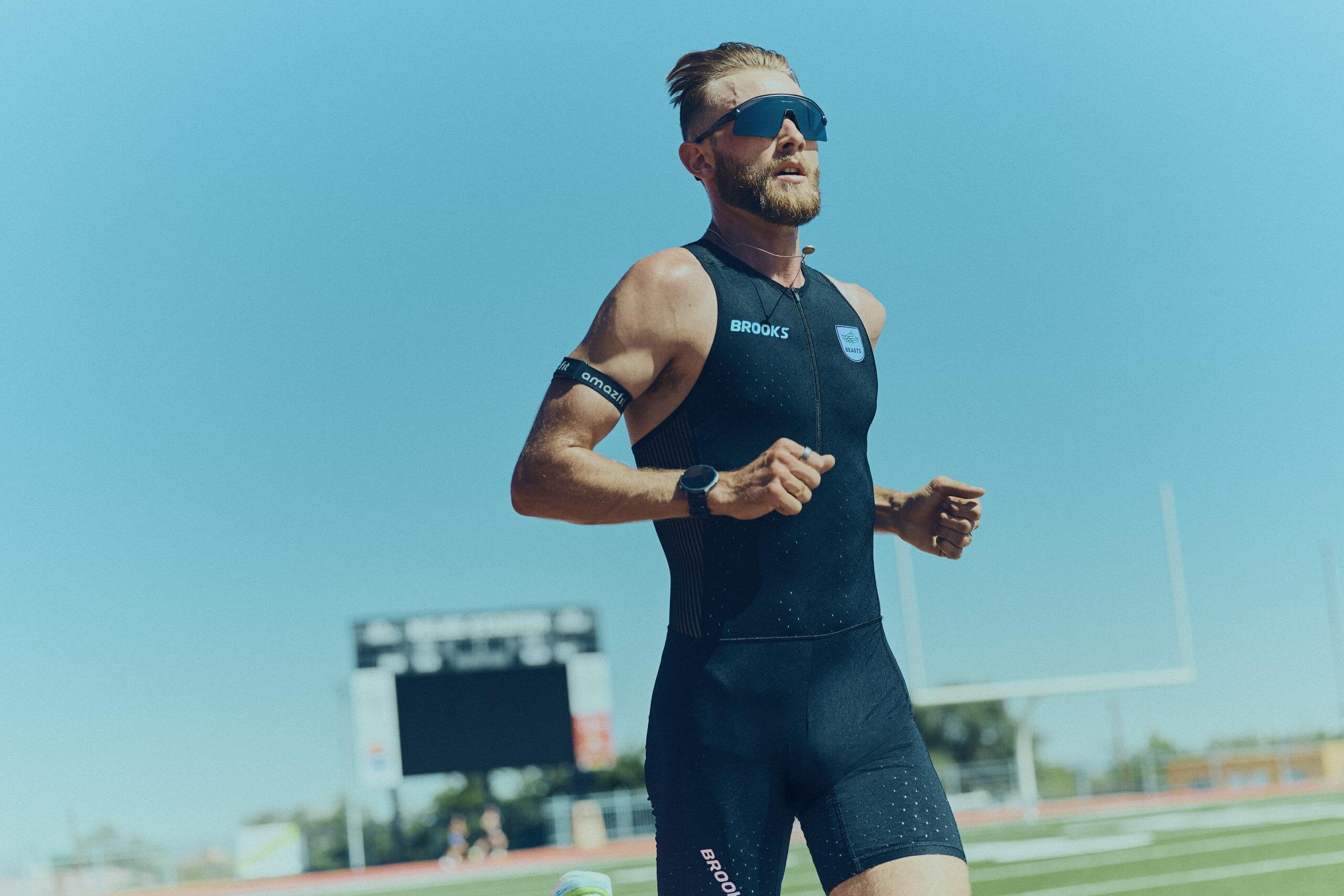
Josh Kerr will be running in a bespoke speed suit in London (Brooks)
“There’s nothing we leave on the table that we think could have given him even a fraction of a per cent towards that goal,” says Bryan Conrad, whose research department works across all distances (100m to 100 miles) and surfaces to support athletes “who are trying to push the limits”.
The training: Simplified and at target pace
Kerr has dedicated his year to this. That meant rebuilding from a grade two calf strain at the World Championships last September, which he sustained at the end of the 1500m semifinal and tried to race through. He hobbled to the finish line in the final as the defence of his 2023 title ended in agony.
“Given the injury and nature of it, I didn’t know how he would heal,” says Mackey. “He didn’t get on a track until January. This will be Josh’s opening mile of the year.”
Mackey adjusted Kerr’s indoor schedule. Winning world indoor gold over 3,000m in March was a big moment, particularly as he beat Olympic 1500m champion Cole Hocker, who had come out on top the month prior over two miles at Millrose Games.
“I’ve gradually added in more sprint work,” Mackey explains. The first time Kerr went “full bore” was for an 800m PB (1:44.60s) in Los Angeles at the end of May. He has only raced once since then, another 800m last month. “We go into a cave and train. You’ll see him in July,” Mackey said on a video call in mid-June between Kerr’s two races.
His mileage is consistently around 70 per week, with strength and 1500m work prioritised. “I felt pretty secure in what we did in 2025,” Mackey says, believing Kerr was in world-record shape last year, which is why they have not made drastic changes.
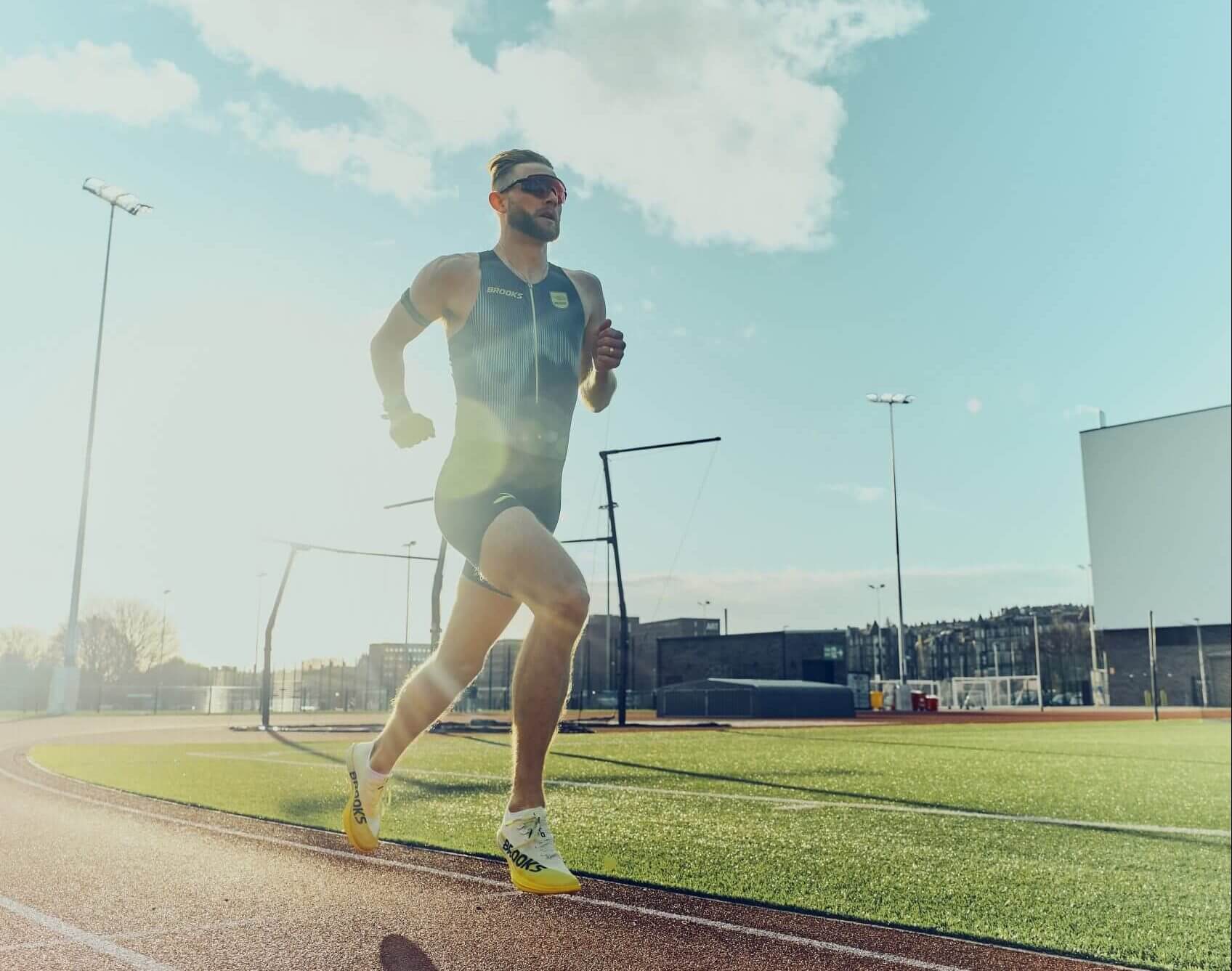
The Briton has been training at the University of New Mexico (Brooks)
In some senses, the preparation has been simplified. They are training to run at a set pace rather than preparing for the various tactics and pace changes that a championship final might throw up.
Kerr offers an analogy: “We’re playing a video game. There are no variables with this opponent.” When he ran 8:00.67s for two miles indoors in early 2024, a world-best performance, “we were just making sure he beat Grant (Fisher) and Cole (Hocker),” Mackey says.
Track sessions always look the same. Kerr lives at high altitude in Albuquerque and trains at the University of New Mexico, where he won multiple collegiate titles in his teens and set a 1500m record. He has stayed there ever since, and chases Mackey round the track, with the coach cycling in front.
The major difference to other training blocks is the work at target pace. “We did some 800m reps at 1:50s. Even though he felt good and controlled, I didn’t want him to run faster,” Mackey says. “I wanted to see how he felt at this pace.”
Kerr is rather philosophical about it. “You can understand the pace, you run it as much as possible, and try and feel comfortable with it, but there’s only a certain level of comfort you can have.”
One of the biggest efforts was a session of four sets of 200m, 600m, 200m, with short recoveries in between and four minutes rest between sets. All repetitions were run at world-record speed or quicker, in white-out spike prototypes, totalling 4,000m of work. At the start of July, he ran a 1200m time trial (three-quarters of a mile), and looked in control when he went through 800m on pace.
The physiology: The three key factors to running at world-record pace
On the simplest level, Kerr needs to run as quickly as he did in the Olympic 1500m final two summers ago, and then keep going for another 109m. He set a huge PB (3:27.79s) that day and earned a British record to go with his silver medal.
His raw speed now is better than it was then. “Coming (into the attempt) from these fast 800m races gives me confidence that he’s got the ability. I think he has the physiology,” says Brad Wilkins.
He has not worked with Kerr directly but has been a part of similar projects: Nike’s Breaking2 event in 2019, when they staged an attempt at a 1:59 marathon, and Breaking4 last summer, in which they tried (and came up short) to break another barrier — the women’s four-minute mile.
“We know a lot about the physiology of the mile, but a little less about the mechanics and the nuance that might limit (an athlete),” he adds.
In short, he won’t give a definitive answer, though he’s cautiously optimistic.
There are three key factors, Wilkins explains, for running a world-record mile. First, “big anaerobic capacity”, which refers to energy created without oxygen, a process that happens more quickly than aerobic respiration but lasts for a very short period.
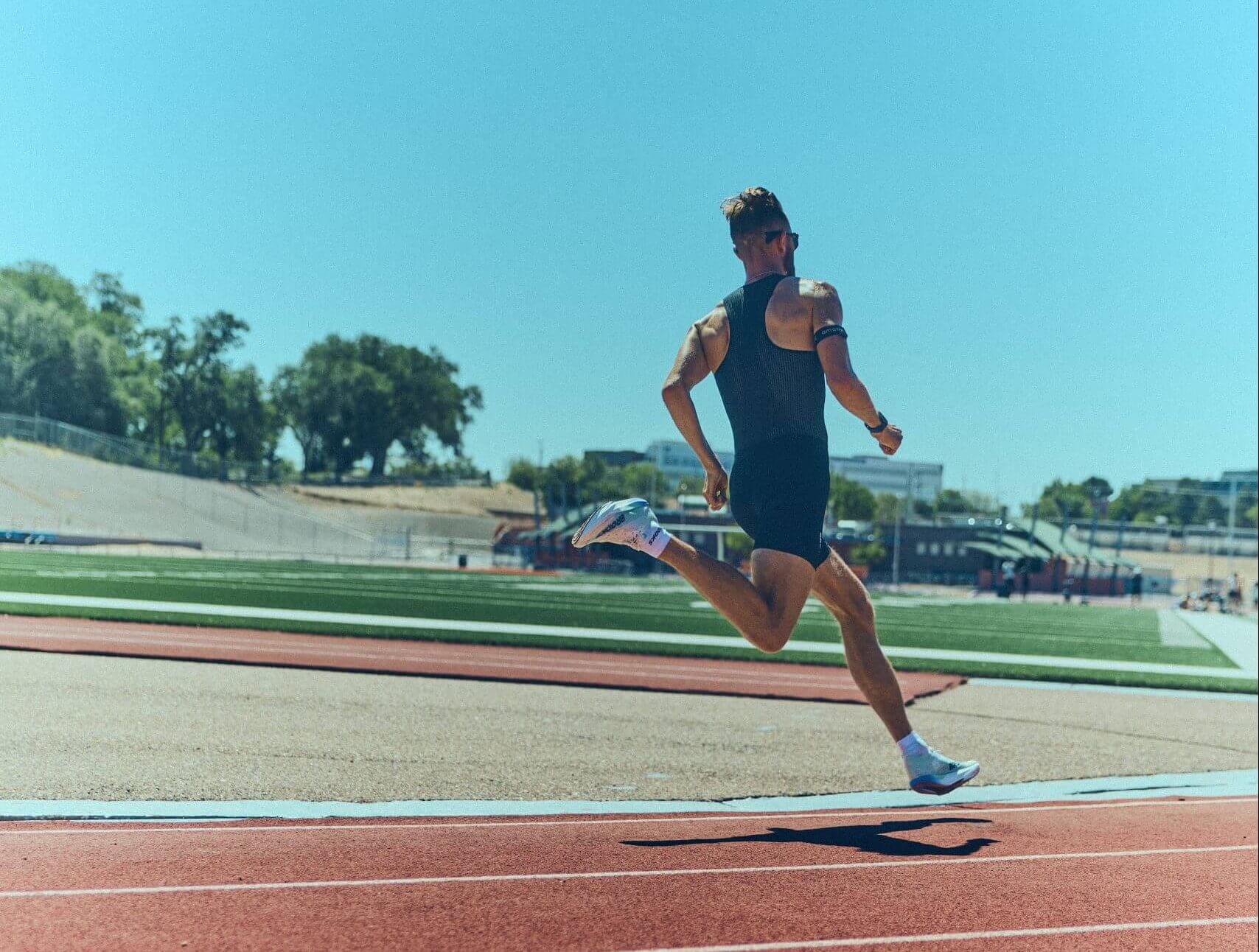
Kerr has been working to a target pace (Brooks)
Secondly, a high VO2 max — the maximum oxygen uptake for an athlete during exercise — because it means the “oxygen deficit” is smaller and redlining is delayed. Third, an individual’s capacity to “recruit as many motor units” as possible. These house muscle fibres, and the more that are recruited, the more forceful the muscle contractions are.
It’s why Wilkins puts stock in Kerr’s faster two-lap runs, because they demonstrate all three factors. “That is a big deal coming into these 1500/mile distances, where you need to sustain those speeds. (It’s important to) have the energetics or the aerobic capacity, but if athletes don’t have that top-end speed, then I’m much more sceptical.”
For Brooks, testing has been multi-faceted. They have a physiologist who has done perception, metabolic and VO2 max testing with Kerr, including visiting them at their altitude camp in New Mexico.
Conrad, the lead on the run research teams, explains an extra step they took: “We partnered with a lab that has a unique treadmill that you can run on with spikes, to test him in the footwear he’ll be wearing for the event. (That way) we could get the detailed measurements of how much oxygen he’s using, how his muscles are working, how his biomechanics change through that spike.”
The race: Pacemakers and a small field
If it were up to coach Mackey, this attempt would be in Monaco or Carolina because of the more reliable conditions. Kerr wanted London and the Diamond League organisers have given him control over the race. Brandon Kidder, one of his Brooks Beasts team-mates, will be on pacemaking duties, alongside Zan Rudolf, the lead rabbit on the European circuit.
Mackey says there were discussions about a potential third pacer, someone to run on the outside of Kerr in case nobody went with him.
Field size has been kept small because, in the men’s 1500m at this meet last year, a tangle of legs with 200m to go caused Australian Cam Myers to fall. “As long as everyone stays on their feet it’s an open race,” Kerr says.
The fastest mile on British soil is El Guerrouj’s 3:45.96s in 2000 at Crystal Palace. There are 16 performances quicker than that, including Kerr’s PB run to win the Prefontaine Classic in 2024.
The consensus is that he’s got the best chance of coming close if someone else is pushing him right to the line.
Second on the all-time list is Noah Ngeny in 3:43.40s, when he finished second and just three tenths behind El Guerrouj in the record-setting run. “That’s when the best results come,” Kerr says. “There’s only been one or two races that I’ve seen as fast as this without any kind of competition.”
Yared Nuguse’s presence is significant. The American record holder is fourth on the all-time list — and is just one of four men to run 3:43-something, achieving that by finishing runner-up to Jakob Ingebrigtsen at the 2023 Prefontaine Classic.
This project is clearly an opportunity for Brooks and Kerr to put themselves in the spotlight and attract attention.
In 2021, when Kerr won bronze at the delayed Tokyo Olympics — his first senior global medal — the Scot was racing in a pair of unmarked Nike Vaporflys because his sponsor did not have a ‘super spike’.
Orr, who helped lead the spike development, says its focus is the 2028 Los Angeles Olympics. “This is stage one in terms of what 2028 looks like. It’s a really fun opportunity to try some stuff, knowing that we have a little bit of time between now and then to get that right.”
This is also a chance for Kerr to fulfil something he said Brooks pitched when they recruited him in 2018. “This is where we wanted to get to,” he says.
A decade-long career and eight months of work are about to boil down into less than four minutes.