
IRVINE, Calif. — Paraguay looked overwhelmed, and Australia outclassed. Senegal, too, was blitzed by the U.S. men’s national team last month, just as Uruguay had been torn apart in late 2025. For much of the past year, and especially since a September win over Japan, the USMNT has looked formidable against teams from four continents. It has rolled into the World Cup knockout rounds.
Now, it meets its kryptonite: Europe.
The U.S. has lost 10 straight games against European opponents. Over the past decade, as this “golden generation” of U.S. players took shape, they have won just once in 18 tries against full-strength European teams — a 2021 victory over Northern Ireland.
Now, they might have to beat five European foes in a row to win the World Cup.
At the very least, they will need to snap this ominous streak when they meet Bosnia and Herzegovina in the round of 32 on Wednesday at Levi’s Stadium in Santa Clara, Calif. (8 p.m. ET, Fox).
Get free access to the most comprehensive World Cup coverage in The Athletic app
Bosnia is not the type of blueblood that first comes to mind when you think of European football prowess. Much of the rotten U.S. record against Europe has been wrought by powerhouses such as Germany and Portugal, or even second-tier teams such as Switzerland.
It has been prolonged by U.S. lineups that weren’t at full strength — last June and again last Thursday vs. Turkey. In many ways, it feels fluky. It is not something that weighs on American players. A few were surprised when informed of the stats last week. “It is what it is,” captain Tim Ream said. “Not really anything we can control.”
But it is something they will have to confront.
“If you want to win this World Cup,” U.S. wingback Sergiño Dest said Sunday, “you gotta be able to beat everyone.”
On Wednesday, they will have to beat a European team at a World Cup for the first time since 2002, the second time since 1950, and the first time in a knockout match.
In many ways, the stats sound more extreme than the struggles actually are. This USMNT has beaten good teams from other continents; it matched England in a 0-0 draw at the last World Cup; its predecessors would occasionally shock European powerhouses, such as Spain in a 2009 Confederations Cup semifinal.
But the multi-faceted drought against Europe helps put the size of the USMNT’s task into perspective. To make history, the Americans will have to end it.
Was there a reason behind Poch’s defensive press conference?
Tom Bogert
The USMNT’s dire streak vs. European foes
Much of soccer’s history is that of European dominance. The sport is culturally prominent nearly everywhere on the continent, from the British Isles to the Balkans, from east to south to west. The depth of talent is unmatched. A majority of the sport’s top 100 players almost always come from Europe. Over the past 60 years, 21 of the 30 men’s World Cup finalists and 44 of the 60 semifinalists, have been European. Seven of international soccer’s top 10 teams and 13 of the top 20, per Elo ratings, come from the continent.
That is the primary reason for the USMNT’s struggles — in other words, European teams are generally good.
The specific reasons are more nuanced.
The drought dates to the 2022 World Cup, when the U.S. got a lesson in totaalvoetbal and clinical finishing from the Netherlands in losing 3-1 in the round of 16. That was loss No. 1 of 10.
Nos. 2 and 4 came in January of the following two years, during training camps once dubbed “Camp Cupcake.” Because these January camps fall outside FIFA windows — meaning professional clubs are not required to release players to their national teams — the USMNT’s best players don’t participate, nor do those of their opponents.
The January 2023 loss to Serbia and the defeat to Slovenia 12 months later featured a grand total of two players who made the 2026 U.S. World Cup roster — reserves Miles Robinson and Alejandro Zendejas.
Loss No. 3 and loss No. 9 came against Germany, a perennial power that, in 2023 and 2026, struggled with the USMNT’s dynamism but punished its lapses.
Losses Nos. 5 and 6 were coach Mauricio Pochettino’s first tests against European teams. The first, 2-1 to Turkey, was a relatively even game. The second, a 4-0 beatdown by Switzerland, was embarrassing but featured something in between a U.S. B- and C-team. Most USMNT starters missed those June 2025 friendlies due to injuries, the Club World Cup or other circumstances.
Losses Nos. 7 and 8 came in March, when a full-strength USMNT met Belgium and Portugal. And those friendlies, more than any others, spoke to what’s coming in July.
The road ahead could be remarkably European
The 2026 World Cup knockout bracket after Canada’s round-of-32-opening win over South Africa (The Athletic)
It isn’t just Bosnia. Five days later, the most likely last-16 opponent would be Belgium. After that, the quarterfinal options would be Spain, Portugal, Austria and Croatia. And the three best teams on the semifinal path, from the bracket’s upper left quadrant, are France, Germany and the Netherlands.
So, the U.S. will not only have to beat a European team; it will likely have to beat European teams ranked in FIFA’s top 10, something it hasn’t done since 2015, when it surprised the Netherlands and Germany in back-to-back friendlies.
Back in that era, giantkilling was a semi-regular feature of the U.S. program. At the 2014 World Cup, the Americans were minutes away from beating Portugal in its second group match. A year earlier, they toppled Germany. In 2012, they beat Italy. In 2011, they drew with Argentina. At the 2010 World Cup, they drew against England. In 2009, they scored that famous upset of Spain, which was riding a 35-match unbeaten streak, and which would go on to win the 2010 World Cup. Four days later, the U.S. nearly stunned Brazil as well — it went up 2-0 before falling 3-2.
So, what changed?
Well, for one, the international soccer calendar. In 2018, the European confederation, UEFA, launched a Nations League that mostly precludes its 55 members from scheduling friendlies. Whereas the U.S. played 16 games against European oppostion in FIFA windows throughout the 2014 World Cup cycle, it only played six this cycle. The irregularity of those games has meant fewer opportunities for statement wins — and has left the U.S., as a team, unfamiliar with European styles.
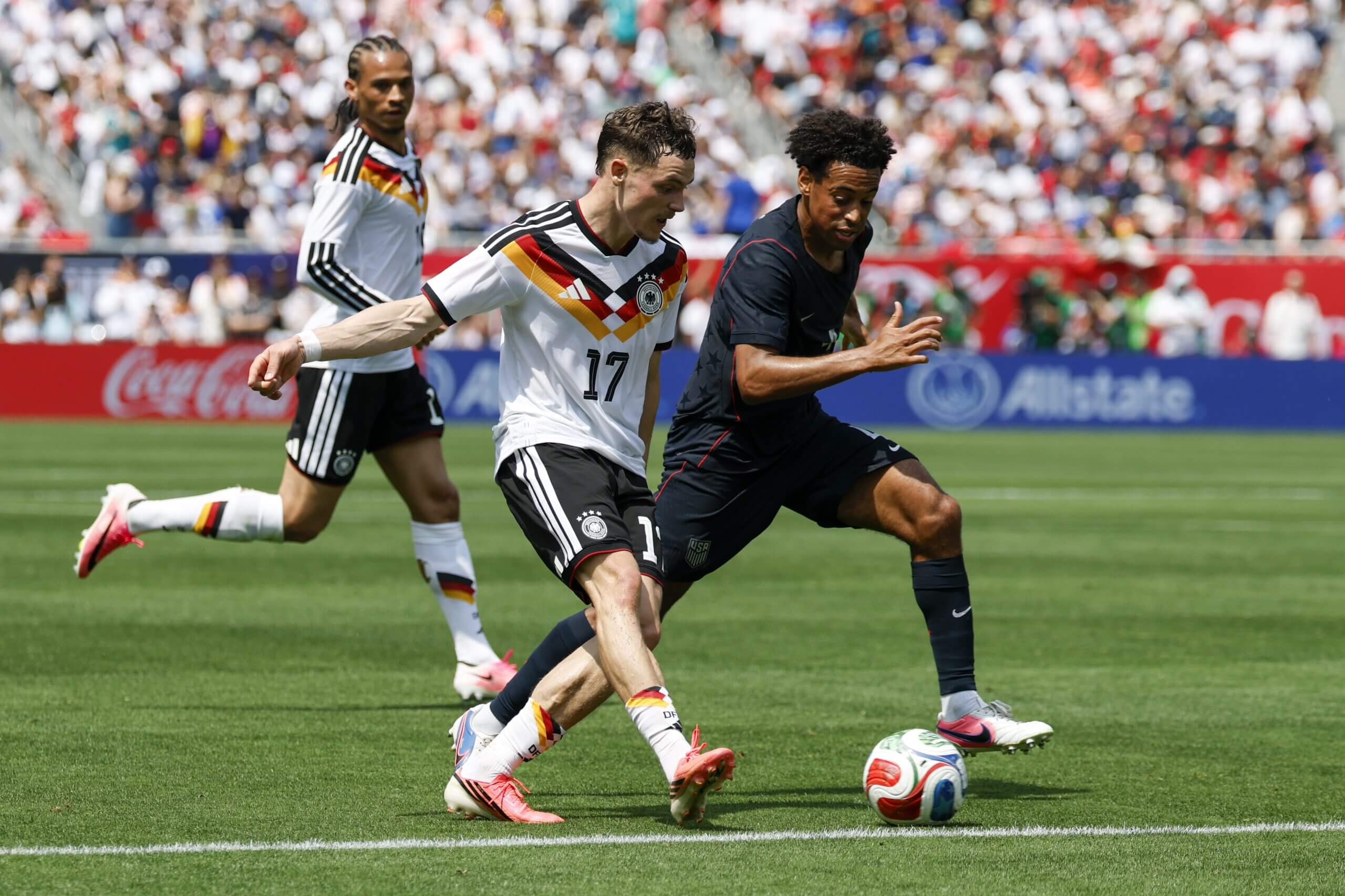
Tyler Adams marks Florian Wirtz in USMNT World Cup send-off friendly vs. Germany (Michael Miller / ISI Photos / Getty Images)
“When you get an opportunity to play maybe twice a year against European competition, it’s difficult,” U.S. midfielder Tyler Adams told The Athletic. “And the flow of the games, understanding that kind of thing, the rhythm, is difficult.
“But we have a lot of high-quality players that are playing (for professional clubs) in Europe. So, that shouldn’t happen.”
There is no solitary, monolithic European style that connects all these top teams, but many do share traits. “When you play against these teams, it’s a lot less chaotic than you would think, it’s a lot more controlled,” U.S. midfielder Sebastian Berhalter said in March after the USMNT’s miserable run against Europeans extended to an eighth-straight loss.
“Guys have great first touches. So, pressing, it makes it even harder. You’re waiting, you’re waiting, and then when you get your chance, you’re going (to press) … (but) any ball you give them, their first touch is dead. It doesn’t matter if they have pressure on them, it’s right at their foot.”
This U.S. team, which is widely seen as more talented than previous iterations, has tried to proactively press top opponents more so than U.S. teams of yesteryear; it has tried to be their equal. Some believe that its lack of an underdog mentality has been detrimental.
But the prevailing answer is simply that talent wins the day.
After the loss to the Netherlands in 2022, then-coach Gregg Berhalter said, “The difference between the two teams is that they have a certain quality in their finishing that we don’t have.”
In March 2026, the story was similar. “In this type of game,” Pochettino said after a 2-0 loss to Portugal, “players like (Pedro) Neto, (Gonçalo) Ramos, Bruno (Fernandes), João Félix — when you give a centimeter, it’s possible that they can score.”
U.S. wingback Max Arfsten, who has played in five of the losses to European teams over the past 13 months, told The Athletic: “They have a bit more quality in the attack as opposed to other teams.”
That’s what the U.S. will have to neutralize — or match with quality of its own — over the coming weeks.
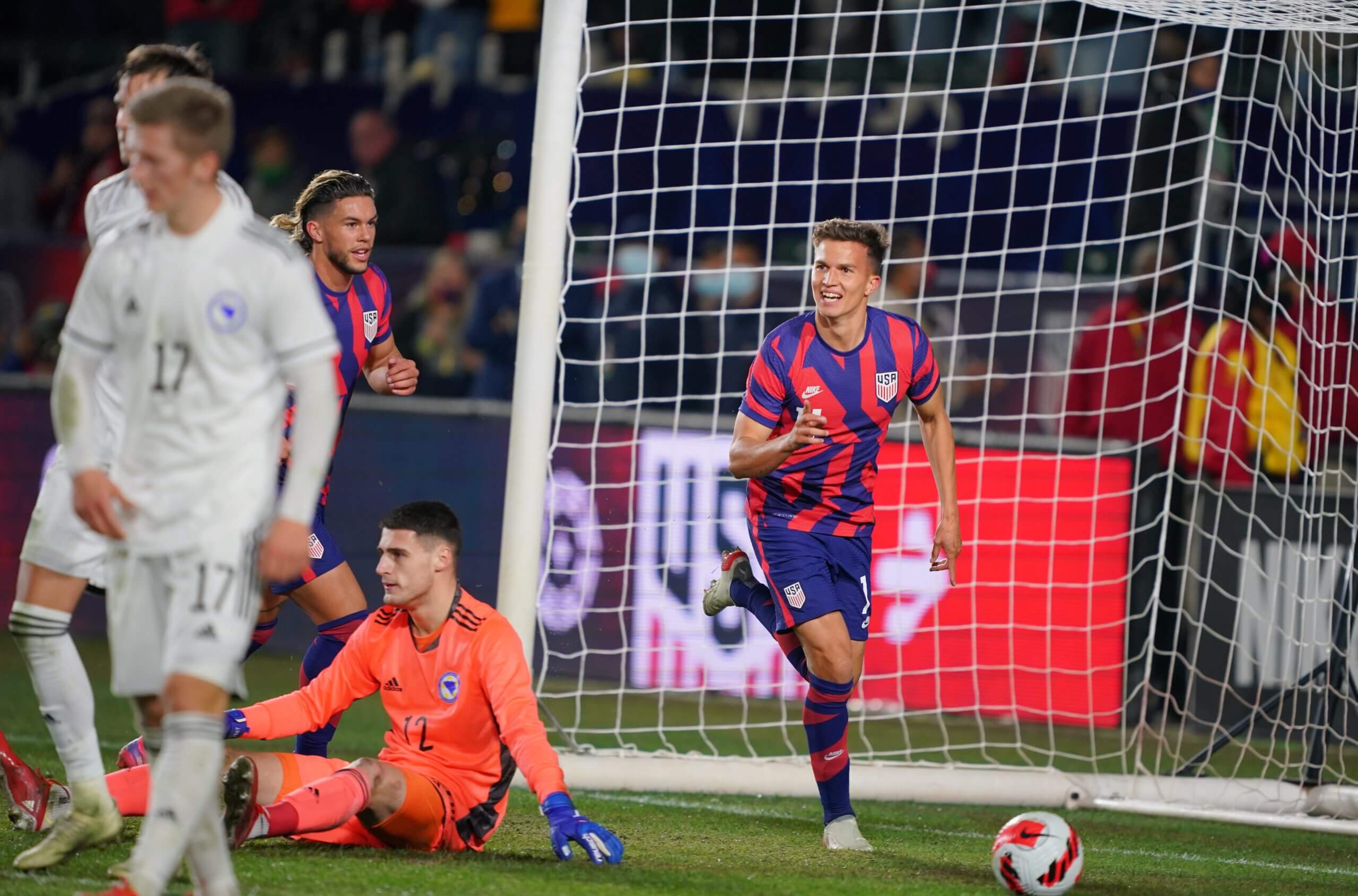
Cole Bassett celebrates his late winner in a USMNT win over Bosnia-Herzegovina in December 2021 (John Todd / ISI Photos / Getty Images)
What awaits on Wednesday
The yearslong barren run against Europe, though, has not dented American confidence entering Wednesday.
The eight European A-teams that dealt the U.S. defeats, starting with the Netherlands in 2022, ranked 3rd, 5th, 10th, 13th, 18th, 21st, 23rd and 25th in the world at the time, per Elo ratings. Bosnia ranks 58th.
And coincidentally, the USMNT’s last win against a European team came in December 2021, outside a FIFA window, against Bosnia.
Cole Bassett, a then-20-year-old midfielder for the Colorado Rapids, came off the bench that day for the only USMNT appearance of his career and scored the game’s only goal, in the 89th minute.
“It feels like that was ages ago,” Bassett told The Athletic on Friday. It was, and when told it was the last U.S. victory over a European team, Bassett said: “That’s very surprising. I can’t say I like to hear that!”
But then he echoed the optimism still swirling around this team as the knockout rounds begin.
“Hopefully the boys change it Wednesday.”
Tom Bogert contributed reporting to this story.