
Network’s LA facility serves as the heart of a sprawling operation built to support 104 matches of the biggest global soccer tournament ever
On the eve of the 2026 FIFA World Cup last Wednesday, it was a quintessential L.A. day. Clear. Sunny. A pleasant 72 degrees. FOX Sports’ Pico Lot in Century City was buzzing with a feel typically reserved for a truck compound the day before a major championship. Only everyone was working right in their own backyard.
Engineering areas were checking remote feeds. Techs worked through host blocking positions on an LED volume that may as well be a soundstage for the next Hollywood blockbuster. Match-control rooms readied for overlapping shifts. Graphics, media management, digital, edit, postproduction. It’s all here; preparing to broadcast one of the largest events in the history of television.
Amidst the hum and the din, a familiar question from those just stopping in: “Ready to go?”
Mike Davies, EVP, Field & Technical Management and Operations, FOX Sports, has heard it before. Ahead of Super Bowls, World Series, Belmonts, Indy 500s, other global soccer tournaments, and every other major event that has come through FOX Sports’ ever-expanding live-production machine, readiness is the thing everyone asks about. Davies usually chuckles.
“Big shows, you never actually feel ready, nor should you,” he says. “Readiness is not a state. It’s a record. It’s a record that these people — the hundreds of people working in different silos but all together on this World Cup — have built. We are ready for these things, even if we don’t feel that way.
“A certain degree of fear and respect for the unknown is vital to maintain your edge,” he adds. “There’s not a person here, let alone in this building or out in all the venues, who doesn’t know how important this is for this company, but also for the country.”
That last point sits at the center of FOX Sports’ massive production effort for the 2026 FIFA World Cup. With the tournament on home soil — spread across the U.S., Canada, and Mexico and expanded to 48 teams and 104 matches — FOX has reimagined the role of its Los Angeles broadcast center. Instead of building the bulk of its production operation at a traditional international broadcast hub (or at the IBC that FIFA has erected in North Texas), the network has turned Pico into the creative, technical, and operational nerve center of its World Cup presentation.
“We are very much the center of attention, and this building is the center of where it all comes together for this country,” says Davies “It’s pretty cool to see not only what we’ve done bespoke for this tournament, but the legacy that’s going to exist here at FOX afterwards.”
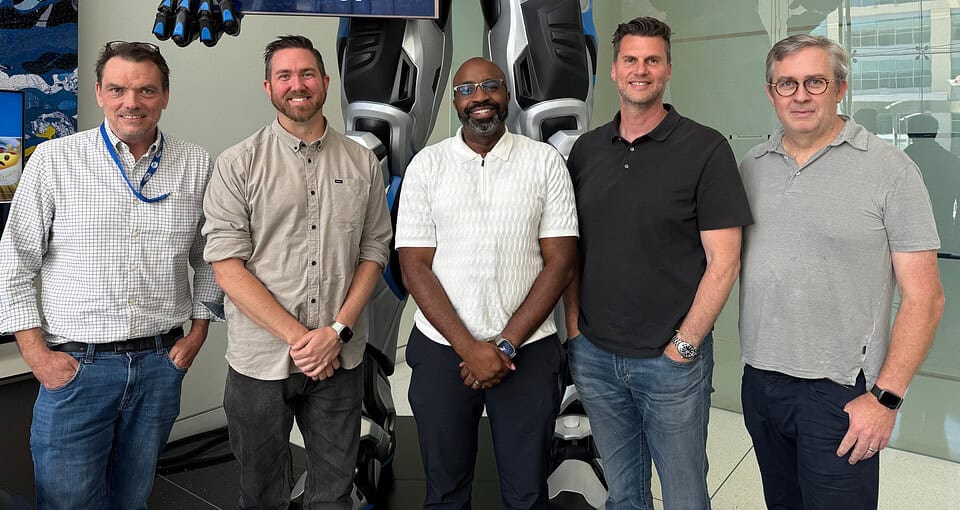
Building the World Cup at Home
FOX’s World Cup operation is, of course, not confined to Pico. The network maintains a critical presence at the FIFA International Broadcast Centre in Dallas, where signals from Host Broadcast Services, FOX unilateral cameras, BRISK systems out at the venues (more on that in a moment), comms, audio, shading, and transmission workflows are managed and moved onward. FOX also leans on its Tempe, AZ, facility for transmission and distribution and has additional resiliency plans in place across its broader plant.
But, for this tournament, Pico is where the show truly comes together.
That changes the feel of the event for those who have worked previous World Cups. In Russia, Qatar, Australia, and other international tournaments, FOX’s operations team would largely decamp to the host country or IBC environment and build a temporary operation dedicated to that event. In 2026, the show is being built inside a facility that never stops.
“For me, this is very different being here,” says Kevin Callahan, VP, Field Operations & Engineering, FOX Sports. “When you are building out an IBC, you’re building out a bespoke facility that you can build up to be exactly what you need for that event. Here, we’re going into a facility that has been on the air 24 hours a day, seven days a week since who knows when, really, since the ’90s.”
That distinction has shaped decisions at Pico for years. According to Callahan, many of the capital and technology investments made around the building since roughly 2022 and 2023 have been made with the World Cup in mind. The tournament has served as both a deadline and a catalyst: a reason to push the facility forward while ensuring that the investment would continue to serve FOX Sports after the final whistle.
“The World Cup would have that kind of legacy,” says Davies. “A lot of the stuff that we bought would live on and do other things afterwards.”
That list of projects is long: transmission, HDR, ST 2110 infrastructure, storage, edit bays, media workflows, the BRISK system and its integration into the building, digital-production spaces, monitor walls, studio stages, graphics, AR, and the less-glamorous but essential logistics of putting hundreds of people into an already active broadcast center.
For Daryl Moore, VP, Systems Engineering for FOX Sports and a third-generation FOX employee, the work began by breaking the build into distinct workstreams.
“There was an engineering workstream, there was a catering workstream, there was the BRISK system build, there were edit bays, there was storage, HDR transition, infrastructure,” he says. “We had to break those all into workstreams. At first, there were a lot of them. Then it was: ‘let’s pare this down, make it make sense, and make sure that we’re all on the same page.’”
The effort required both long-range planning and procurement discipline. Networking gear, switches, computers, and compute resources all had to be ordered early, particularly amid long lead times and broader demand for compute infrastructure.
“You have to get that stuff up front,” Moore says. “Those are the things that you want to get up front because of the AI boom; it’s really tough. So we tried to get in front of that as much as possible.”
BRISK and the Distributed World Cup
One of the key technologies enabling FOX’s Pico-centric model is BRISK, short for Broadcast Remote IP Studio Kit.
Developed with the World Cup in mind and tested in a high-profile environment at the Super Bowl, BRISK is FOX’s tactical remote-studio layer: a set of ST 2110-based flypacks that can be deployed to remote locations and integrated into the company’s permanent production facilities. Using low-latency JPEG XS encoding, the systems allow cameras and sources from remote sets or fan environments to be treated by a Pico-based production team as if they were part of the local show.
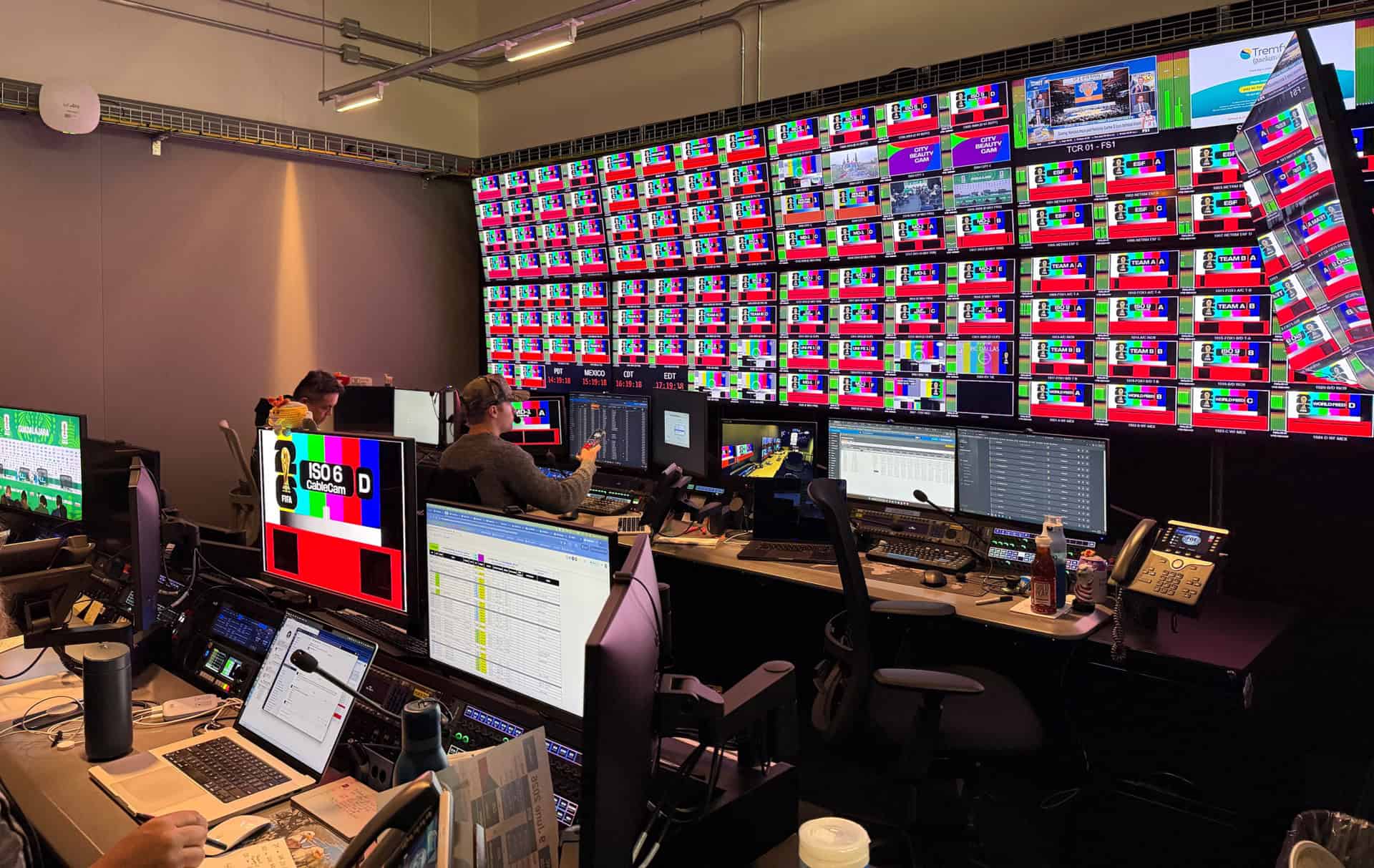
Davies describes BRISK as part of a broader distributed-production evolution that began before the World Cup and accelerated during the pandemic. The concept is not to make the remote location a self-contained production island, but to extend FOX’s main production environment outward.
For the World Cup, that matters editorially as much as technically. HBS produces the world feed of the matches. FOX’s job is to present the event for its U.S. audience, which means getting out into the stadiums, fan zones, host cities, team environments, and cultural moments that surround the tournament.
“What we’re responsible for is presenting it for the United States,” Davies said during a presentation on BRISK at SVG’s Silicon Valley Video Summit earlier this year. “Our team believes strongly in being out there with the people. We don’t want to just have a nice wide shot of a skyline. We want to be right there.”
The BRISK systems, combined with the Dallas IBC, Pico control rooms, and Tempe transmission workflows, help make that possible. They also embody one of the defining principles of FOX’s World Cup build: the show must be flexible enough to accommodate ideas that emerge late, live, or under pressure.
“We don’t engineer to a finish point,” Davies says. “We’re engineering towards a show that hasn’t fully been imagined yet because the best ideas oftentimes come late, the best ideas come live, and the best ideas are audibles.”
That means building headroom into the operation: not because every use case is known in advance, but because everyone involved knows that the tournament will evolve.
“Nobody can say that 104 games after this that this is going to turn out like everybody thought,” Davies says. “It’s not. So, because of that, we need to engineer flexibility.”
For Rob Rees, VP, Live Production & Post Production Engineering, FOX Sports, the building’s World Cup transformation has been a stark contrast to previous tournaments.
“In the years past, it was kind of nice: World Cup, alright, I’ll be back at the facility. We’ll watch everything come back and make sure it goes on-air okay,” says Rees. “Now, the building is in full mode for the World Cup.”
To understand the rhythm, Rees compares it to something FOX knows intimately: an NFL Sunday in Los Angeles.
“I know what that feels like,” he says. “We all have that same every-Sunday feel. So, for me, this kind of feels like we’re in that mindset, but every day.”
And larger. The 2026 World Cup presents a radically different match volume than prior editions. The move from 32 to 48 teams expanded the tournament to 104 matches. The early portion is particularly relentless. The competition runs 27 packed match days before the first non-competition day, by which point 96 matches will already have been completed. Four-match days are the norm early in the tournament, with simultaneous windows later in group play.
In other words, it is not simply a marathon.
“This is like a marathon where you sprint the whole time,” Davies says.
That leaves little margin for early instability.
“We’ve got to get on the air clean,” says Rees. “We’ve got to get through this weekend clean because that really sets the precedent. We’re going to be going through this entire tournament in a sprint. If things get rocky and shaky, then people start to feel nervous throughout.”
Inside Pico’s World Cup Footprint
Inside Pico, FOX has four match-control rooms designed to handle overlap across the World Cup schedule and pass programming cleanly through the facility. Each is paired with an audio-control room. Elsewhere, flexible production positions that might, during the fall, support EVS, graphics, or other regular production needs for College Football Saturdays and NFL Sundays have been reassigned to World Cup-specific workflows.
One key technical area, nicknamed “Club 2110,” serves as the check-in point for BRISK and other remote-feed sources before they are handed off to control rooms. According to Moore, the area functions as a nerve center for feeds arriving into the building from BRISK kits, with engineers monitoring sync, comms, HDR, color, and overall technical quality before those sources move downstream.
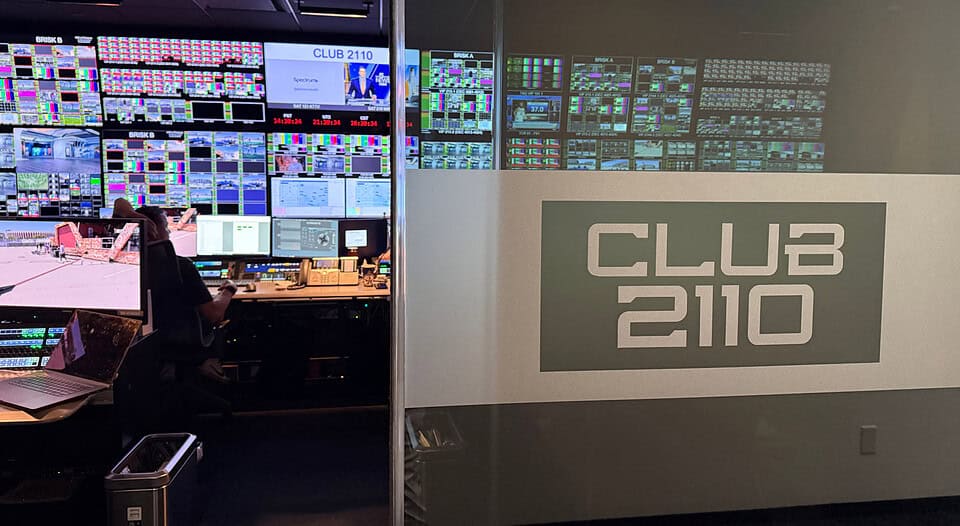
“This is essentially the nerve center of every feed that’s coming in from BRISK,” Moore says. “All of our comms is handled through here. All the engineers are checking in, checking out the sync for everything coming in, making sure before we hand it off to the control room that it’s ready to go for air.”
The philosophy is simple: nothing gets handed off until it is ready.
“This is really where all of our check-ins for HDR are happening, making sure that the colors are right,” Moore adds. “Everything starts here. We do not hand off here unless it’s good.”
That area complements the inbound work being done through the Dallas IBC. Davies describes the split this way: one floor handles inbound feeds from the IBC, while the floor above handles BRISK and other remote-unit sources from venues and other locations.
Those workflows are part of a much larger ecosystem. HBS is producing all 104 match feeds, with FOX receiving access to dozens of feeds per match. FOX layers in its own unilateral cameras, ENG teams, LiveU systems, BRISK remote studio kits, fan-zone and watch-party content, digital productions, studio elements, graphics, AR, highlights, and postproduction.
To the viewer, the goal is seamless presentation. Inside the building, it is a constant exercise in routing, checking, ingesting, recording, producing, editing, and adapting.
Stage B and the Visible Layer
While much of the Pico operation is invisible to viewers, Stage B is very much a piece of eye candy that World Cup viewers in the States will become quite familiar with over the next month.
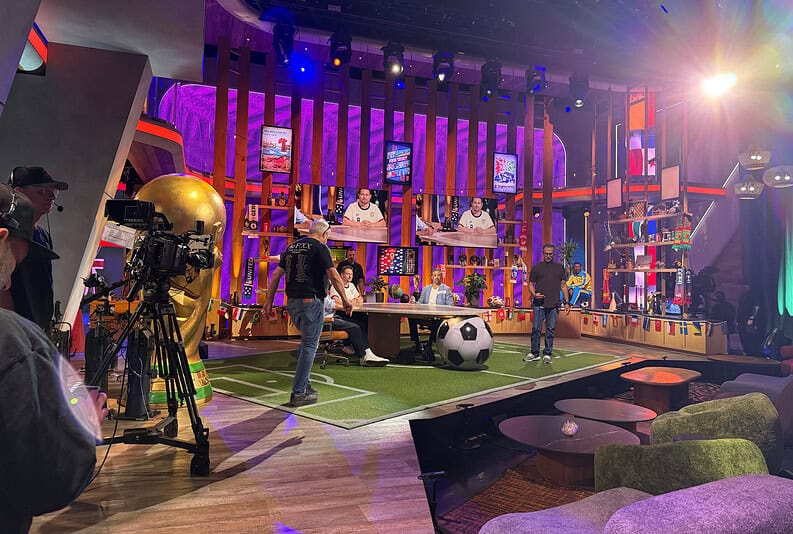
FOX Sports’ Stage B studio is serving as the centerpiece of the network’s World Cup presentation. Launched in September 2025, the studio features a massive live multi-camera LED volume powered by 32 render engines and built to deliver real-time, multi-perspective virtual environments. The LED volume includes left and right walls, a back wall, and a full LED floor, with more than 48 million LED elements across the installation. The setup supports 10 in-studio cameras, including pedestals, a Steadicam, and a 24-ft. Techno Jib with stYpe tracking.
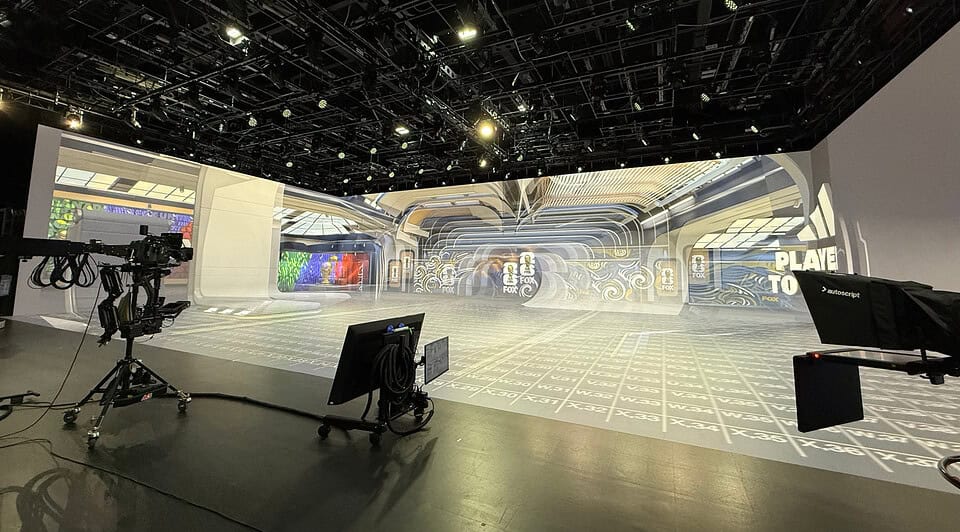
For Davies, the studio and AR layer are the visible face of a much larger technical undertaking.
“That’s going to be the fundamental rubber stamp [for our viewers],” he says.
At past World Cups that studio has been at a location in the host country that is quickly erected by FOX’s remote studios team. Now, working out of their own building, one of the biggest advantages is all of the extra rehearsal time. Zac Fields, SVP, Graphic Technology and Integration, FOX Sports notes the team might be lucky to get a couple of full rehearsal days once a temporary broadcast center was built. On the Pico Lot, Stage B was available earlier, allowing for graphics rehearsals, director rehearsals, HDR testing, updates, and workflow refinement inside FOX’s own building.
“This has been obviously super helpful for us,” Fields says, “to just get days of rehearsals where it’s just graphics, days of rehearsals for director, etc.”
The same at-home advantage applies to media management and postproduction, but the scale is staggering. For David Sobel, VP, Media Management, FOX Sports, previous World Cups were often defined by the challenge of standing up temporary workflows at an IBC and moving massive quantities of FIFA and match media into systems that could support production and post. In 2026, some of that stress is reduced by having Pico as the production home. But the volume is far greater.
“The scale is just so much more and it’s so consistent,” Sobel says. “You’re always ready, but something always changes.”
FOX’s media-management operation must deal with match feeds, BRISK feeds, HBS files, ENG material, field contributions, fan-zone content, digital needs, watch parties, and postproduction requests. The company stress-tested the system and, in the process, replaced a six-petabyte storage environment with a faster all-flash Dell PowerScale system to support the expected load.
The numbers tell the story: more than 300 records per day, an estimated 150 TB per day on upload alone, and stress tests that reached 220 concurrent records.
The key challenge is not simply whether FOX can access everything. It is deciding what must be recorded, what must be available immediately to live teams, what postproduction needs, and what can be purged quickly enough to keep the system healthy.
“There’s no halftime adjustments,” Sobel says. “You’ve got to be able to make those adjustments on the fly.”