
In four short weeks, Lionel Messi and Kylian Mbappe have rewritten the course of World Cup history.
Both have defied what we thought was possible on football’s biggest, most illustrious stage. They have torn through the 2026 edition of the competition, sweeping aside nations with their brilliance alone, all while shattering records that had stood for decades before.
For Messi, we can only marvel at his longevity, still able to swing games his way at the age of 39.
Mbappe, meanwhile, has staked his claim as the World Cup’s greatest goalscorer at lightning speed, with only the great Argentinian himself left for the 27-year-old Frenchman to surpass.
Should both win their respective semi-final ties this week, their inevitable courses will collide in a second consecutive World Cup final; a shootout for the Golden Boot, the all-time scoring record and football’s most prestigious prize.
And if that last meeting was anything to go by — even with eight goals each already this summer — Messi and Mbappe still have plenty to give as the World Cup reaches the business end.
When Messi — one of the game’s greatest players of all time — finally got his hands on the World Cup trophy in December 2022, it felt a fitting way for a glittering international career to end. On the losing side that day, a 23-year-old Mbappe had just scored a hat-trick. It was the perfect, metaphorical passing of the torch.
But four years on, Messi has only doubled down on his legendary reputation at an age when many have already hung up their boots, racing past Miroslav Klose’s tally of 16 World Cup finals goals with a ferocity that few expected.
(Kirill Kudryavtsev/Getty Images)
On the day this tournament started, Messi was 38 years and 352 days old, and only two players older had ever scored a World Cup goal (Cameroon’s Roger Milla at 42 years and 39 days in 1994, and Portugal’s Pepe at 39 years and 283 days in 2022 — Cristiano Ronaldo has since also scored at 41 years and 147 days). But Messi rattled in five in his opening three games, also scoring against Jordan, Cape Verde and Egypt thereafter, to become the first player to surpass 20 goals in tournament history.
Remarkably, only six days later, Mbappe became the second.
Like Messi, the Real Madrid forward has scored or assisted a goal in every game so far, and is now just one goal behind him in the historic standings despite almost 1,200 fewer minutes on the pitch.
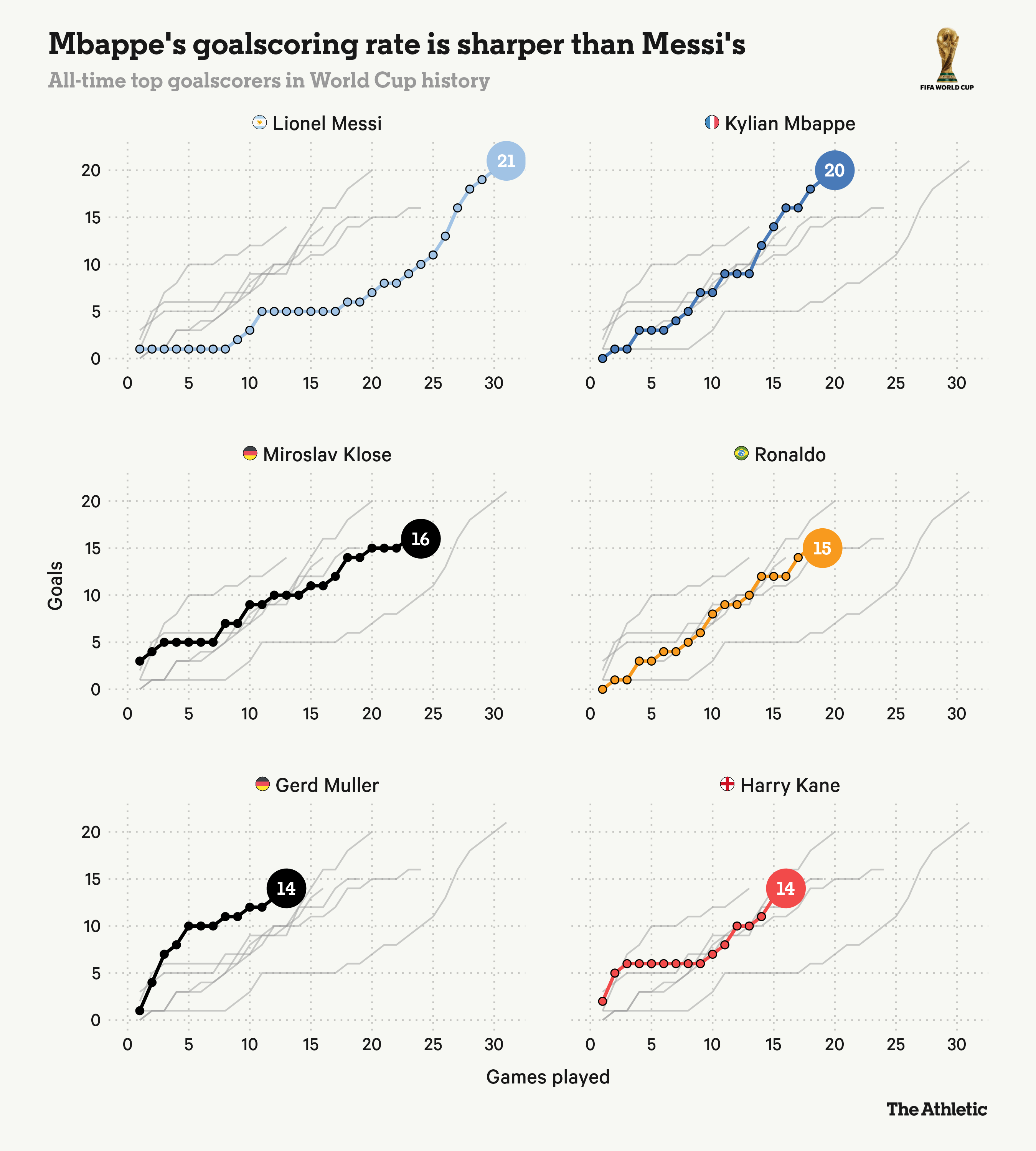
As we can see from the plot below, it took Messi much longer to hit goalscoring form at the World Cup, while Mbappe flew straight out of the blocks and has continued that form over the course of eight years at the top of his game.
Of course, not all goals are equal.
Some add gloss to convincing victories over World Cup minnows, others are last-minute winners that help a team progress through to the next round. The best players step up in the crucial moments, and there is little to choose between Messi and Mbappe when breaking down the importance of their goals.
Looking at the number of ‘Game state-changing’ goals — ie, scoring an equaliser when their team is losing, or putting them into the lead when drawing — shows that 14 of Messi’s 21 in World Cups have changed the course of the contest, a rate of 66 per cent. By contrast, 11 of Mbappe’s 20 have moved the dial in the state of the match, a slightly lower rate of 55 per cent.
Still, you cannot suggest that France’s captain does not know how to rise to the occasion, not when he became the first player to score a hat-trick in a World Cup final since England’s Sir Geoff Hurst in 1966 in that loss to Messi and company four years ago.
Another way of looking at it; Mbappe has scored 12 of his 20 goals in the knockout phase, already the most in World Cup history. Messi’s tally of seven leaves him behind Mbappe as well as Brazil’s Ronaldo and countryman Leonidas, who played in the 1934 and 1938 editions.
Both players clearly have it in them to be decisive when the pressure is on.
It is interesting that despite being at vastly different stages of their career, both seem to have moved in-field slightly from the flanks to hit their most frightening form.
Messi first broke onto the scene as a fleet-footed, slick-haired winger who would look to dance inside with tip-tapping feet from the left. His move to a false-nine position at Barcelona under Pep Guardiola saw him take up a more central role for the national team in the following World Cups, while his twilight years have seen him hone his energy towards the left-half space, where he can do most damage.
Mbappe has also started to gravitate inwards, but for different reasons. With the emergence of Michael Olise as a peerless creative link for this France side, and the two-footed technical ability of Ousmane Dembele on the opposite flank, it has allowed manager Didier Deschamps to be flexible with his forward options.
He encourages positional fluidity and rotations, allowing Mbappe to attack the penalty area with searing pace when the space opens up.
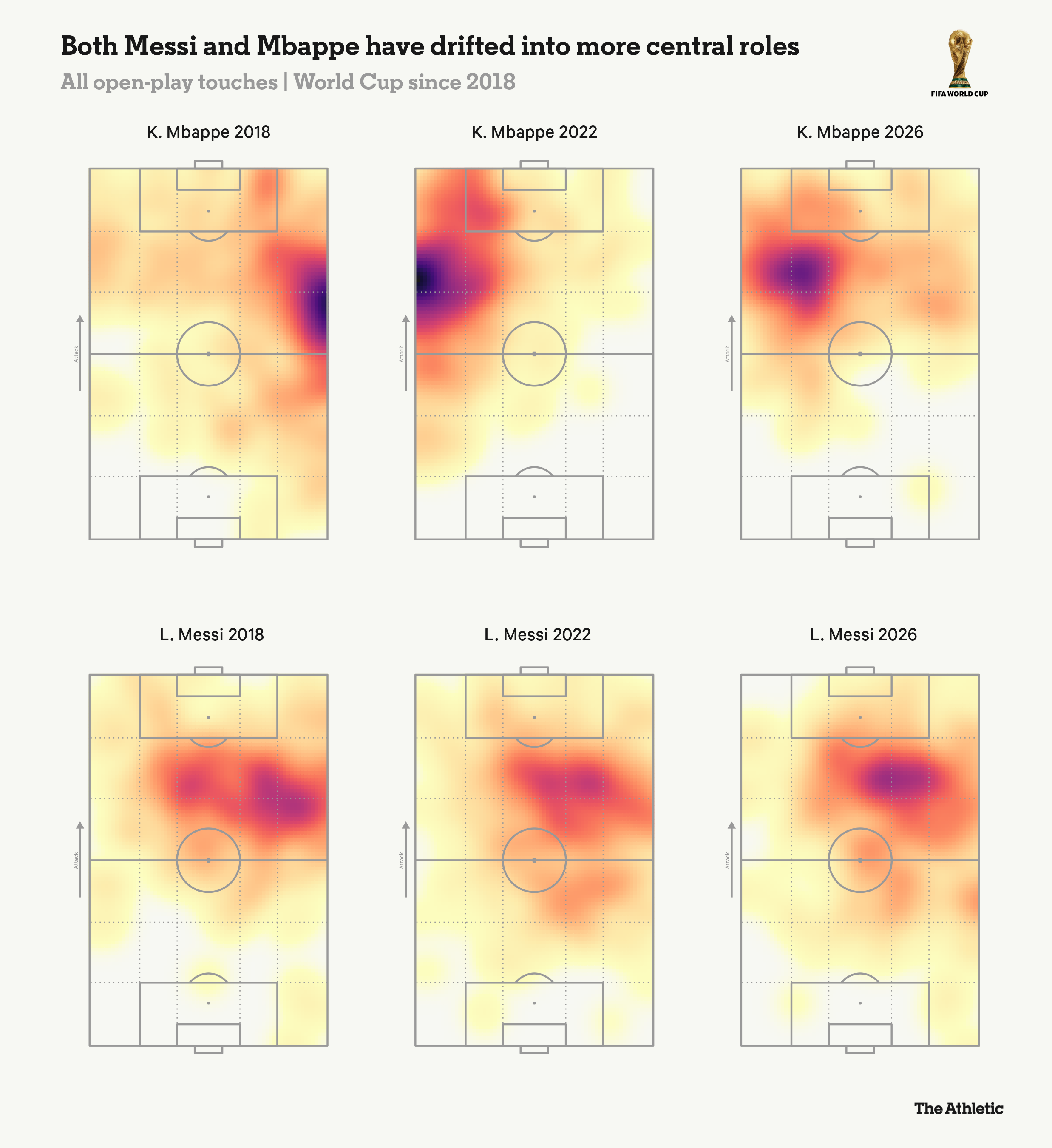
Ironically, Messi’s propensity to prowl in that half-space is a well-trodden point of discussion.
No player at this World Cup has spent a higher share of time walking than his 63 per cent, but it would be foolish to think that less running equates to less impact from an attacking perspective.
Messi might be approaching the end of his career, but 49 per cent of Mbappe’s time on the field has been spent walking too. Among forwards with 100-plus minutes played this summer, that is the fourth-highest rate in the tournament, which suggests that it is not merely age that is influencing such carefully managed physical output.
Both players are intelligent enough to know when to burst into life, and there is a qualitative difference in how they go about it. While Mbappe edges Messi in the volume of sprints per 90 minutes (29.2 to 23.1), his distance per sprint is also notably longer.
It passes the eye test when you imagine both players in the final third.
Where Messi’s averages 2.2 metres per sprint to dart between a mob of opposition defenders, Mbappe will stretch his legs within an average of 8.0 metres per sprint when pulling away to find a yard of space.
Think of it as “same; same but different” when assessing the physical output of both players. They might have different capacities at different stages of their career, but you can be certain that every step is purposeful and carefully managed to ensure they are inflicting maximum damage on their opponents.
Such presence for both in central areas predictably leads to a high volume of shots and key passes, as superstar figures shoulder a huge amount of their team’s attacking responsibility.
Mbappe has scored 43.5 per cent of France’s World Cup goals since his debut, the highest share of any player across that time.
Messi, meanwhile, is the focal point for most of Argentina’s forward play; to employ a basketball term, his “usage rate” is the highest of any player at this year’s competition, finishing almost one-quarter of his team’s possession sequences with an effort on goal or an attempted defence-splitting pass.
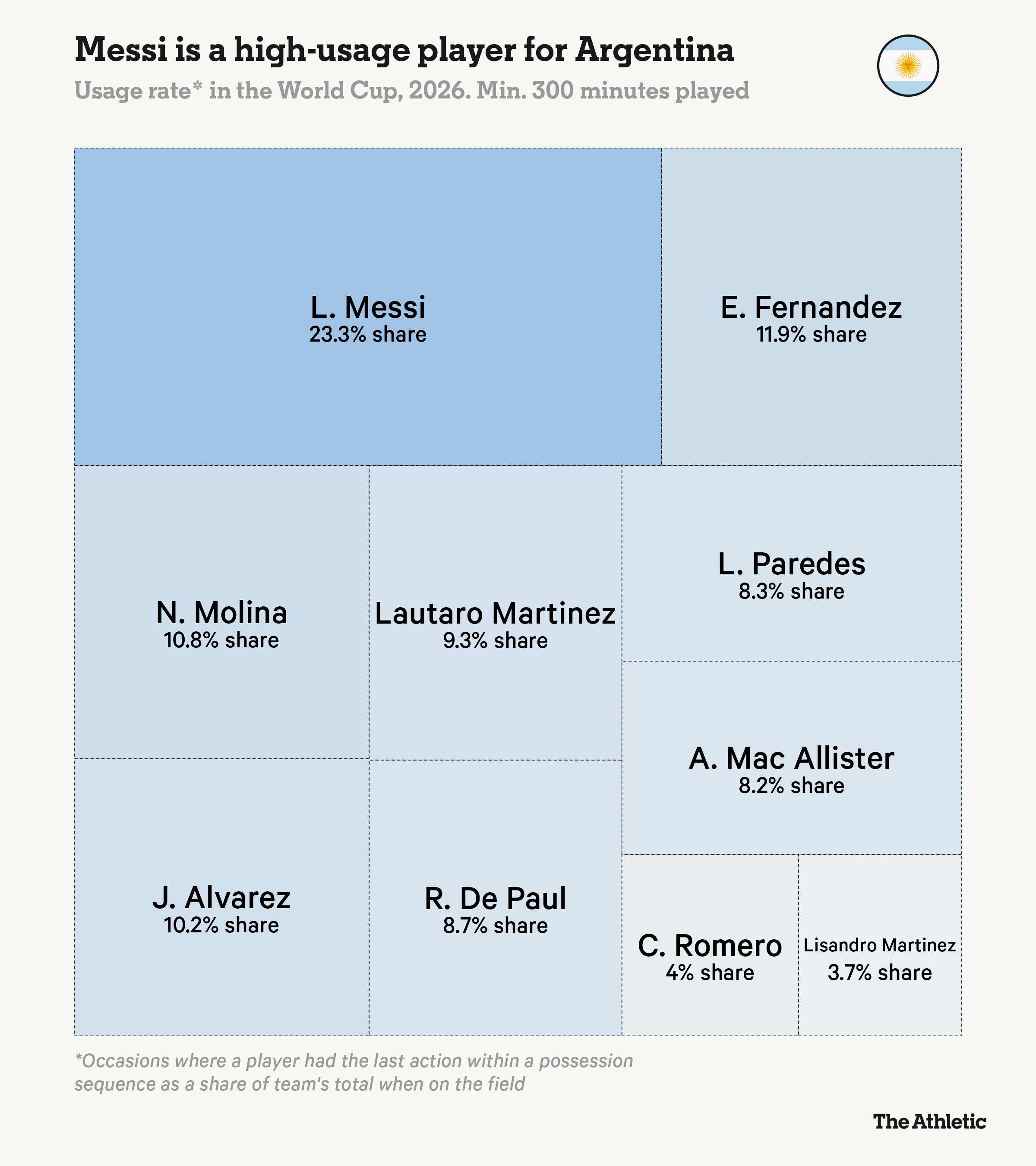
Mbappe has more of a supporting cast when it comes to team-mates trying things in the final third, but it is the 27-year-old’s clinical edge that helps him to post such devastating numbers nonetheless.
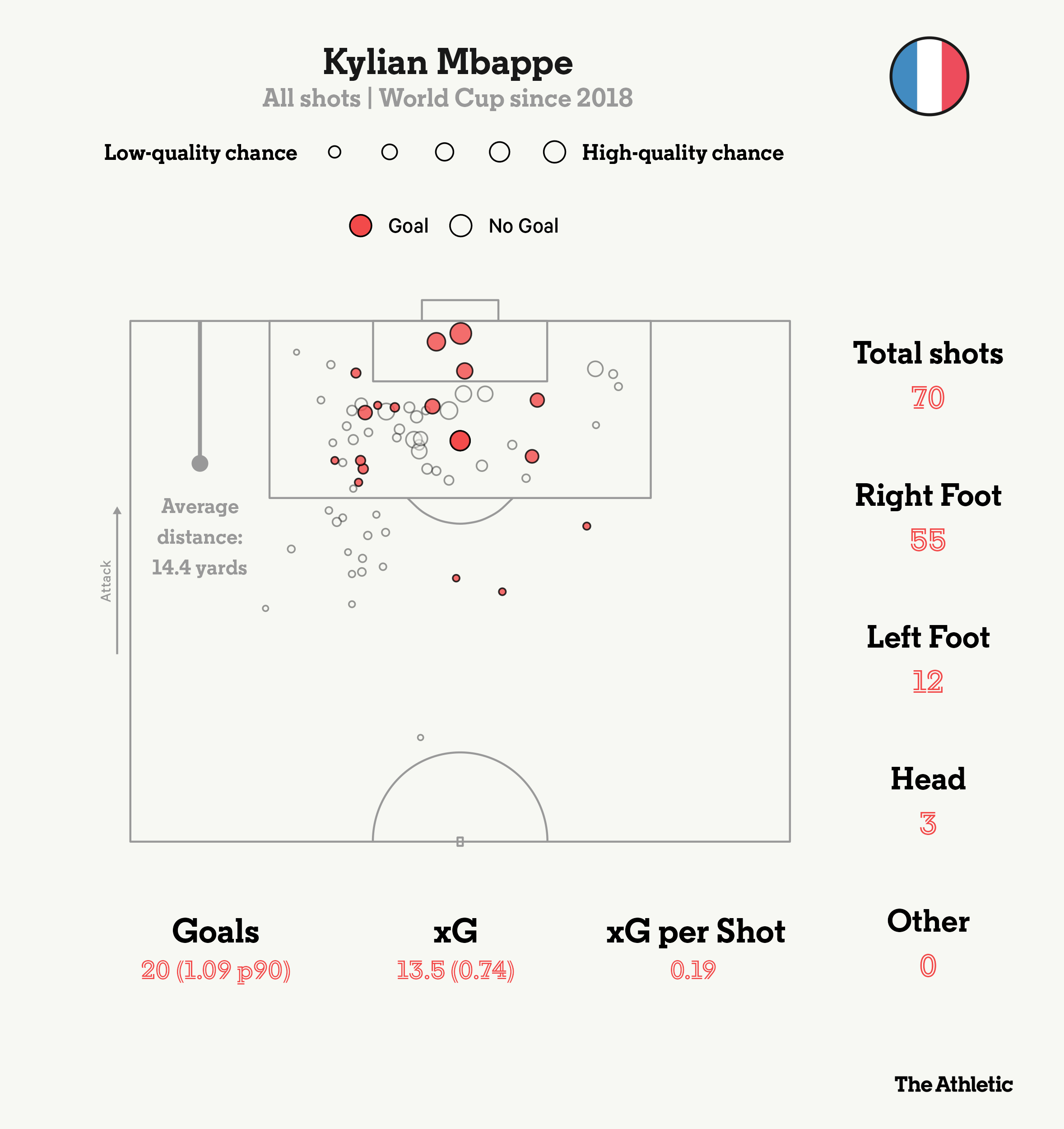
The graphic below illustrates all of his World Cup shots.
As we can see, the cumulative expected goals (xG) value of his attempts suggests that the average player would expect to score between 13 and 14 goals from the same opportunities. With his ability to strike the ball viciously from distance, and to chop inside and find the corners consistently from an angle, Mbappe has comfortably outperformed the model.
Alongside his form for Paris Saint-Germain and Madrid over the years, that points to a ruthless finisher who can reliably turn half-chances into goals.
The narrative is tantalising as two era-defining players edge towards another cosmic tussle for a second World Cup crown on Sunday, but both will need to overcome stern opposition in the final four over the next two nights, as Mbappe faces Spain and Messi takes on England.
Nothing would demonstrate their game-bending powers more than if they were able to drag their countries to the final again.