
Some spoilers below.
Like Annie January (superhero alias: Starlight) on The Boys, Erin Moriarty has had to learn how to reclaim her own narrative. Throughout the five seasons of the popular Prime Video superhero series, Moriarty has already observed “a lot of parallels” between herself and her character, the actress tells ELLE. But the penultimate episode of the series—season 5, episode 7, titled “The Frenchman, the Female, and the Man Called Mother’s Milk”—proved a particularly pivotal moment for them both.
Episode 7 was filmed almost exactly a year ago, Moriarty shares, and it was the first shoot to take place in the wake of her diagnosis with Graves’ disease, an autoimmune condition causing hyperthyroidism, the symptoms of which can include fatigue, weight loss, heart palpitations, increased anxiety, and more. “Episode 7 is the first episode that I started to film while I started treatment,” Moriarty says. “Episode 8 is the only episode that I shot when I was a few weeks into treatment, and I was really feeling like myself again.” She continues, “Everything changed for me. I felt like myself again. I enjoyed acting again because I was no longer uncomfortable, literally, in my skin.”
The actress, 31, has portrayed Annie January/Starlight since 2019, when the character began season 1—and her subsequent journey as a superhero—with a genuine sense of idealism. Joining the Seven, The Boys’ satirized version of the Justice League, changed her perspective entirely.
In the world of The Boys, superheroes (referred to as “supes”) are…well, mostly jerks. (Annie, as Starlight, is a rare outlier.) These supes have been created by Vought International, a corrupt organization bent on control through their supe-making serum, Compound V. At the head of the Seven is Homelander (Antony Starr), a narcissistic version of Captain America with whom Annie comes into conflict when she rebels against Vought International’s so-called company values.
Becoming more disillusioned with the world of supes the more she’s ensconced in their business, Annie eventually abandons her role as Starlight in the Seven in season 3, episode 6. This breakaway is the first time she reclaims her agency, striking out to help her boyfriend Hughie (Jack Quaid) and his gang of rebels (led by Karl Urban’s character, Billy Butcher) fight back against Vought and Homelander’s increasing lust for power. A resistance movement is born, and the anti-Homelander supporters dub themselves “Starlighters.”
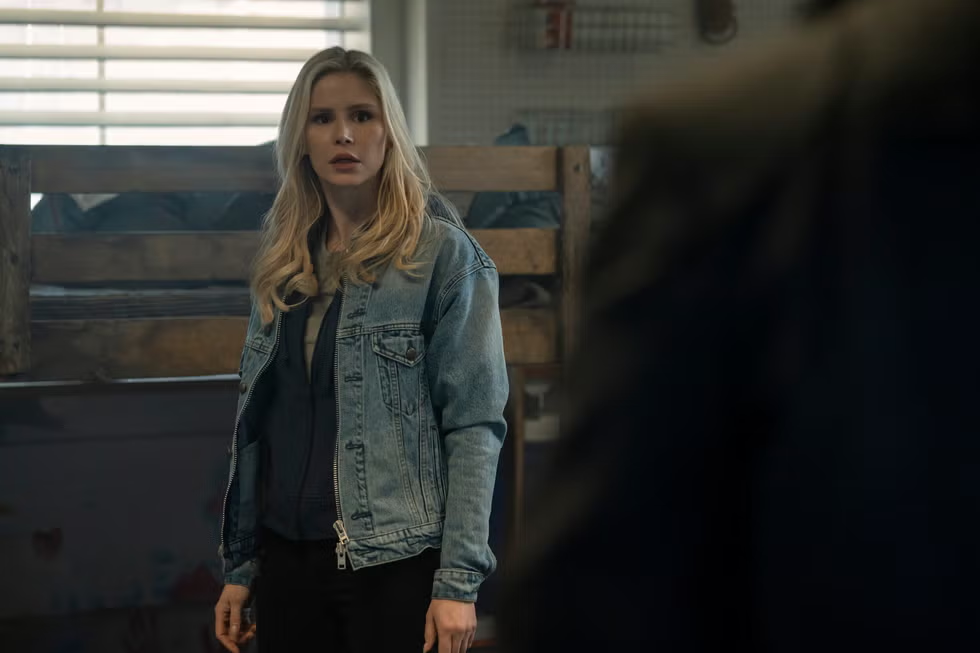
At the peak of this Starlighter movement in season 5, Annie nearly loses her will to fight when she learns that Homelander has received a vital dose of V1, a compound that grants the user immortality, from his father, Soldier Boy (Jensen Ackles). For Annie and her fellow rebels, this is a crushing blow, as they’ve already spent the bulk of the season attempting to craft a supe-killing virus. By this point, Annie is nearly “devoid of hope,” Moriarty explains. “[Episode 7] is where she finds herself again after really struggling all season.”
One key moment in the episode takes place when Marie Moreau (Jaz Sinclair), a character from The Boys spinoff series Gen V, throws a familiar line back in Annie’s face. Way back in season 1, when Annie first auditioned for a spot among the Seven, she said something poignant in her audition tape: “Since when did hopeful and naive become the same thing?”
In season 5, when Annie orders Marie and Jordan Li (London Thor)—another character from Gen V—to stand down and save themselves after a year of recon, Marie retorts, “Was that just some line you said to get that gig?” It’s a sobering moment for Annie, who until this point had served as something of a mentor figure to Marie, having herself encouraged Marie to join the anti-Vought, anti-Homelander fight.
This interaction is “a really interesting moment for [Annie],” Moriarty says. “Many of us, when we have moments like that when we are very abruptly reminded of who we once were in contrast to who we are now, we [realize] we want to be that previous version of ourselves once again. [Marie’s comment] galvanizes her, I think, into finding her hope again.”
While filming season 5, Moriarty experienced a version of this realization in her own life. The actress, too, had begun to feel hopeless as she dealt with debilitating fatigue, nausea, weight loss, brain fog, and numbness in her feet, among other symptoms. (As Moriarty shared in a previous Instagram Story, “Not long after filming [season 5, episode 4], I started losing the ability to walk.”) She had already been dealing with a slew of negative commentary online about her appearance, well before her eventual diagnosis with Graves’ disease. In 2024, Moriarty declared in a now-deleted Instagram post that she was taking a break from Instagram after political commentator Megyn Kelly speculated, on her podcast, that the actress had undergone plastic surgery. (Moriarty called out the segment in the same Instagram post.) Moriarty would return to the platform about a month later, thanking fans for their continuous support. Behind the scenes, she was still dealing with symptoms.
However, she forged forward with The Boys, convincingherself she was merely experiencing fatigue. She remained dedicated to Annie’s character arc, and as the series prepared for its final season, Moriarty says that her “sole request” to The Boys showrunner Eric Kripke was that Annie would have the chance to meet her father. Knowing that Kripke often received requests from his actors for particular character beats, Moriarty chose not to bother him with her own until she knew the request would “hold a certain amount of gravity.” The final season felt like the right time, Moriarty explains.
“The show can’t end without [Starlight] meeting [her] father,” Moriarty argued. Kripke agreed.

“Our parents play such important, integral roles in our lives,” Moriarty says. “So it makes so much sense to me that, in this final season, when she lacks hope and she’s looking for a source of validation for her nihilism or for validation to keep going…she needs clarity [first].” And while Annie’s father, Rick January (Tim Daly), doesn’t fix her problems, he does provide the first dose of strength she needs from a source outside her core group.
“What he does for her in [season 5, episode 4], the way that he unveils the truth—reminding her how the bravest thing that we can all do is to maintain hope, especially when the circumstances around us are hopeless—is such an integral moment for Annie, and that’s the moment that she starts to find herself again,” Moriarty says.
That hopeful evolution continues into episode 7, in which Annie’s friend and fellow member of The Boys, Mother’s Milk (Laz Alonso), helps spur Annie back into action. As Annie and Mother’s Milk attempt to infiltrate Vought Studios, he recounts a time where he also nearly gave in to despair—until he managed to rescue an injured pigeon and nurse it back to health. As he argues to her, it’s not worth losing the will to fight if there’s one life that can be saved.
Annie takes this lesson to heart. “The cool thing is that Annie and Mother’s Milk have always had this really interesting bond,” Moriarty says. “People talk a lot about how Hughie and Annie are the moral compasses of the show. But I think Mother’s Milk deserves an honorable mention because he’s always trying to do the right thing. There is this unspoken bond between Mother’s Milk and Annie that Laz Alonso, the actor playing him, and I often talk about.” She continues, “He has this ability to see in [Annie] what she needs in a way that not many characters do.”
Prior to filming this pivotal penultimate episode of The Boys, the actress was still struggling with her health issues. But another moment of life imitating art intervened to help her: As Mother’s Milk aids Starlight, so did one of Moriarty’s castmates aid Moriarty herself.
“There is a C.S. Lewis quote that I really love that goes along the lines of: ‘A friend is someone who sings your song when you forget it,’” Moriarty says. While filming the earlier episodes of season 5, she recounts, “Jack Quaid saw me, and he knew I wasn’t [figuratively] there anymore. He knew it, and he spoke up because that’s who he is, and he knew that there was something wrong. And he said, ‘I’m worried about you. You need to go see a doctor.’”
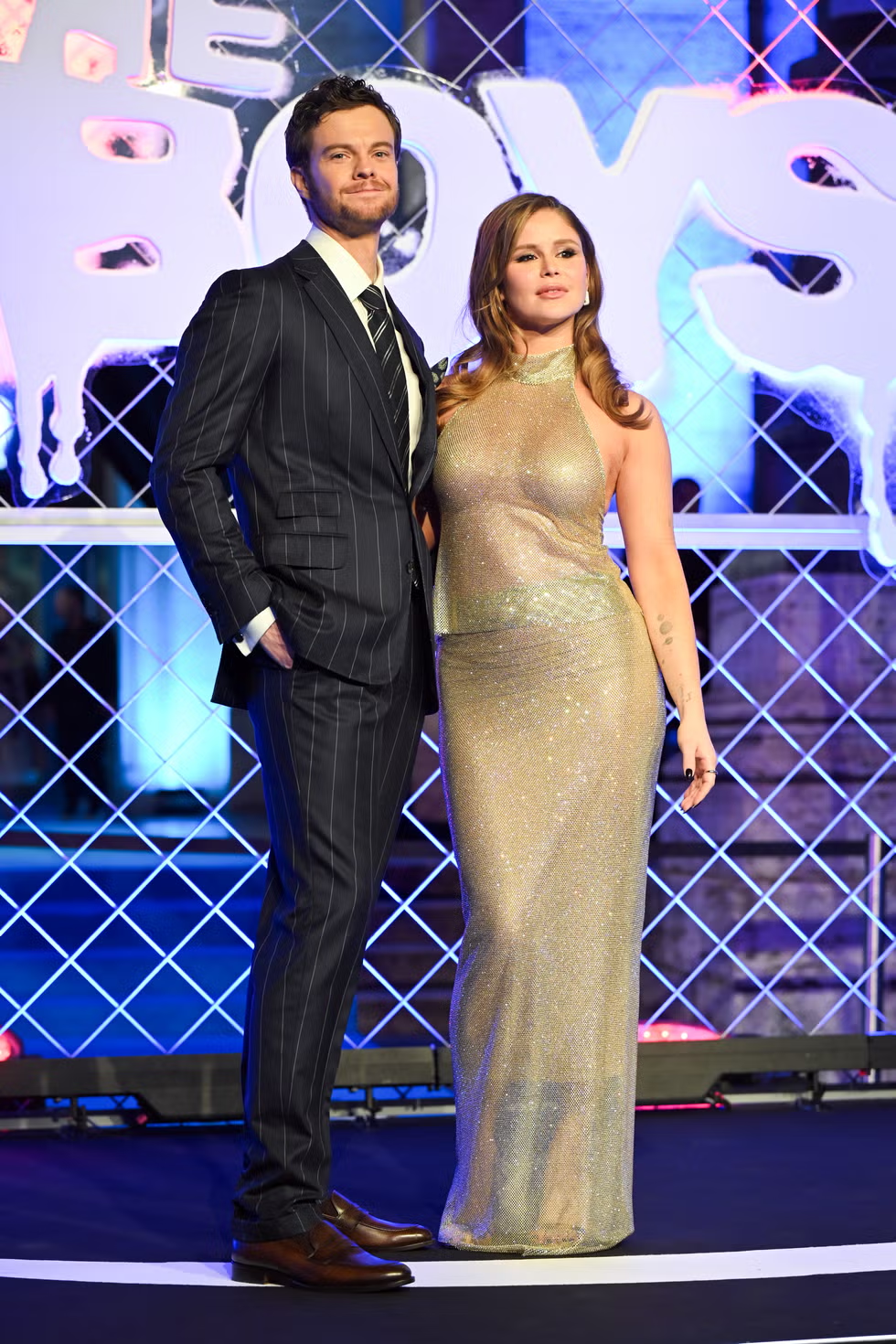
Quaid and Moriarty at the season 5 premiere of The Boys.
Moriarty says that she might not have sought professional help had Quaid not voiced his concerns for her welfare. And as it turns out, she had a chronic condition: Moriarty was diagnosed with Graves’ disease in May 2025, prior to filming the penultimate episode.
Even now, Moriarty struggles to speak up about her diagnosis, for fear of seeming too self-centered. However, as I relay to her, her bravery and openness has helped me feel less alone. As someone who was recently diagnosed with the autoimmune disorder Hashimoto’s disease, which causes hypothyroidism (basically, the opposite of Graves’), I completely relate to Moriarty as she notes that conditions like ours “impact your cognitive ability to form linear thoughts, to be present and to be capable of making decisions.” She summarizes, “It’s like a system-wide failure.”
She keenly acknowledges the fans and friends who wondered what was going on with her behind the scenes, and who questioned why she didn’t go to a doctor sooner. “I just thought I was exhausted,” she says. “And I showed up to set [last year], and Jack just said to me, ‘Something is going on, and I know you, and something’s wrong. I am really worried about you.’”
She continues, “Had he not said that, I wouldn’t have demanded to see a doctor the next day, and I wouldn’t have gone on the journey that I did to get the proper diagnosis because he knew my ‘song,’ and he remembered it when I forgot it.”
After her diagnosis, Moriarty has ultimately found strength in sharing her story. As we discuss the online criticism Moriarty received as her appearance changed, I’m reminded of a moment in the penultimate episode of The Boys, in which Annie watches a Vought production featuring a caricature version of Starlight. She wonders, what’s the point of fighting for the truth if half the country will still believe that fictionalized version of her is real?
But, like Annie, Moriarty ultimately discovered that the truth matters, if only in the context of her own life—and she found fortitude in protecting that life from outside voices. “As I grew up, my dad always taught me to try and embody the concept that the most self-defeating thing we can do is let others define us,” Moriarty says. “People can criticize me as much as they want. But they’re not with me day in and day out. I have been subject to a lot of scrutinization. That’s okay, because I’ve come out the other side conditioned into protecting myself in a bubble.”

Alonso, Urban, and Moriarty in season 5 of The Boys.
The similarities between herself and Annie are as obvious to Moriarty as they are to her fans. Both went from relative anonymity to worldwide fame very quickly. “When you get cast on a show like The Boys, that becomes the primary thing that puts you on the map,” Moriarty says. “It’s not a natural thing to experience. Navigating it perfectly is impossible.”
She continues, “When it comes to anyone that’s in the public eye, there is something to be said for going to therapy and taking accountability in your own personal ways on a daily basis. But that has nothing to do with comment sections that people are anonymously writing. There is no benefit I can get from that, when it comes to self-betterment. They have no idea who I am behind closed doors, who I am with my friends, who I am with my family—who I am as a human being. And they will never be able to take that away from me. The most valuable currency I have is who I am.”
Moriarty feels that Starlight goes on her own journey of discovering “the same thing,” she says. “She wants to do everything right, and she has to deal with the lesson that perfection can be the enemy of good. And I had to deal with that, too. Ironically, letting go led to being at peace with myself.”
In one of the final moments in the penultimate episode, Annie finds her own peace in a very unexpected manner: She chooses to protect a room full of Homelander supporters known as “Hometeamers,” the very people who’ve shown her so much hatred, from being ripped apart by two Vought lackeys, Dogknott (Zach McGowan) and Sheline (Emma Elle Paterson). At this juncture, the Hometeamers have finally been pushed to their limit with Homelander worship; they refuse to truly believe that Homelander is the next Jesus after serving as a test audience for a film that suggests the idea. Oh Father (Daveed Diggs), a new season 5 antagonist akin to a corrupt superpowered preacher, is too afraid to stand up to Homelander’s order: Kill all the nonbelievers at the test screening. Oh Father lets Dogknott and Sheline do the dirty work—and Annie finally reclaims her will to fight, saving most of the Hometeamers from certain death.
“When faced with these people, these Hometeamers who have vilified Starlight in every way, crucified her publicly in ways that are unfounded, she makes the decision to save them,” Moriarty says. “That’s such a reflection of who she is at her core.”
This reclamation of who the character “is at her core” has been hard-earned, Moriarty argues: “I think if she had found herself earlier in season 5, it would have felt premature, and it would have felt dismissive of everything that she’s gone through.” In other words, Annie needed time to heal—and to grow—as she approached the conclusion of her story.
As Moriarty approached her own final days on set, the actress felt an overwhelming sense of gratitude toward The Boys cast and crew, the people she now considers a second family.
“I remember looking at my cast and thinking, ‘Oh my God, I haven’t seen you guys in two years,’” she says. “‘I’ve been so sick for two years. I haven’t even been here. I don’t know what version of me has been, but I’ve been buried inside of myself.’ And this disease took over, and I felt it lifting. And I looked around and I was like, ‘Wow, I am seeing these guys again. I’m playing this character again.’”
Moriarty must now let Annie go as The Boys reaches its conclusion. But the actress has found a new sense of purpose in her own story.
“I’ve struggled and debated about whether or not I wanted to publicly say anything [about the diagnosis],” Moriarty says, “because I do get concerned sometimes that talking about our own struggles with these very specific things can verge into the world of feeling, almost, self-centered and taking up too much space.”
She continues, “And then I remember that I am undoing a lot of that conditioning that I received as a young woman—to not take up space. I’ve learned so much from Annie and from Starlight and her advocacy that I kind of soaked that up through osmosis. I am coming out of this experience having dealt with a challenge that affects more women than men, and regardless of the gender, I’ve had it. It felt like this character has inspired me to transcend my own self-consciousness around what people might think, because what matters to me the most is the people out there who, when they read about or hear about or see my struggles, feel less alone. Or, if they’re going through something, they might seek out answers themselves. If my experience does that [for them], then that’s the most important thing.”