
Beijing
Chinese leader Xi Jinping hailed ties with Russia as a force of “calm amid chaos” during a meeting with Vladimir Putin in Beijing on Wednesday, days after Xi hosted President Donald Trump for a landmark US-China summit.
Xi alluded to an increasingly fractious international situation – and took a veiled jab at the US – as he sat down with Putin in the Great Hall of the People for meetings kicking off the Russian leader’s roughly 24-hour state visit in the Chinese capital.
“The international situation is marked by intertwined turbulence and transformation, while unilateral hegemonic currents are running rampant,” Xi said, using Beijing’s typical language to criticize what it sees as American foreign policy overreach.
In the face of this, China and Russia should enhance their “comprehensive strategic coordination,” Xi said, according to Chinese state media.
For Xi, hosting leaders of both the US and Russia – two nations both mired in conflict – in the space of a few days is a boon as he aims to cement China’s reputation as a global powerbroker.
But while both leaders received a red-carpet welcome, Putin’s visit was marked by a more outward display of the friendship between the two leaders and their countries.
Putin and Xi also signed a joint statement – a diplomatic gesture that’s become standard during the Russian leader’s state visits to China but which did not happen during Trump’s – reiterating their close ties and a desire for a “multipolar world.”
The joint criticism of the US dominance included Xi and Putin denouncing Trump’s plan to build a multibillion-dollar Golden Dome missile defense system.
“The parties believe that the US ‘Golden Dome’ project … poses a clear threat to strategic stability. These plans completely negate the key principle of maintaining strategic stability, which requires the inseparable interconnection of strategic offensive and strategic defensive weapons,” the two said in a joint statement, according to the Kremlin.
The Chinese leader directly addressed the US-Israeli war against Iran, saying that its “early end” will help reduce disruption to energy supplies, supply chains and trade.
“A comprehensive cessation of war brooks no delay, restarting hostilities is even less desirable, and persisting with negotiations is particularly important,” Xi said.
Putin – whose military continues to wage war in Ukraine – is making his 25th official visit to China during his quarter-century as Russia’s leader and his first since the outbreak of fresh conflict in the Middle East.
Xi and Putin have significantly tightened their countries’ coordination across trade, diplomacy and security in recent years, driven together by shared frictions with the US and an aim to reshape a world order they see as unfairly dominated by the West.
In opening remarks, Putin said China-Russia relations had reached an “unprecedentedly high level” – and were among the “main stabilizing factors on the international stage.”
He also alluded to the close personal ties between himself and the Chinese leader, who have met more than 40 times, in opening remarks. He used a Chinese idiom that translates to “One day apart feels like three autumns,” used to emphasize the sadness of being separated.
A day of meetings between Putin and Xi focused on further expanding their “no limits” partnership – while also giving the two an opportunity to discuss Trump’s visit and the wars in Ukraine and Iran.
Putin suggested earlier that energy, industry, agriculture, transport, and high-tech would be other topics on the agenda.
“Amid the crisis in the Middle East, Russia continues to maintain its role as a reliable supplier of resources, while China remains a responsible consumer of these resources,” he told Xi.
Putin’s welcome outside the monumental Great Hall on Wednesday morning had all the trappings of the typical state-visit welcome, which Beijing also bestowed on Trump last week.
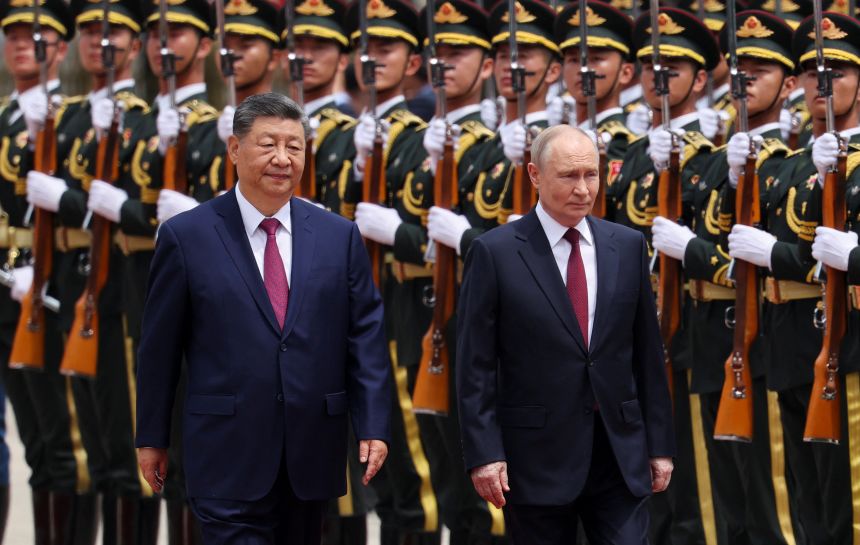
Xi and a line-up of his top officials shook hands with the Russian president, before the relaxed-looking leaders stood shoulder to shoulder during a gun salute, while a military band played and Russian and Chinese flags fluttered in the background.
Children waved flags and flowers as the leaders walked by – a feature of last week’s ceremony that visibly amused Trump.
Those optics appeared geared to underscore China and Russia’s enduring and ever-deepening alignment, even as both governments shift their relationship with the US.
The two sides are celebrating the 25th anniversary of their 2001 “Treaty of Good-Neighborliness and Friendly Cooperation,” which resolved long-standing border frictions and ushered in a new period of cooperation.
They were also expected to hail what they see as a new direction for international relations – one set to serve their strategic goals and in which the US is no longer the global superpower.
But behind the pomp and platitudes, Putin is also facing Xi in a much weaker position than during his last visit to Beijing in September.
Days before his arrival, Ukraine launched what Russian media said was the largest attack on Moscow in more than a year, targeting the capital with more than 500 drones. Russia has also been losing ground to Ukraine, last month suffering what analysts say was the first net loss of territory since August 2024.
Xi may use the increasingly lopsided relationship between the two – with the Russian economy heavily beholden to China – to push for wins for Beijing in energy cooperation at time when conflict in the Middle East is squeezing Beijing’s access to crude oil.