
Key Points
Microsoft (NASDAQ: MSFT) had a strong 2025, rising from about $420 per share at the start of 2025 to around $490 by December. That’s about a 17% return, making it a strong stock pick in normal years. However, the S&P 500 (SNPINDEX: ^GSPC) also had a great year, rising around 18%. This means that Microsoft’s stock lost to the market despite an impressive year.
Looking ahead to 2026, will Microsoft be able to outperform the market? Or will it be another year of market-matching to market-losing performance? Let’s figure out what Microsoft’s stock price could be to end 2026, and see if that will be good enough to beat the market.
Where to invest $1,000 right now? Our analyst team just revealed what they believe are the 10 best stocks to buy right now. Continue »
Image source: Getty Images.
Microsoft is a neutral player in the AI race
There are several varieties of companies involved in the artificial intelligence realm. Microsoft is more of an AI facilitator rather than a developer, which could have its benefits and drawbacks as we move closer to an AI-first world.
One of Microsoft’s major components that isn’t discussed enough is its Azure cloud computing business. Azure is the second-largest cloud computing service behind Amazon Web Services (AWS), but it may not stay there for long with its rapid growth rate. In first-quarter fiscal year 2026 (ended Sept. 30, 2025), Azure’s revenue rose 40% year over year, doubling AWS’ 20% growth. Azure’s performance likely has to do with the fact that it’s neutral in what generative AI models it offers to users.
Although Microsoft has a 27% OpenAI stake, that’s not the only model it offers on Azure. Developers can deploy competing models like xAI’s Grok or Anthropic’s Claude, or choose a cost-efficient model from DeepSeek. Because Microsoft isn’t tying its success to one model, it can benefit from the rising tide of increased AI usage.
One area where increased AI usage has benefited Microsoft is its Office products. Its Copilot add-on, which gives users generative AI capabilities specifically for these platforms, has become popular and helped deliver 17% Microsoft 365 commercial growth and 26% 365 consumer growth.
All these trends that existed in 2025 aren’t likely to disappear in 2026, and Wall Street analyst projections back that assumption up. For FY 2026 (ending June 30, 2026), expect Microsoft to deliver 16% sales growth. For FY 2027 (ending June 30, 2027), the consensus estimate for Microsoft’s revenue growth is 15%. That’s pretty much on par with where Microsoft has been over the past five years.
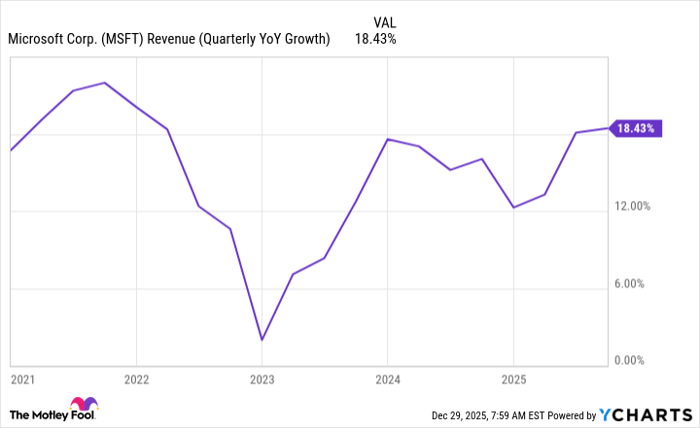
MSFT Revenue (Quarterly YoY Growth) data by YCharts.
Microsoft is a very successful business, but it’s also quite predictable. This should give us a great basis on which to build out our stock price estimate.
Microsoft won’t get any help from an increased valuation
One area investors must consider to predict a stock price is how the company will be valued. Thirty times forward earnings (or greater) has become the norm for big tech companies like Microsoft and its peers, and assigning a year-end valuation of 30 times forward earnings is reasonable and fair.
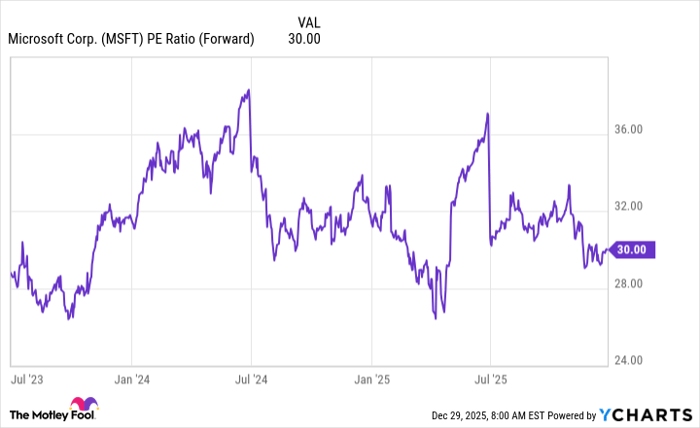
MSFT PE Ratio (Forward) data by YCharts.
If Microsoft can deliver a 15% growth rate from a revenue and earnings perspective throughout the back half of FY 2026 and the first half of FY 2027, and maintain its 30 times forward earnings valuation, that would indicate the stock will rise by the corresponding growth rate.
So, with Microsoft’s stock trading at about $485 per share right now, my year-end stock price expectation for Microsoft would be nearly $560. As mentioned above, that growth rate wasn’t enough to beat the market in 2025. However, over the long term, if Microsoft can continue growing at a double-digit growth rate, I have no doubt that it will maintain its status as a long-term winner, making it a solid stock to buy now and hold for several years.
Should you buy stock in Microsoft right now?
Before you buy stock in Microsoft, consider this:
The Motley Fool Stock Advisor analyst team just identified what they believe are the 10 best stocks for investors to buy now… and Microsoft wasn’t one of them. The 10 stocks that made the cut could produce monster returns in the coming years.
Consider when Netflix made this list on December 17, 2004… if you invested $1,000 at the time of our recommendation, you’d have $490,703!* Or when Nvidia made this list on April 15, 2005… if you invested $1,000 at the time of our recommendation, you’d have $1,157,689!*
Now, it’s worth noting Stock Advisor’s total average return is 966% — a market-crushing outperformance compared to 194% for the S&P 500. Don’t miss the latest top 10 list, available with Stock Advisor, and join an investing community built by individual investors for individual investors.
See the 10 stocks »
*Stock Advisor returns as of January 5, 2026.
Keithen Drury has positions in Amazon. The Motley Fool has positions in and recommends Amazon and Microsoft. The Motley Fool recommends the following options: long January 2026 $395 calls on Microsoft and short January 2026 $405 calls on Microsoft. The Motley Fool has a disclosure policy.
The views and opinions expressed herein are the views and opinions of the author and do not necessarily reflect those of Nasdaq, Inc.