
Get free access to the most comprehensive World Cup coverage in The Athletic app.
This is a bit of a tasty one.
In arguably one of the most eye-catching ties in the round of 16, Brazil, five-time winners and a nation ubiquitous with international soccer’s showpiece international tournament, take on Norway, the talented underachievers who are back in the big time for the first time in 28 years.
Vinicius Junior and Erling Haaland are the headline names and there’ll be talent aplenty on show at MetLife Stadium, with a place in the quarter-finals on the line.
This is everything you need to know about Sunday’s game and how it will be decided.
What’s the key information I need to know?
Round of 16: Brazil (FIFA ranking No. 5) vs Norway (FIFA ranking No. 21)
Venue: MetLife Stadium, East Rutherford, New Jersey
Date: Sunday, July 5
Kick-off: 1pm PT/4pm ET/9pm BST
How did Brazil reach the last 16?
Carlo Ancelotti’s side kicked off their World Cup campaign at MetLife Stadium with a 1-1 draw against Morocco before convincing 3-0 wins against Haiti and Scotland, which saw them top Group C, with Vinicius Junior scoring in all three matches.
Brazil then faced Group F runners-up Japan in the round of 32, where they came from behind to win 2-1, substitute Gabriel Martinelli scoring a dramatic 95th-minute winner to break Japanese hearts.
How did Norway reach the last 16?
Norway secured their place in the knockout rounds by winning their first two matches in Group I against Iraq (4-1) and Senegal (3-2), meaning they made 10 changes for an eventual 4-1 loss to France, progressing in second place.
Those changes included star striker Haaland being benched, but he returned for Norway’s round-of-32 fixture against the Ivory Coast, netting his fifth goal of the tournament in the 86th minute to secure a 2-1 victory.
How to watch on TV
U.S.: 1pm PT/4pm ET; Fox Sports (English), Telemundo/Peacock (Spanish)
Canada: 1pm PT/4pm ET; TSN (English), RDS (French)
Mexico: 2pm CST; ViX Premium.
UK: 9pm BST; ITV
What should we expect from Brazil?
The whole gamut of emotions. They will leave you simultaneously underwhelmed, worried about the state of the national team, and firmly convinced that Carlo Ancelotti has figured it out.
Brazil remain a luxurious work in progress. One of the team’s leaders, the constantly underestimated Danilo (he’s played for Real Madrid, Manchester City, Juventus and Flamengo) is under no illusions. Other teams are more talented, more complete.
Is that a problem?
Not necessarily, as the best team doesn’t always win and, besides, Brazil have more quality than many will have you believe. They have a goalkeeper, a couple of centre-backs, midfielders and wingers who are or once were among the top five players in the world in each of their positions. Vini Jr has stepped up. Bruno Guimaraes has, quietly, been one of the players of the tournament, too. Rayan has filled in for an injured Raphinha and, crucially, been prepared to defend.
Five-time Champions League winner Carlo Ancelotti is leading Brazil’s charge for a sixth World Cup (Mauro Pimentel/AFP via Getty Images)
The calm Ancelotti transmitted to the team when they were 1-0 down and panicking against Japan made a real difference, as did his immense experience. He was arguably the only person on the planet, aside from Casemiro’s friends and family, who thought it’d be a good idea to keep him on in the second half against Japan. That decision, and the one to bring Martinelli on, are why Brazil are still in the competition.
“Carlo Ancelotti, we’re coming for you!” Norway coach Stale Solbakken said in the dressing room after his team qualified for the round of 16. It was an interesting framing. How should we think about it? Does Norway fear the coach in the dugout more than the players on the field? “I’m 100 per cent sure I’m not a genius,” Ancelotti said. “I’m also 100 per cent sure I’m not a fool.”
They will need all of his nous if Brazil is to win a knockout game against a European team for the first time in 24 years.
James Horncastle
What should we expect from Norway?
A sense of boyish freedom. The team’s innocence is uplifting – they are revelling in the opportunity to showcase their country’s identity. It’s like one big Boy Scouts trip.
It translates into their football. They’ve not been involved in a boring game yet, not even when Solbakken fielded his second string against France and ruined a day out for thousands who had paid only to see Haaland vs Mbappe.
Optimism runs through their play, and they have a healthy variety in attack; strong at set pieces, capable of countering, and able to control possession if they choose.
Solbakken has used Alexander Sorloth on the right flank, providing the team with another out ball who can drift inside to become a second striker in the penalty area. On the left, Antonio Nusa has been one of their best performers. His intricate dribbling and combination play were too much for Iraq to handle, and his curling finish against the Ivory Coast is one of the best the tournament has seen. Patrick Berg has added more drive to the midfield since replacing Fredrik Aursnes and can sharpen their possession.
Norway have resisted the temptation of using their two stars — Martin Odegaard and Haaland — in the best-kid-in-the-playground way that many smaller nations have done so in the past. Instead, Solbakken has sought to keep their roles defined.
Haaland, like at Manchester City, is not expected to drop in and link the play. He is allowed to stay on the periphery, then pounce. Somehow 99 per cent of the commentary during the Ivory Coast game was still spent lamenting Haaland’s lack of involvement — and then he got his goal.
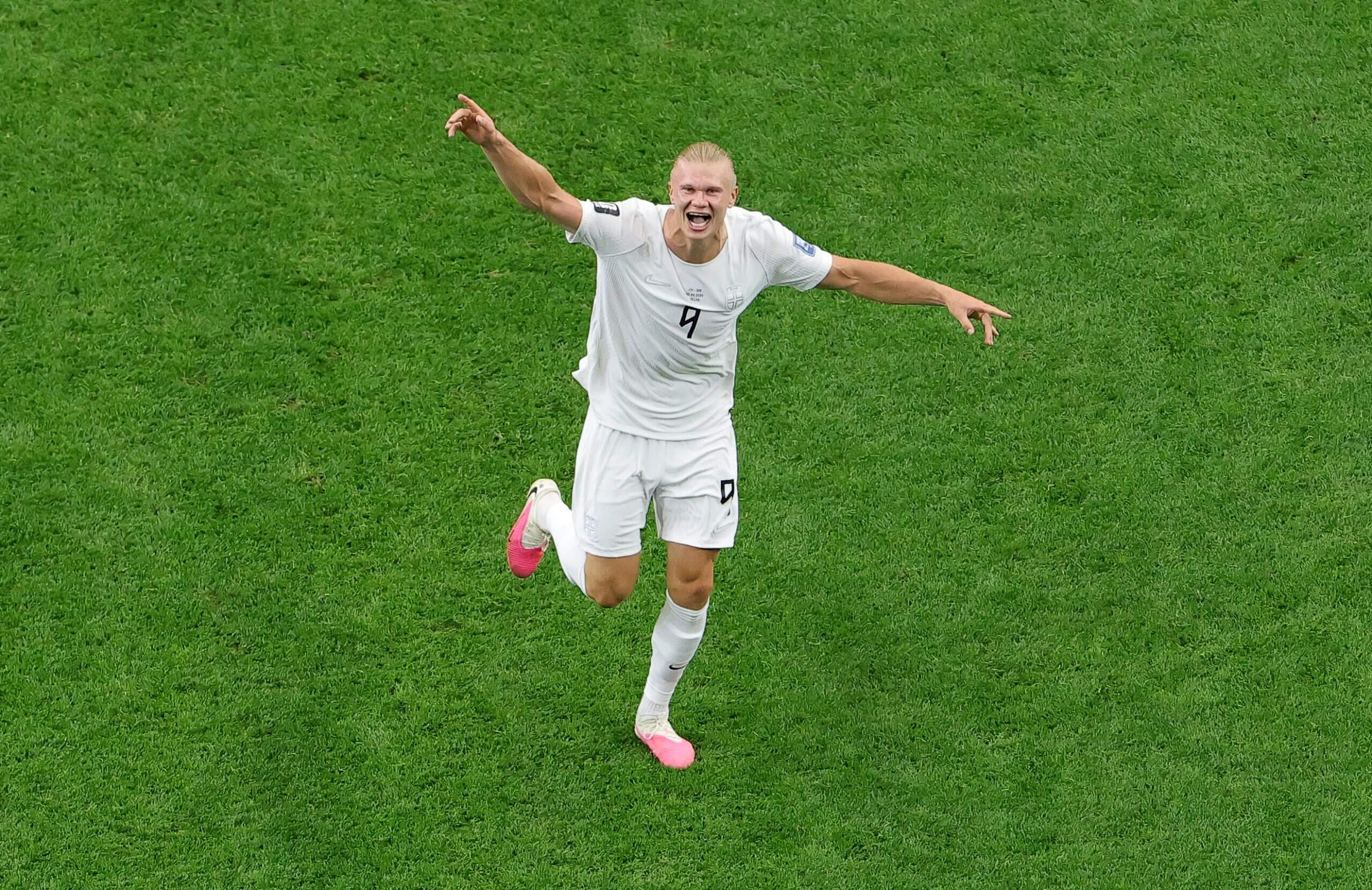
Erling Haaland toasts Norway’s 2-1 win over Ivory Coast (Alex Slitz/Getty Images)
Odegaard has started to ball-hog a little as he tries to orchestrate but he has generally been asked to operate in his preferred areas on the right of midfield rather than dog-walking every single play from centre-back and then forward. Sander Berge is there to do that. There is trust and togetherness in this team that is not common at the international level.
How good are they overall, though? It’s still not entirely clear. Norway can go through spells where they look second-best and a little flat. Then they produce a 10-minute spell where they look like they could score every time they go past the halfway line.
Having not been on the big stage since 1998, any concerns about stage fright have been put to bed. The last-16 felt was probably par for the course. Now that they’ve reached that checkpoint, they pose a dangerous proposition as underdogs, shorn of expectations.
Of all the nations to throw a Haaland-shaped hammer at, Brazil is surely the most exciting.
Jordan Campbell
Who is the star player for each team?
Haaland and Vinicius Jr, their nations’ respective top-scorers in this tournament, are the easy answers. Their teams will go as far as they can take them.
That said, there are other players to be wary of in this game. Odegaard’s ability to get into the half-spaces when Norway outnumber teams out wide has proved crucial, and his connection with Haaland was on show during the group stage. He assisted Nusa against Ivory Coast too, and Nusa and Sorloth have played important roles in isolating Haaland against the opposition centre-backs.
For Brazil, Matheus Cunha and Guimaraes have played important roles. Guimaraes has pretty much been the lone creative spark from midfield, while Cunha’s positioning has helped elevate Vinicius Jr. Ancelotti’s shrewd management and ability to get his teams to rise to the occasion in knockout matches will prove handy, too.
Anantaajith Raghuraman
Is there any history in this match-up?
Norway are that rare thing in international football: a true outlier.
In four meetings, they have never lost to Brazil. Granted, the two nations have only met once in a competitive setting. That was at the end of the 1998 World Cup group stage. Brazil, the defending champions, in the midst of a 10-game unbeaten run in World Cup games, would, of course, go on to make the final. But before then, Norway surprised them in Marseille.
It was a remarkable occasion. Let me explain why. Before kick-off, FIFA granted the unusual request for a couple to be married. The groom was from Norway. The bride from Brazil. The reception afterward turned out to be the game itself.
How a California town adopted Brazil’s team during the 1994 World Cup
Charlotte Harpur and Johnny Sweet
Bebeto put the holders in front late, and a Brazil win looked firmly on the cards. Only Tore-Andre Flo suddenly turned into Flonaldo. After leveling the score, he collected the ball and ran back to the centre-circle for the restart. Flo was uninterested in celebrating. He wanted to win the game.
The chance to do so came when the referee pointed to the spot. Kjetil Rekdal’s last-minute penalty secured a famous win and passage to the last 16.
It was literally a dream come true.
“The night before the game, I had a dream that I would score the winner with a late penalty,” Rekdal said. “In the dressing room, I was singing that I was going to score the winner with a late penalty. When we were awarded the penalty, Ole Gunnar (Solskjaer) came up to me and said: ‘Now you’ve got the chance to do what you said you were going to do’. I had talked the talk and now had to walk the walk!
“Fortunately, I managed to score. It was a feeling of great relief and joy.”
James Horncastle
Where will the game be won and lost?
Out wide. Norway prevailed in a match of high-quality wing play in the round of 32, beating the Ivory Coast thanks to a Nusa far-post shot and a Haaland tap-in, which resulted from tidy combination play.
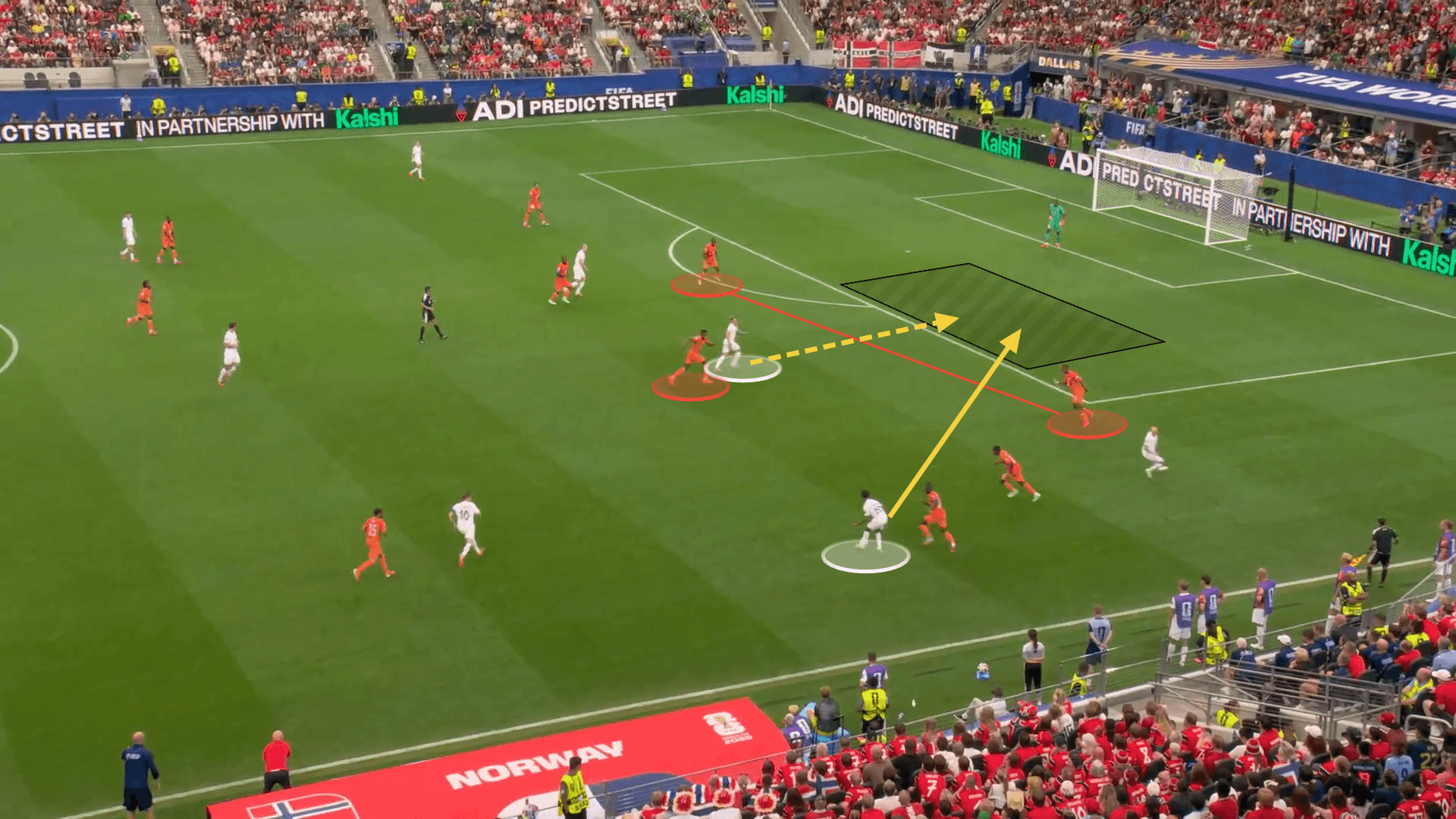
Let’s break down their winning goal. Aursnes, a second-half substitute, passed forward to right winger Oscar Bobb, who had replaced Sorloth. The underlap from Aursnes helped disrupt the Ivory Coast’s 4-4-2 block. He took left midfielder Yan Diomande with him and pulled left centre-back Odilon Kossounou wide.
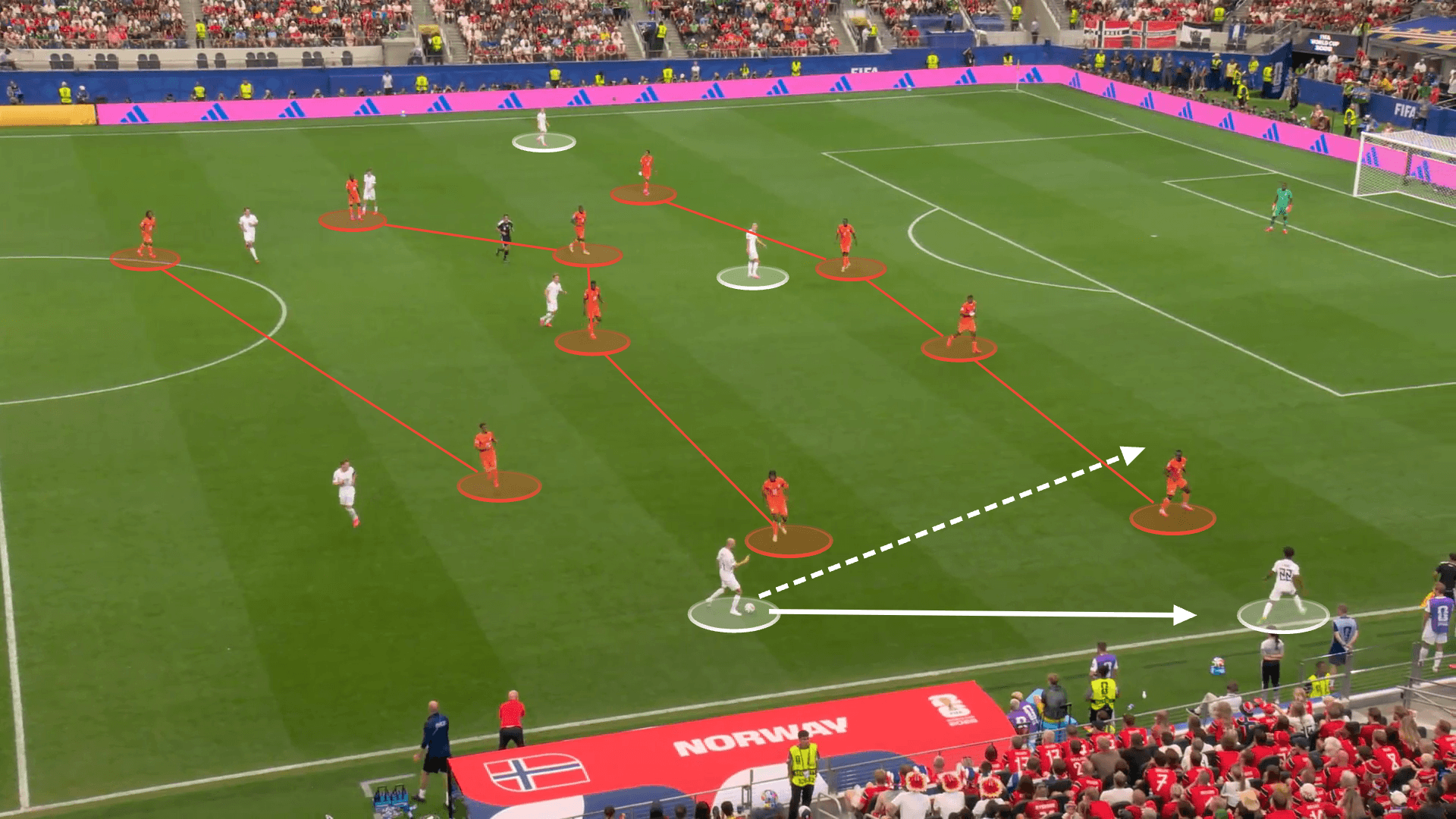
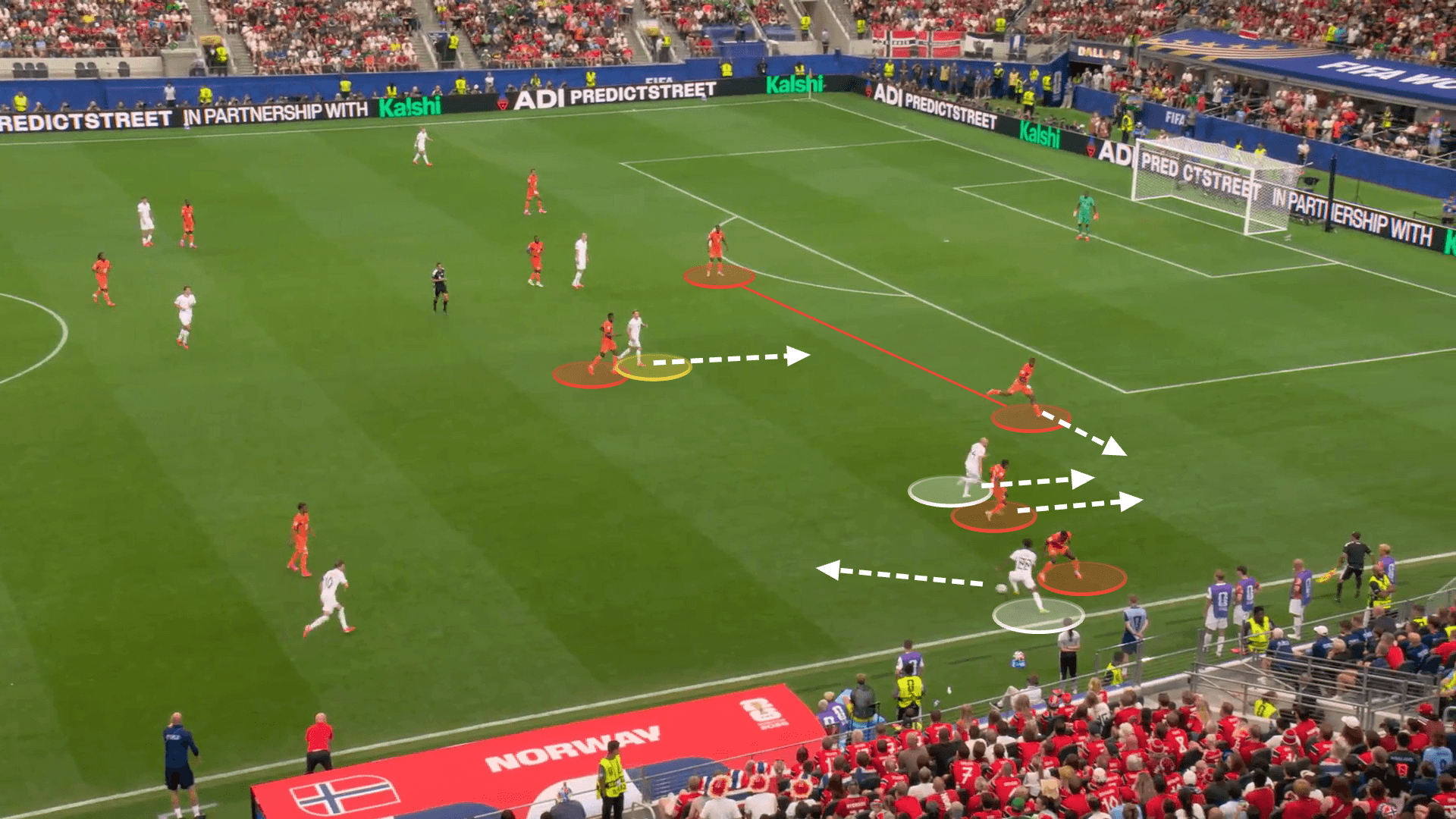
That opened the angle for Bobb’s through ball to Patrick Berg, who made a blindside run and then squared the ball to Haaland.
This will be a match-up of teams playing 4-3-3. Norway head coach Solbakken uses Sorloth — who, for his club Atletico Madrid, is the same target man that Haaland is for Manchester City — out wide. He is obviously not a winger, and the right-back has to do a lot of running.
With Brazil, it’s their left side that is the strongest. Winger Vinicius Jr is the key threat — he’s tied with Lamine Yamal for dribbles at this tournament (30).
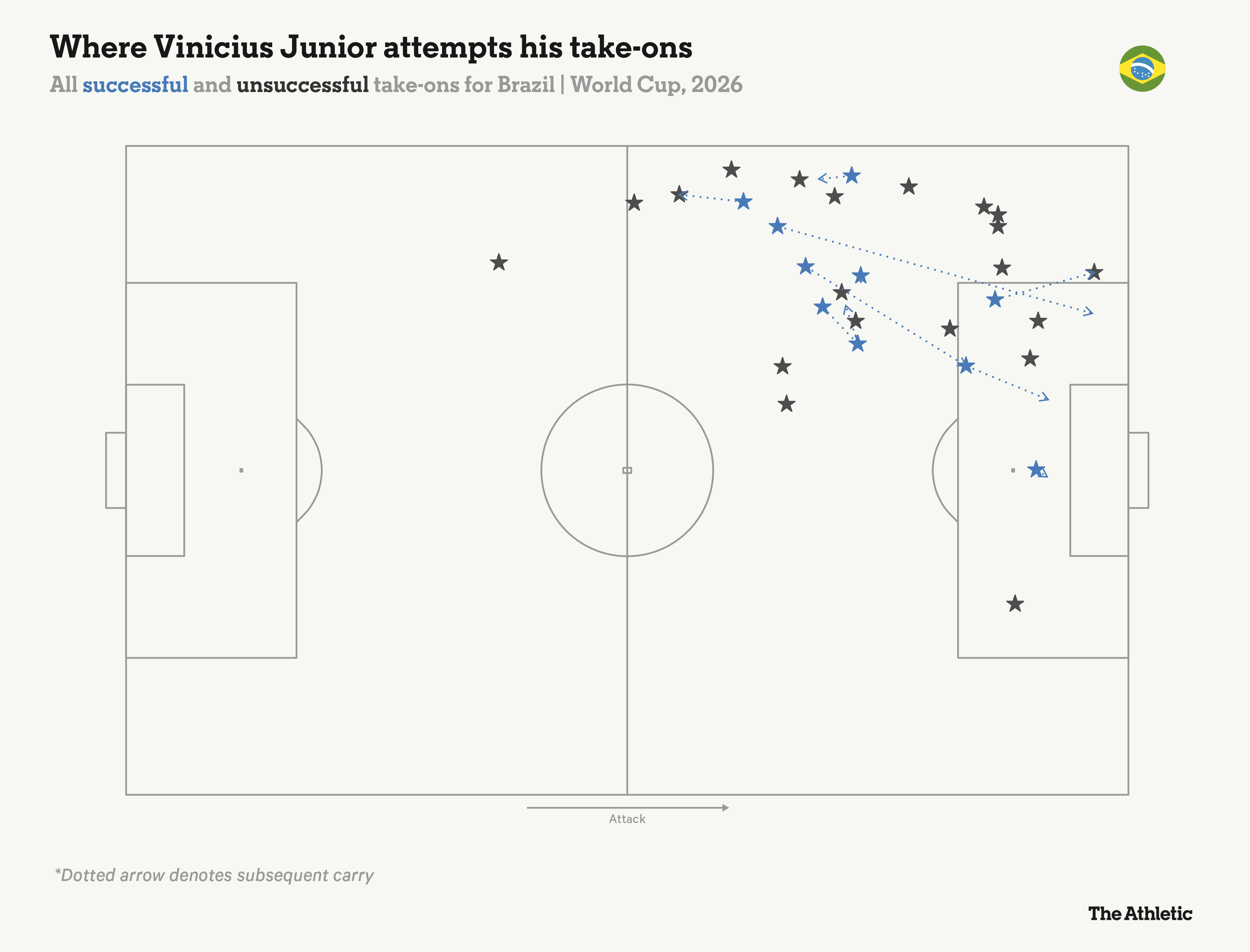
Against Japan’s 5-4-1 in the previous round, they pushed left-back Douglas Santos forward so that Vinicius could move narrow. Lucas Paqueta, the left side of their midfield triangle, came up short in getting on the ball and making forward passes.
Liam Tharme
Who do our experts think will win?
Jordan Campbell: Brazil 2-1 Norway. Ancelotti finds ways to win, even when his team isn’t dominant and has clear deficiencies. Norway are a tidy team but they can be too passive in possession and give away too many chances for Vinicius not to punish them.
Seb-Stafford Bloor: Brazil 2-2 Norway AET (Brazil win on penalties). Even sides with excellent wide forwards, even if Norway’s attacking thrust has more Haaland-shaped physicality, Brazil should edge through on penalties. Yet I’m not wholly convinced that Norway won’t win this. I’m troubled by how their defence might withstand Brazil’s scything attack but they can do just as much damage.
Oliver Kay: Brazil 1-0 Norway. “Norway nil” feels like a risky shout, given the Haaland factor, but Brazil’s experience could help them to lock this game down. They have the players to do that, even if, conversely, Casemiro, their match-winner against Japan, has looked a weak link at times.
Matt Slater: Brazil 3-2 Norway. I think Brazil will win this by a goal, although they may need extra time to make their greater/deeper quality pay. I initially went for 2-1 but then thought: “You only live once, let’s push the boat out”, which is very much FIFA’s motto. Can’t wait to see another round of Gabriel v Haaland.
Dan Sheldon: Brazil 3-2 Norway. The attacking players on the pitch are too good for this game not to have goals. Haaland and Vinicius Jr are both in excellent form, and I expect both to be on the scoresheet. Brazil’s squad is superior, which is why I think they will edge it.
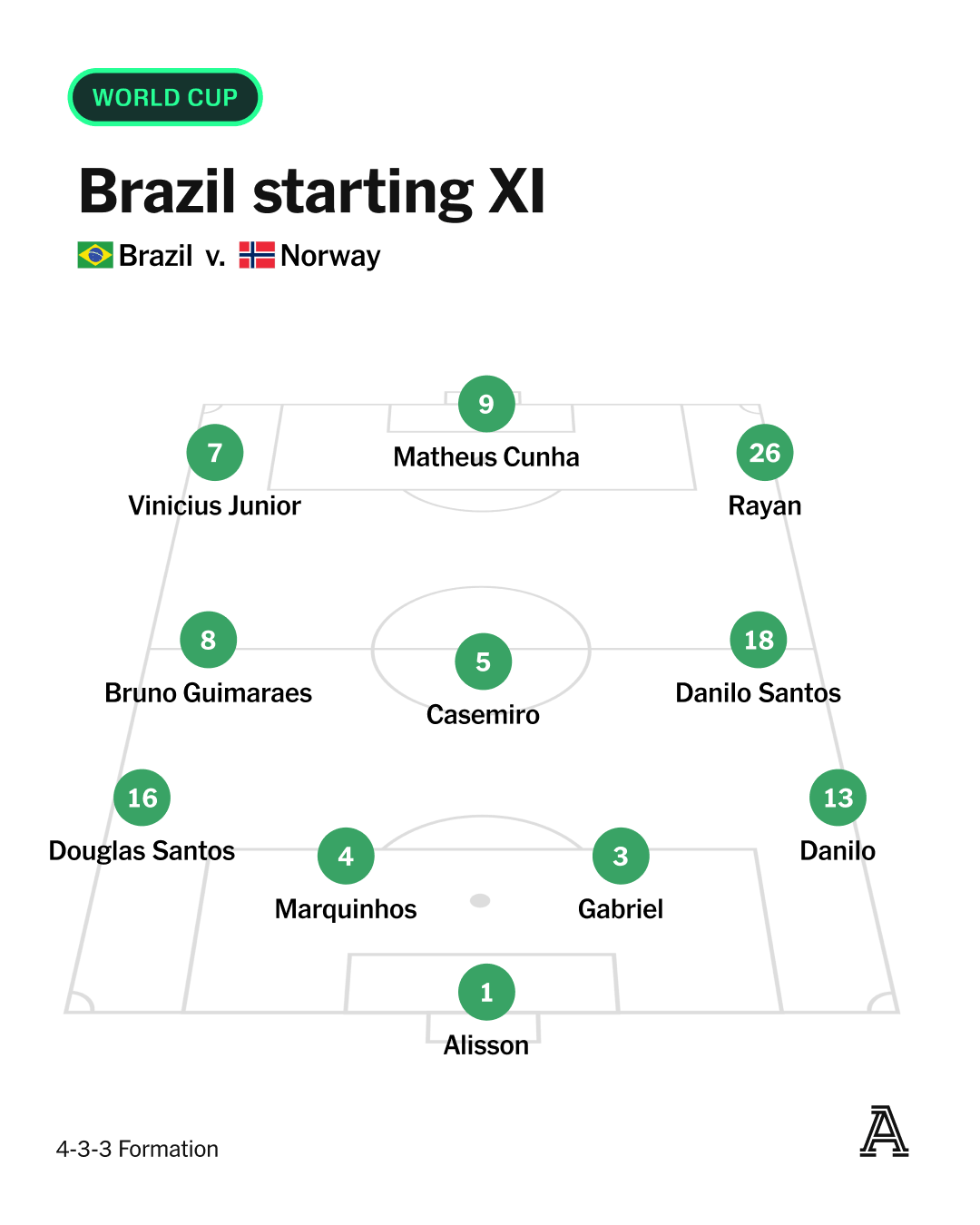
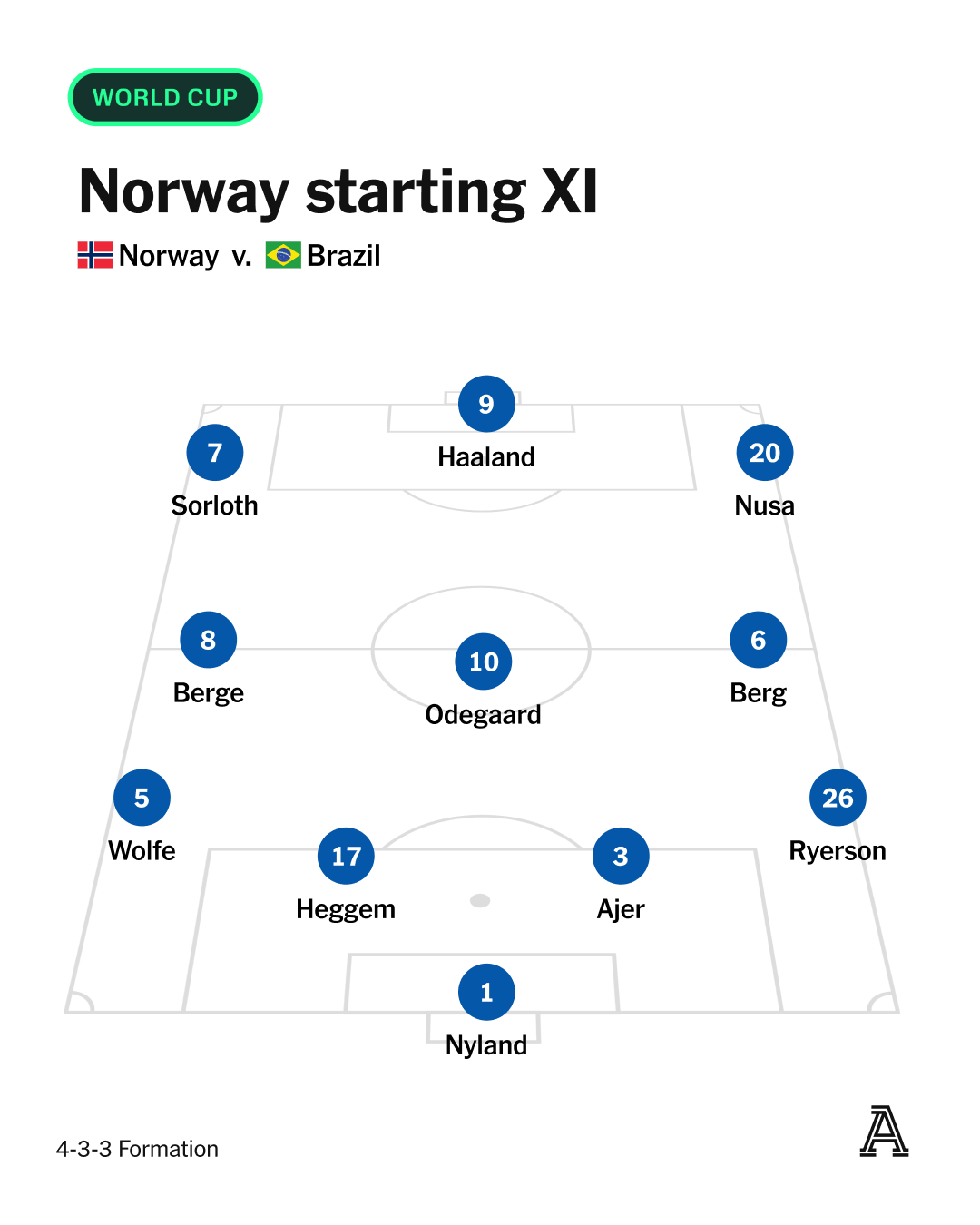
Predicted line-ups
Tell me one thing about Brazil that’s going to make me look clever to my friends
They have had the second-most fast-break shots this tournament (eight). Argentina are the only team to match that, with Ancelotti’s side content to defend in a 4-4-2 block because they can counter-attack from midfield-third regains, maximising the pace of Rayan and Vinicius Jr. Both of Cunha’s goals in the group-stage win over Haiti came from such attacks.
Tell me one thing about Norway that’s going to make me look clever to my friends
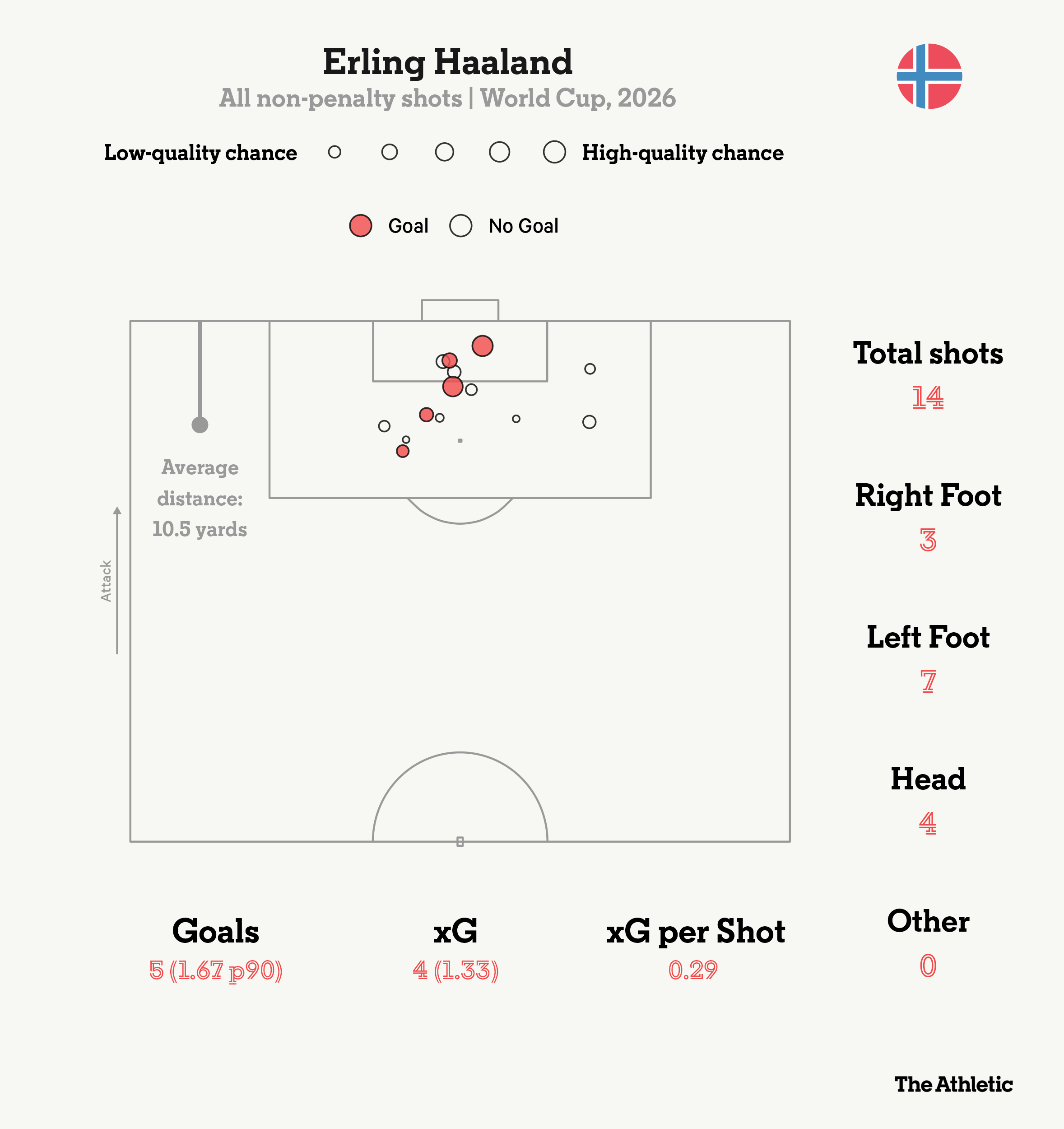
All 14 of Haaland’s shots — and thus his five goals — at this World Cup have been first-time efforts. It’s the most of any player (ahead of Mikel Oyarzabal and Cristiano Ronaldo on 10) and owes to how well Norway work their wide combinations. Both full-backs make overlapping runs, Odegaard provides crosses from the right, and Sorloth adds a second box threat to prevent opposition centre-backs doubling up on Haaland.
Liam Tharme
Who is the referee?
U.S.-based Ismail Elfath will complete his third match assignment at this summer’s World Cup when he takes charge of Brazil-Norway, having officiated Spain’s
1-0 group-stage win against Uruguay and the 2-2 draw between the Netherlands and Japan in Group F.
The 44-year-old has distributed seven yellow cards during those two matches, and a straight red — to Uruguay’s Agustin Canobbio, following his studs-up challenge on Spain defender Pau Cubarsi in the fifth minute of stoppage-time.
Elfath, one of eight U.S. referees at this summer’s tournament, has refereed Brazil at a World Cup before, taking charge of their 1-0 group-stage defeat to Cameroon at the Qatar World Cup, which proved largely inconsequential as the South Americans won the group.
A graduate from the University of Texas at Austin, Elfafth, who was born in Morocco, has refereed in the MLS since 2012 and, in August 2016, was part of the first on-field video assistant referee (VAR) call as the system had its first live trial in a game between New York Red Bulls II and Orlando City B.
Who will the winners play next? And when/where?
The winners will head to Hard Rock Stadium in Miami, Florida, to face Mexico or England in the quarter-finals on July 11, with the match kicking off at 2pm PT/ 5pm ET/10pm BST. Mexico and England play later on Sunday, kicking off at 5pm PT/8pm ET and 1am BST on Monday for UK viewers.